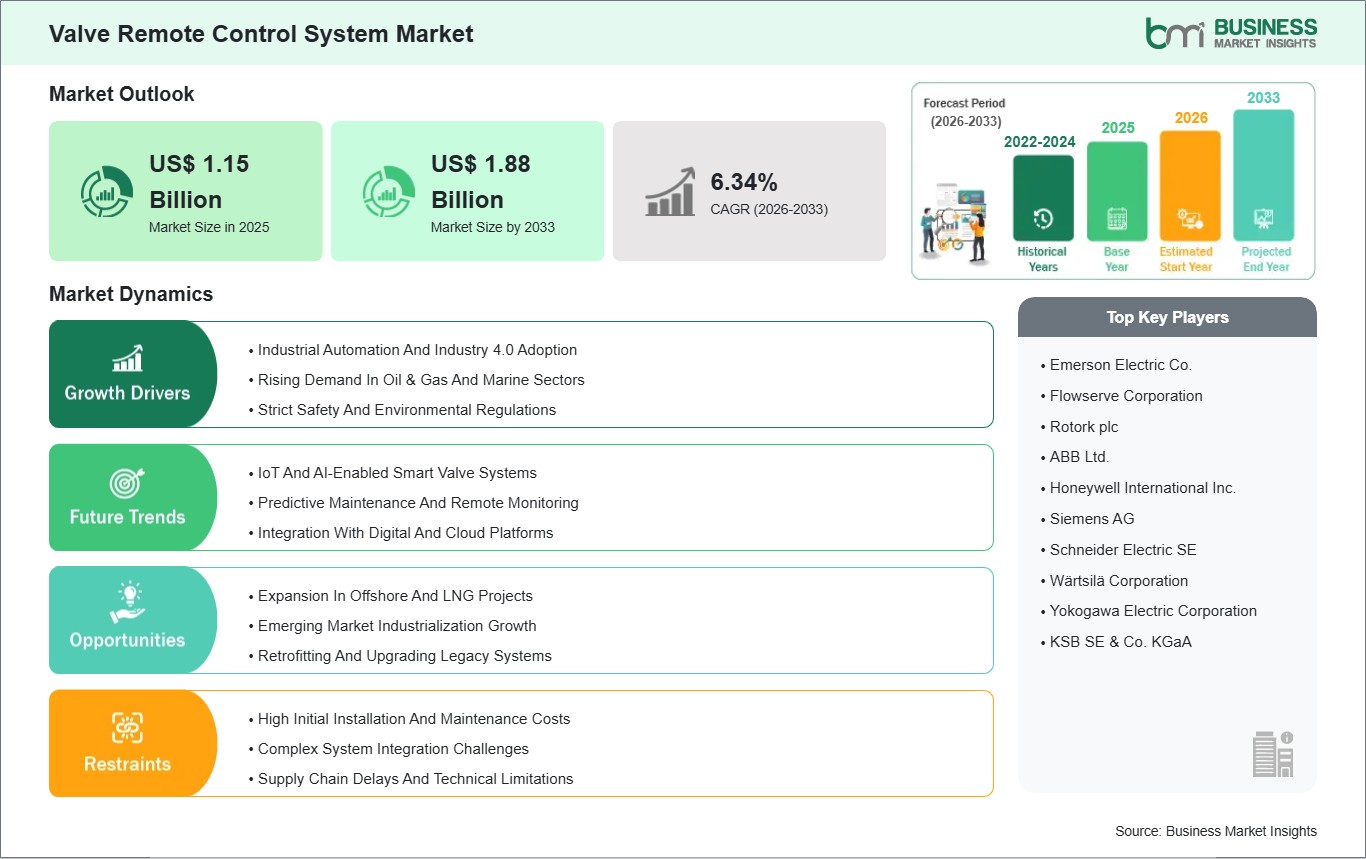
The global Valve Remote Control System Industry is witnessing steady growth, supported by increasing automation across marine, offshore, oil and gas, water treatment, and industrial processing applications.
According to Business Market Insights, the global Valve Remote Control System Market size is expected to reach US$ 1.88 billion by 2033 from US$ 1.15 billion in 2025. The market is estimated to record a CAGR of 6.34% from 2026 to 2033.
Technological advancement is reshaping the industry through intelligent actuators, hydraulic power units, digital control consoles, and real-time monitoring systems. These solutions enable centralized control of critical valves, improve operational safety, and support predictive maintenance across complex maritime and industrial environments.
Download Sample Report : https://www.businessmarketinsights.com/sample/BMIPUB00034593
What Is a Valve Remote Control System?
A Valve Remote Control System is an integrated system designed to operate and monitor valves from a centralized or remote location. It combines actuators, control panels, hydraulic power units, sensors, and communication networks to regulate the flow of liquids and gases across industrial and marine systems.
VRCS solutions are commonly used to control butterfly, ball, globe, gate, and other valve types. In marine and offshore environments, they support ballast, bilge, cargo, fuel, and process-fluid operations while reducing the need for manual valve handling in hazardous or difficult-to-access areas.
Industry Drivers
A primary driver of the Valve Remote Control System Industry is the growing adoption of automation in maritime and industrial operations. Automated valve control improves process accuracy, reduces labor requirements, and allows operators to manage complex fluid systems from safe and centralized locations.
The increasing focus on maritime decarbonization is another major growth factor. The adoption of alternative fuels such as liquefied natural gas, ammonia, and hydrogen requires precise control of fluid flow, pressure, and fuel-handling systems, strengthening demand for advanced VRCS solutions.
In addition, rising investments in offshore exploration, water treatment infrastructure, and smart manufacturing are supporting industry expansion. Stringent safety requirements and the need for rapid leak isolation are also encouraging operators to replace manual systems with remote and automated technologies.
Get More Details: https://www.businessmarketinsights.com/buy/BMIPUB00034593
Industry Segmentation
By Type
- Electric: A rapidly growing segment, valued for ease of integration with digital automation platforms, low maintenance requirements, and precise control.
- Hydraulic: Used in heavy-duty applications requiring high torque and reliable operation under demanding conditions.
- Electro-Hydraulic: Combines electrical control with hydraulic actuation for high-performance marine and industrial applications.
- Pneumatic: Preferred in environments where rapid actuation and explosion-resistant operation are required.
The Electric segment is gaining significant traction due to its compatibility with digital control systems and increasing demand for energy-efficient automation.
By Application
- Marine: The dominant application segment, used in commercial vessels, passenger ships, tankers, and cargo ships for ballast, bilge, and cargo operations.
- Offshore: Used on offshore platforms, drilling units, and support vessels for process control and fluid management.
- Other Applications: Includes power generation, water treatment, chemicals, petrochemicals, manufacturing, and industrial processing.
The Marine segment held the dominant industry share in 2025 due to continued vessel modernization and the need to comply with maritime safety and efficiency standards, while Offshore applications are expected to maintain strong growth.
By Valve Type
- Butterfly Valves: Widely used for flow isolation and regulation in marine and industrial systems.
- Ball Valves: Preferred for reliable shutoff and high-pressure fluid applications.
- Globe Valves: Used for precise flow control and throttling operations.
- Gate Valves: Applied in systems requiring full-flow isolation.
- Others: Includes diaphragm, plug, check, and safety valves.
Regional Insights
- Asia-Pacific remains a major and rapidly expanding region, supported by a large shipbuilding ecosystem, offshore development, and smart manufacturing investments in China, Japan, South Korea, India, and Southeast Asia.
- North America maintains a significant industry position, driven by offshore energy modernization, advanced industrial automation, and stringent safety requirements.
- Europe represents a mature and technology-focused region, with strong demand from maritime, chemical, and passenger vessel applications.
- Middle East & Africa is witnessing steady growth, supported by offshore energy projects, smart city development, and water management modernization.
- South & Central America is experiencing gradual adoption as industrial facilities and marine infrastructure are upgraded.
Top Players in the Valve Remote Control System Industry
The competitive landscape includes global industrial automation companies, valve manufacturers, and marine technology providers focused on precision, safety, and digital integration.
- Emerson Electric Co.
- Flowserve Corporation
- Rotork plc
- ABB Ltd.
- Honeywell International Inc.
- Siemens AG
- Schneider Electric SE
- Wärtsilä Corporation
- Yokogawa Electric Corporation
- KSB SE & Co. KGaA
Leading companies are investing in intelligent valve positioners, digital controllers, predictive maintenance tools, and integrated automation platforms to strengthen their position in the evolving industry.
Technological Innovations
Digital control and smart sensing are transforming valve remote control systems by enabling real-time monitoring of actuator torque, vibration, valve travel time, and system pressure. These capabilities help operators identify abnormal conditions before failures occur.
Artificial intelligence and digital twin technologies are also creating new opportunities for predictive maintenance. By analyzing operational data and simulating system behavior, these tools can reduce downtime, improve maintenance planning, and support safer offshore and maritime operations.
Future Industry Outlook
The future outlook for the Valve Remote Control System Industry remains positive, supported by maritime automation, offshore energy development, industrial digitization, and the transition toward alternative fuels. Demand is expected to increase as operators modernize legacy systems and adopt more intelligent fluid-control infrastructure.
Industry leadership over the next decade will likely depend on digital integration, energy efficiency, safety performance, and retrofit flexibility. Companies that can provide reliable, low-maintenance, and intelligent valve control solutions will be best positioned to capture long-term growth.
Frequently Asked Questions (FAQs)
What is the projected size of the Valve Remote Control System Industry by 2033?
The industry is projected to reach US$ 1.88 Billion by 2033, rising from US$ 1.15 Billion in 2025.
What is the CAGR for the Valve Remote Control System Industry?
The industry is expected to grow at a CAGR of 6.34% from 2026 to 2033.
Which type segment is gaining traction?
The Electric segment is gaining traction due to its ease of integration with digital automation platforms and its precise control capabilities.
Which application segment is dominant?
Marine held the dominant industry share in 2025 due to vessel modernization and increasing maritime safety requirements.
What is the primary factor driving demand?
The primary drivers are maritime automation, offshore energy development, industrial safety requirements, and the adoption of alternative fuels.
Browse More Reports:
high speed data converter market
fiber optics collimating lens market
About Us
Business Market Insights is a market research platform that provides subscription service for industry and company reports. Our research team has extensive professional expertise in domains such as Electronics & Semiconductor; Energy & Power; Oil & Gas; Marine; Chemicals & Materials; Manufacturing; and Technology, Media, & Telecommunications.
Contact Us
If you have any questions about this report or would like further information, please contact us:
Contact person: Ankit Mathur
Email: sales@businessmarketinsights.com
Phone: +16467917070
