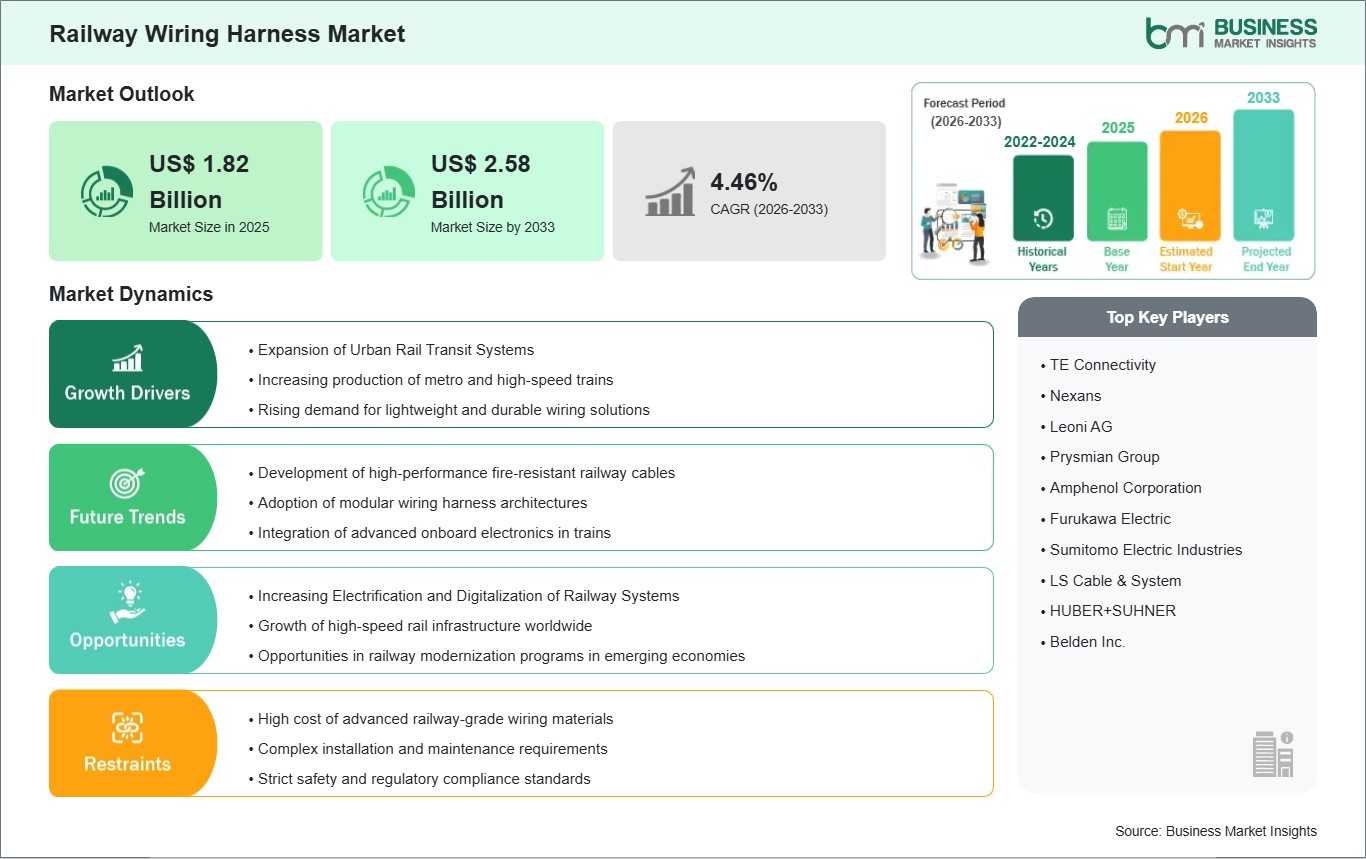
The global Railway Wiring Harness Industry is experiencing significant growth, driven by the rapid expansion of global rail infrastructure, the modernization of rolling stock, and the increasing electrification of rail networks.
According to Business Market Insights, the global Railway Wiring Harness Market size is expected to reach US$ 2.58 billion by 2033 from US$ 1.82 billion in 2025. The market is estimated to record a CAGR of 4.46% from 2026 to 2033.
Technological advancement is continuously shaping the industry landscape, with major wiring and cable manufacturers focusing on halogen-free low-smoke (HFFR) materials, optical fiber integration, and modular harness assemblies. Innovations in automated cable processing and advanced shielding techniques are enhancing signal integrity while protecting critical train control systems against electromagnetic interference (EMI). Strategic investments in research and development are accelerating the deployment of these robust harness architectures across high-speed rail, metro, and freight operations globally.
Download Sample Report : https://www.businessmarketinsights.com/sample/BMIPUB00034257
What Are Railway Wiring Harnesses?
A railway wiring harness is an organized, pre-assembled bundle of electrical wires, cables, terminals, and connectors designed to transmit power, control signals, and data throughout a train or rail infrastructure system. Encased in durable conduit or protective sleeving, these harnesses streamline installation, optimize spatial layout, and shield vital circuits from severe operational stressors.
Operating in harsh environments, railway wiring harnesses must withstand extreme temperature fluctuations, mechanical vibration, moisture, and chemical exposure. They form the electrical backbone of locomotives, passenger coaches, and autonomous rail cars supplying reliable connectivity for everything from traction propulsion and braking systems to passenger infotainment and automated door mechanisms.
Market Drivers
A primary driver of the Railway Wiring Harness Market is the massive global investment in urban transit and high-speed rail (HSR) projects. Expanding urban populations have forced municipalities to construct and upgrade metro, monorail, and light rail transit (LRT) systems to relieve traffic congestion. The complex electrical requirements of modern high-speed trains demand extensive wiring networks capable of handling high voltage alongside high-speed data communications.
Stringent rail safety regulations act as another major catalyst. Fire safety standards, such as EN 45545 in Europe and NFPA 130 in North America, mandate strict fire, smoke, and toxicity (FST) performance for all materials used inside railway vehicles. Consequently, operators are replacing traditional cabling with advanced, self-extinguishing, and halogen-free wiring harnesses to minimize fire hazards in enclosed tunnels and coaches.
Furthermore, the integration of advanced passenger amenities such as onboard Wi-Fi, real-time passenger information displays, dynamic lighting, and IoT-enabled predictive maintenance sensors has exponentially increased the volume of interior wiring needed per train car.
Get More Details: https://www.businessmarketinsights.com/buy/BMIPUB00034257
Market Segmentation
By Component
- Wire: The foundational conductive element, available in single-core and multi-core configurations tailored for high flexibility and heat resistance.
- Connector: Crucial heavy-duty interconnect components engineered to maintain secure, vibration-proof electrical connections across rail cars.
- Terminal: Specialized end-point fittings that facilitate fast, reliable crimping and contact connection with electronic control units and power distribution boxes.
By Cable Type
- Power Cable: Essential for carrying medium and high-voltage electrical current to traction motors, pantographs, and auxiliary converters.
- Jumper Cable: Flexible, weather-resistant inter-car cable harnesses designed to transmit power and control signals between moving train carriages.
- Transmission Cable: Specialized shielded and fiber-optic cables utilized for high-speed data transfer, signaling, and telecommunications.
By Material
- Copper: The leading material segment, widely favored for its superior electrical conductivity, thermal endurance, and ductility.
- Aluminum: Increasingly adopted in heavy-duty power lines to reduce overall train weight and improve energy efficiency.
- Optical Fiber: The fastest-growing material segment, critical for supporting gigabit onboard networks and high-bandwidth infotainment systems.
By Application
- Traction System Harness: Serves high-voltage propulsion units and power converters essential for locomotive movement.
- Engine & Brake Harness: Delivers fail-safe control signals to pneumatic and electro-dynamic braking systems.
- HVAC Harness: Powers climate control and ventilation units to ensure passenger comfort.
- Infotainment & Connectivity Harness: Rapidly expanding segment supporting displays, security cameras, passenger Wi-Fi, and public address systems.
- Lighting & Safety Harness: Feeds interior LED lighting, emergency indicators, and signaling systems.
By Train Type
- High-Speed Rail / Bullet Train: Dominant segment requiring light, highly specialized, and fire-safe harness architectures built for extreme speeds.
- Metro & Monorail: Driven by rapid urbanization and continuous expansion of automated subway networks globally.
- Light Rail / Tram: Encompasses urban streetcars requiring compact, flexible wiring systems.
- Locomotive & Freight Cars: Focuses on heavy-duty, ruggedized harnesses built to handle heavy cargo loads and outdoor weather exposure.
Regional Insights
- Asia-Pacific holds the dominant market share and leads global growth. This is driven by massive railway electrification programs and extensive high-speed rail construction in China, India, Japan, and South Korea, alongside booming urban subway development.
- Europe represents a highly sophisticated market, prioritizing green rail transport, cross-border high-speed corridors, and strict compliance with EN 45545 fire safety standards. European manufacturers lead in adopting halogen-free and recyclable cabling.
- North America is experiencing steady expansion, supported by federal funding dedicated to modernizing passenger rail corridors (such as Amtrak), upgrading freight rail efficiency, and expanding municipal transit fleets.
- Middle East & Africa is witnessing reliable growth due to mega-rail projects, mining freight line developments, and new urban metro networks across Gulf Cooperation Council (GCC) countries.
- South & Central America is steadily growing as key metropolitan centers upgrade legacy commuter rail lines and expand port-hinterland freight links.
Top Players in the Railway Wiring Harness Market
The competitive landscape features leading global cable and interconnect manufacturers dedicated to specialized, rail-certified wiring assemblies.
- TE Connectivity Ltd.
- LEONI AG
- Prysmian Group
- Nexans S.A.
- Sumitomo Electric Industries, Ltd.
- Furukawa Electric Co., Ltd.
- Hitachi, Ltd.
- Samvardhana Motherson International Ltd.
- HUBER+SUHNER AG
- NKT A/S
- Taihan Cable & Solution Co., Ltd.
Technological Innovations
The incorporation of fiber-optic technology and hybrid cable construction is revolutionizing railway wiring harness design. As trains evolve into computers on wheels, harness suppliers are integrating copper power lines with fiber-optic cores within a single protective conduit. This dual-capability harness reduces total harness weight while enabling gigabit-speed communication for real-time diagnostic telemetry and automated train operations (ATO).
Additionally, modern manufacturing techniques rely on fully automated wire-crimping, laser stripping, and ultrasonic welding machines to meet precision tolerances. Combined with thin-wall halogen-free cross-linked polyolefin insulation, current-generation harnesses offer up to 30% weight savings over legacy cabling without compromising thermal or flame resistance.
Future Market Outlook
The future outlook for the Railway Wiring Harness Market is highly promising through 2033, underpinned by global decarbonization targets that position rail as the preferred eco-friendly alternative to short-haul aviation and road freight. As autonomous, driverless train systems and smart railway infrastructure proliferate, demand for specialized, zero-failure wiring harnesses will intensify.
Market leadership over the next decade will belong to suppliers capable of delivering customized, pre-tested, lightweight harness modules that fulfill stringent fire safety certifications while accommodating rapid advancements in onboard data networking.
Frequently Asked Questions (FAQs)
What is the projected size of the Railway Wiring Harness Market by 2033?
The global market is projected to reach US$ 23.83 Billion by 2033, expanding from US$ 16.88 Billion in 2025.
What is the CAGR for the Railway Wiring Harness Market?
The market is estimated to record a CAGR of 4.41% during the forecast period from 2026 to 2033.
Which train type segment holds the largest share?
High-speed rail and bullet train networks hold a major market share due to the intensive density of electrical, control, and safety wiring required per carriage.
Which material is growing fastest in railway wiring harness manufacturing?
Optical fiber is the fastest-growing material, driven by high demand for real-time onboard data transmission, passenger infotainment networks, and smart sensor connectivity.
What is driving the adoption of Halogen-Free Low-Smoke (HFFR) harnesses?
HFFR harnesses are mandated by global fire safety standards (such as EN 45545) because they prevent the emission of toxic fumes and dense smoke during a fire, significantly enhancing passenger survival in tunnels and enclosed coaches.
Browse More Reports:
semiconductor and ic packaging materials market
About Us
Business Market Insights is a market research platform that provides subscription service for industry and company reports. Our research team has extensive professional expertise in domains such as Electronics & Semiconductor; Aerospace & Defense; Automotive & Transportation; Energy & Power; Healthcare; Manufacturing & Construction; Food & Beverage; Chemicals & Materials; and others.
Contact Us
If you have any questions about this report or would like further information, please contact us:
Contact person: Ankit Mathur
Email: sales@businessmarketinsights.com
Phone: +16467917070
