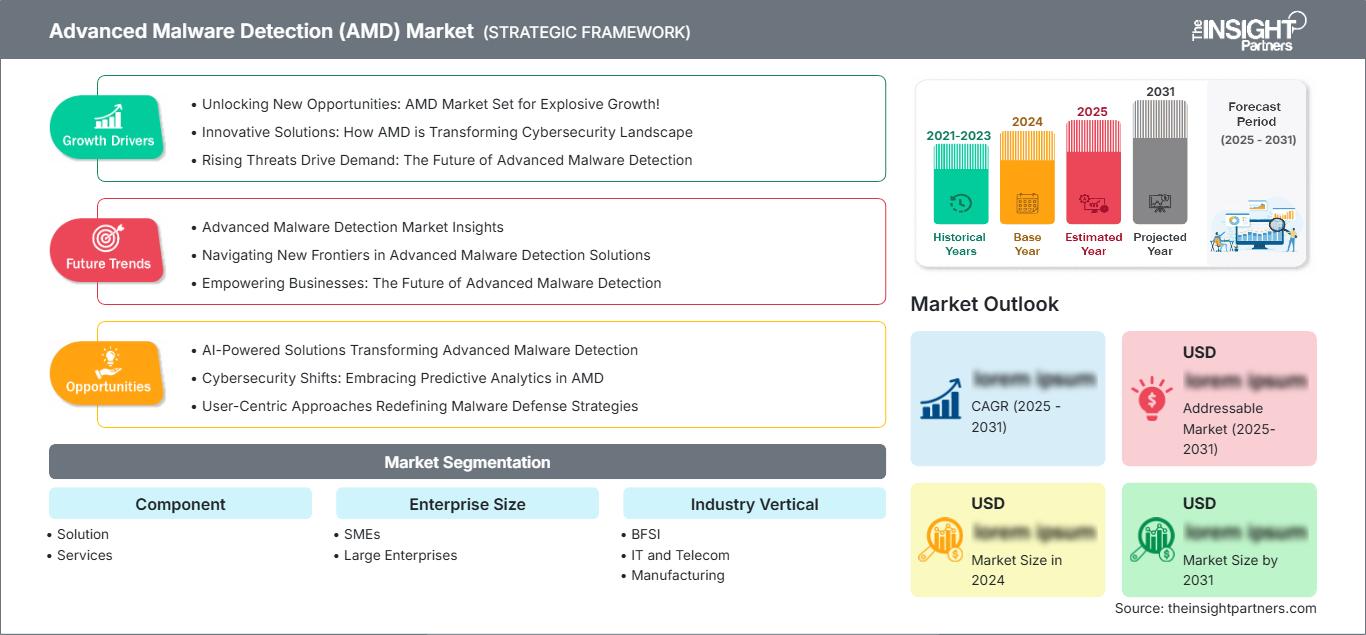
The global Advanced Malware Detection (AMD) market is experiencing rapid expansion as enterprises face an unprecedented volume of highly sophisticated cyber threats. Traditional signature-based antivirus solutions are no longer sufficient to counter zero-day exploits, polymorphic viruses, and stealthy ransomware strains. Advanced malware detection solutions offer real-time visibility, behavioral analytics, threat intelligence, and sandboxing capabilities to identify and neutralize malicious activities before they compromise enterprise infrastructure.
The advanced malware detection market was valued at US$ 9.96 Billion in 2025 and is projected to reach US$ 29.98 Billion by 2034, expanding at a CAGR of 14.77% during 2026–2034.
Key Market Drivers
- Surge in Sophisticated and Zero-Day Cyber Threats: Modern threat actors utilize artificial intelligence and automated frameworks to build evasive malware. The growing frequency of ransomware-as-a-service (RaaS) and state-sponsored cyber espionage forces organizations to deploy proactive AMD platforms.
- Rapid Expansion of Cloud Environments and Hybrid Workplaces: As businesses transition critical workloads to public, private, and hybrid cloud infrastructures, traditional perimeter defenses become inadequate. AMD tools provide centralized, continuous monitoring across remote endpoints and cloud ecosystems.
- Strict Regulatory Compliance and Data Governance: Global mandates such as the General Data Protection Regulation (GDPR), the California Consumer Privacy Act (CCPA), and industry-specific regulations require strict protection of sensitive data. Implementing advanced malware detection helps enterprises meet compliance standards and avoid heavy financial penalties.
- Shift toward Behavioral and AI-Driven Analysis: Unlike legacy tools that rely strictly on known signatures, modern AMD frameworks leverage machine learning algorithms to spot anomalous file behavior, memory drift, and unexpected network traffic patterns in real time.
Download Sample Report@ https://www.theinsightpartners.com/sample/TIPRE00027022
Key Opportunities
- Integration of Artificial Intelligence and Dynamic Automation: Incorporating generative AI and automated threat hunting allows AMD platforms to analyze vast streams of telemetry data instantly. Vendors that provide self-healing security systems and automated remediation will capture significant market share.
- Rising Demand among Small and Medium Enterprises (SMEs): While large enterprises historically led adoption, SMEs are increasingly targeted by cybercriminals. The rise of cloud-native Security-as-a-Service (SECaaS) models makes enterprise-grade malware detection accessible and cost-effective for smaller organizations.
- Emergence of Zero-Trust Architecture (ZTA): As organizations adopt zero-trust security strategies, AMD platforms serve as an essential verification engine. Continuous inspection of file integrity and user activity aligns perfectly with the “never trust, always verify” framework.
Market Segmentation
The Advanced Malware Detection market is categorized across several key segments:
By Component
- Solutions: Includes sandboxing technologies, behavioral analysis platforms, endpoint detection engines, and threat intelligence feeds.
- Services: Encompasses managed security services (MSS), incident response, system integration, and consulting.
By Deployment Mode
- Cloud-Based: Rapidly growing due to seamless scalability, lower upfront capital expenditure, and continuous real-time signature updates.
- On-Premises: Favored by highly regulated sectors such as defense, banking, and government, where strict data sovereignty and local control are mandatory.
By Enterprise Size
- Large Enterprises: Hold the largest market share due to expansive digital footprints, substantial cybersecurity budgets, and high-value target profiles.
- Small and Medium Enterprises (SMEs): Exhibiting the fastest growth rate as affordable cloud deployment models become widely available.
By End-User Industry
- Banking, Financial Services, and Insurance (BFSI)
- Healthcare and Life Sciences
- IT and Telecommunications
- Government and Defense
- Retail and E-Commerce
- Manufacturing and Energy
Market News and Recent Developments
- Vendor Consolidations and Strategic Mergers: Major cybersecurity providers are actively acquiring specialized threat intelligence and sandboxing startups to expand their endpoint protection platforms (EPP) and extended detection and response (XDR) suites.
- Launch of AI-Native Detection Engines: Leading players have introduced machine learning models trained on billions of threat artifacts, allowing security teams to reduce false positives and speed up mean time to detect (MTTD).
- Focus on Critical Infrastructure Resilience: Governments worldwide are issuing guidelines to strengthen operational technology (OT) and industrial control systems (ICS) against malware, spurring renewed investment in specialized network-based AMD tools.
Competitive Landscape and Top Players
The global Advanced Malware Detection market is highly competitive and dynamic, characterized by continuous technological innovation. Key vendors focus on strategic partnerships, continuous product updates, and multi-layered threat protection to maintain market leadership.
Top Industry Players
- Palo Alto Networks, Inc.
- CrowdStrike, Inc.
- Fortinet, Inc.
- Cisco Systems, Inc.
- Trend Micro Incorporated
- Check Point Software Technologies Ltd.
- Trellix
- Sophos Ltd.
- Broadcom Inc. (Symantec)
- Kaspersky Lab
Market leaders are differentiating their offerings by providing unified platform capabilities that combine endpoint, network, email, and cloud security into a single operational console.
Get Full Copy of This Report @ https://www.theinsightpartners.com/buy/TIPRE00027022
Future Outlook
Looking forward to 2034, the Advanced Malware Detection market is set to become an essential pillar of global cybersecurity infrastructure. As threat vectors grow more complex with automated malware creation tools, static defense mechanisms will become obsolete. The integration of predictive AI analytics, quantum-resistant encryption monitoring, and autonomous incident response will reshape the AMD landscape. Organizations that proactively adopt cloud-native, behavior-driven detection frameworks will maintain stronger operational resilience, protect brand reputation, and successfully navigate the evolving cyber threat ecosystem.
About The Insight Partners
The Insight Partners provides comprehensive syndicated and tailored market research services in the healthcare, technology, and industrial domains. Renowned for delivering strategic intelligence and practical insights, the firm empowers businesses to remain competitive in ever-evolving global markets.
Contact Information
- Email: sales@theinsightpartners.com
- Website: theinsightpartners.com
- Phone: +1-646-491-9876
Also Available in : Korean|German|Japanese|French|Chinese|Italian|Spanish
