The global aerospace and defense sector is undergoing a rapid technological transformation driven by the modernization of commercial fleets, rising defense procurements, and the integration of sophisticated electronic warfare and communication systems. Essential to ensuring the reliability, safety, and regulatory compliance of these advanced airborne systems is the specialized testing infrastructure behind them.
Get a PDF Sample- https://www.theinsightpartners.com/sample/TIPRE00025974
Market Overview and Growth Drivers
Avionics and radio test equipment plays a pivotal role in validating flight-critical electronics, radio frequency (RF) communication, navigation platforms, radar systems, and flight control computers. Modern aircraft rely on intricate webs of interconnected software and hardware components. A single breakdown in airborne communication or radar positioning can compromise flight safety or mission success. As a result, test solutions are essential at every stage of the lifecycle—from initial research and development and factory-floor integration to field maintenance, repair, and overhaul (MRO).
Several key factors fuel the expansion of the global market:
Fleet Modernization and Military Procurement: Global defense budgets continue to emphasize the modernization of aging military fleets and the deployment of next-generation fighter jets, unmanned aerial vehicles (UAVs), and tactical transport platforms. These modern aircraft feature multi-band radios, software-defined communication suites, and complex electronic warfare packages that require automated and high-precision testing routines.
Rising Commercial Aviation Passenger Traffic: Commercial aircraft original equipment manufacturers (OEMs) are ramping up production lines to address substantial order backlogs. With thousands of commercial airliners entering service over the next decade, rigorous production testing and in-service verification are imperative to maintaining stringent civil aviation authority standards.
Transition to Software-Defined and Synthetic Testing: Traditional manual testing methodologies are increasingly being replaced by automated, software-defined, and synthetic test solutions. Automated Test Equipment (ATE) reduces turnaround time, eliminates human error, and allows technicians to simulate complex real-world flight and electromagnetic environments in controlled depot or lab settings.
Market Forecast
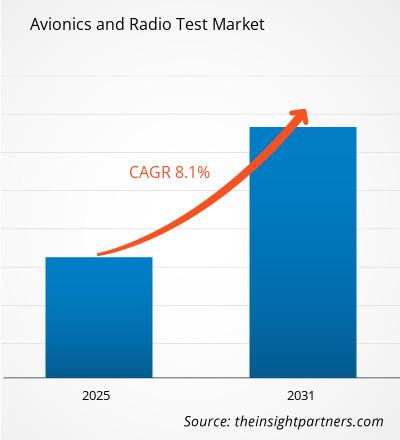
The Avionics and Radio Test Market size is expected to reach US$ 5.89 Billion by 2034 from US$ 3.39 Billion in 2025. The market is estimated to record a CAGR of 7.15% from 2026 to 2034.
Industry Segmentation and End-User Demand
The market is segmented based on platform type, product type, stage type, and end user.
By Type: Commercial aircraft represent a massive market share due to high production volumes, while military platforms command strong investment due to specialized radio frequency and tactical data-link testing requirements.
By End-User: Key end-user segments include avionics and radio manufacturers, airframe OEMs, defense contractors, military forces, and third-party MRO service providers. As commercial airlines and armed forces seek to maximize fleet availability, MRO facilities are investing heavily in versatile, portable, and rack-mounted test sets capable of supporting multiple aircraft platforms.
Regional Dynamics
North America currently dominates the avionics and radio test market, backed by major defense budgets, leading aerospace OEMs, and an extensive network of accredited MRO facilities. Meanwhile, the Asia-Pacific region is projected to experience rapid growth, stimulated by surging commercial passenger traffic, expanding regional airline fleets, and military defense expansion in key nations.
Key Players
The global avionics and radio test market is characterized by a mix of established defense contractors, specialized test equipment manufacturers, and global measurement technology corporations. Key players operating in the market include:
Astronics Corporation
General Dynamics Corporation
Keysight Technologies, Inc.
Lockheed Martin Corporation
National Instruments Corporation
Rohde and Schwarz GmbH & Co. KG
Tel-Instrument Electronics Corporation
Teradyne, Inc.
Testek Solutions
Viavi Solutions, Inc
These industry leaders focus on strategic partnerships, continuous R&D investment, and modular instrumentation architectures (such as PXI and VXI) to deliver scalable, future-proof test environments capable of handling evolving wireless standards and high-frequency communication protocols.
Get Full Copy of This Report- https://www.theinsightpartners.com/buy/TIPRE00025974
Future Outlook
Looking ahead, the avionics and radio test market is poised for transformative growth as artificial intelligence (AI), machine learning, and cloud-based predictive analytics become integral to diagnostic hardware. The rapid development of Urban Air Mobility (UAM), electric vertical takeoff and landing (eVTOL) aircraft, and autonomous drone networks will create brand-new avenues for high-speed, multi-channel radio frequency and sensor testing. Furthermore, as cyber threats to aviation navigation and satellite communication intensify, testing solutions will increasingly incorporate robust cybersecurity validation and anti-jamming verification protocols. Driven by these technological imperatives and robust structural demand across both commercial and military sectors, the market is set to expand steadily, establishing safer and more connected skies worldwide.
Related Report-
