The commercial refrigeration industry is experiencing a significant structural shift driven by modernizing retail infrastructures, expanding supermarket and hypermarket chains, and escalating consumer demand for ready-to-eat and frozen foods. At the forefront of this market evolution is the global refrigerated glass door sector. Refrigerated glass doors serve as a crucial interface between commercial food displays and energy management systems, offering visibility, product protection, thermal efficiency, and aesthetic appeal.
Get a PDF Sample- https://www.theinsightpartners.com/sample/TIPRE00026015
Market Dynamics and Growth Drivers
Several key macro and microeconomic factors are propelling the steady expansion of the market:
Rapid Expansion of Organized Retail & Foodservice: The global expansion of supermarkets, hypermarkets, convenience stores, and quick-service restaurants (QSRs) relies heavily on high-visibility merchandising. Refrigerated glass display doors allow shoppers to view produce, beverages, dairy, and frozen goods without opening the display unit, directly driving impulse purchases while maintaining optimum internal temperatures.
Emphasis on Energy Efficiency and Sustainability: Energy costs represent a major operational expense for food retail operators. High-performance insulated glass doors—featuring double or triple glazing, low-emissivity (Low-E) coatings, argon gas fills, and vacuum-insulated panels—significantly reduce thermal loss compared to open multideck display cases. Regulatory pushes globally toward lower energy consumption and greener refrigerants further accelerate the retrofit and adoption of advanced glass doors.
Technological Advancements in Glass & Frame Design: Innovations such as anti-fog and anti-reflective glass coatings, heated glass technologies, lightweight frameless designs, and integrated LED lighting solutions enhance product presentation and consumer interaction. Modern display units are also increasingly compatible with IoT-enabled monitoring systems that track internal ambient temperatures and door-opening frequencies.
Market Forecast
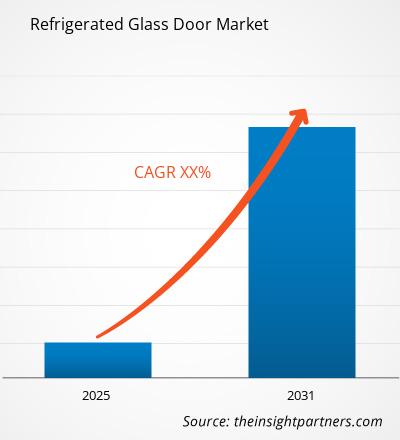
The global Refrigerated Glass Door Market size is projected to reach US$ 34.56 Billion by 2034 from US$ 14.23 Billion in 2025. The market is anticipated to register a CAGR of 8.3% during the forecast period 2026–2034.
Key Market Players
The competitive landscape of the global refrigerated glass door market comprises prominent global manufacturers, system integrators, and specialized commercial refrigeration companies actively investing in product innovation, energy-efficient designs, and regional expansion. Key industry players include:
Arneg S.p.A
Carrier Corporation (UTC)
Daikin Industries, Ltd.
Epta S.p.a. Refrigeration
Frigoglass S.A.I.C.
Hoshizaki Corporation
Illinois Tool Works
Johnson Controls
Lennox International Inc.
Panasonic Corporation
These industry leaders are consistently advancing thermal engineering, adopting natural refrigerants (such as CO₂ and hydrocarbons), and introducing customizable glass display solutions to cater to evolving retail formats and commercial cooling demands worldwide.
Get Full Copy of This Report- https://www.theinsightpartners.com/buy/TIPRE00026015
Regional Insights
North America & Europe: These mature markets account for a substantial portion of revenue, driven by strict energy efficiency mandates, extensive commercial retail networks, and widespread replacement/retrofit activities aiming to upgrade legacy open-front merchandisers to high-efficiency glass door units.
Asia-Pacific: Anticipated to record the fastest growth over the forecast period. Rapid urbanization, growing disposable income, expanding cold-chain logistics networks, and the proliferation of modern retail chains across emerging economies like China, India, and Southeast Asia are fueling strong demand for commercial refrigeration solutions.
Rest of the World: Regions across Latin America, the Middle East, and Africa are experiencing steady investments in hospitality, food service, and food distribution infrastructure, contributing positively to global market momentum.
Future Outlook
The future of the global refrigerated glass door market looks exceptionally promising, anchored by the rapid fusion of smart technologies, sustainability standards, and evolving retail environments. Over the next decade, manufacturers will increasingly focus on ultra-thin vacuum-insulated glass (VIG) technologies, dynamic smart-tinting glass, and interactive digital glass displays that combine product visibility with targeted digital advertising. Coupled with stringent environmental regulations pushing for zero-emission cold chains and energy-optimized store layouts, the adoption of advanced, eco-designed refrigerated glass doors is set to accelerate globally, creating sustainable growth trajectories for key manufacturers and retail stakeholders through 2034 and beyond.
Related Report-
