Modern manufacturing processes are undergoing a radical shift toward automation, precision, and high-volume efficiency. Central to this transformation is the workholding industry, which provides essential clamping, supporting, and positioning tools required to hold workpieces securely during machining, welding, inspection, and assembly operations.
Get a PDF Sample- https://www.theinsightpartners.com/sample/TIPRE00026921
Market Overview and Core Growth Drivers
The modern industrial landscape relies heavily on computer numerical control (CNC) machining centers, robotic cells, and flexible manufacturing systems (FMS). As industrial original equipment manufacturers (OEMs) and contract machine shops strive to reduce cycle times and maximize spindle uptime, the demand for sophisticated workholding solutions has escalated rapidly. Workholding devices ranging from traditional vices, chucks, and collets to advanced hydraulic fixtures, zero-point clamping systems, and magnetic tables ensure structural rigidity, high repeatability, and operational safety.
A primary driver of market growth is the accelerating adoption of Industry 4.0 and smart factory automation. Automated loading and unloading systems using industrial robots require workholding devices equipped with sensors, pneumatic controls, and quick-change capabilities to facilitate unmanned, 24/7 “lights-out” manufacturing. Furthermore, the expansion of key end-use industries, including automotive, aerospace, defense, energy, medical device manufacturing, and heavy machinery, continues to propel global investments in high-precision workholding systems.
In the aerospace and defense sector, the machining of complex, lightweight materials such as titanium alloys and carbon-fiber composites demands specialized workholding fixtures that prevent part deformation while withstanding heavy cutting forces. Similarly, the rapid growth of the electric vehicle (EV) sector is fueling demand for custom modular tooling and multi-axis workholding systems designed to produce battery trays, motor housings, and intricate structural components.
Market Forecast
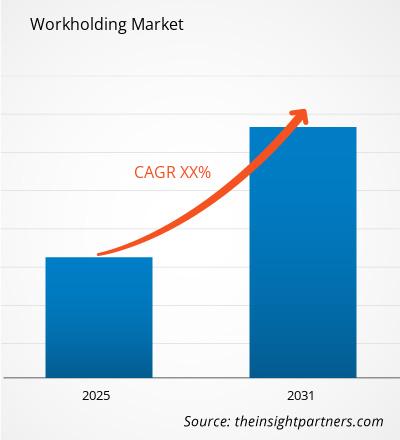
According to an extensive market research report by The Insight Partners, the Workholding Market size is expected to reach US$ 14.08 Billion by 2034 from US$ 7.47 Billion in 2025. The market is estimated to record a CAGR of 8.25% from 2026 to 2034.
Technology Trends Shaping the Industry
Technological advancements are reshaping the capabilities and design of modern workholding equipment. Modular workholding systems and zero-point clamping technology are gaining immense popularity due to their ability to minimize setup times and maximize machine utilization rates. Zero-point clamping allows operators to change pre-configured fixtures within seconds with micron-level repeatability, thereby drastically reducing idle machine time.
Another notable trend is the integration of smart, IoT-enabled clamping devices. Sensors embedded directly into clamping elements monitor clamping pressure, workpiece orientation, thermal expansion, and vibration levels in real time. This continuous telemetry enables predictive maintenance, reduces scrap rates caused by workpiece slippage or misalignment, and ensures strict adherence to quality assurance standards in high-precision manufacturing.
Additionally, the rise of 5-axis CNC machining has created a surge in demand for compact, multi-axis vices and pyramid workholding towers. These systems allow cutting tools unimpeded access to five sides of a workpiece in a single setup, optimizing tool pathing, cutting tool life, and overall production throughput.
Regional Market Dynamics
Geographically, Asia-Pacific remains a major contributor to the workholding market, driven by massive manufacturing infrastructure, robust automotive manufacturing hubs, and expanding electronics production across China, India, Japan, South Korea, and Southeast Asian nations. Regional governments actively promote advanced manufacturing initiatives, encouraging small and medium enterprises (SMEs) to modernize their machine shops with automated workholding tools.
North America and Europe also account for significant market shares, characterized by early adoption of highly automated, high-precision manufacturing technologies. Strong defense budgets, thriving commercial aviation industries, and a persistent focus on reshoring critical supply chains are accelerating investments in state-of-the-art workholding systems across these regions.
Get Full Copy of This Report- https://www.theinsightpartners.com/buy/TIPRE00026921
Key Market Players
The global workholding market features a mix of established international corporations and specialized niche manufacturers focusing on engineering innovation, modularity, and custom fixture design. Prominent players profiled in the market study include:
DESTACO: A leading provider of high-performance clamping, gripping, and transferring solutions serving automotive, industrial, and packaging sectors.
ENERPAC: Renowned globally for high-pressure hydraulic tools and controlled force products, offering robust hydraulic clamping systems.
Gerardi SPA: A recognized European innovator in modular vices, angle heads, and quick-change workholding systems for CNC machining.
Jergens Inc.: A pioneer in standard tooling components, ball-lock fast-change systems, and vice solutions for high-mix production environments.
TE-CO: A premier manufacturer of workholding equipment, including clamping tools, vice jaws, and tooling components for industrial tooling.
Alpha Workholding Solutions, LLC: Specialized in custom workholding fixture design and advanced magnetic clamping technology for metalworking applications.
Emuge Corporation: Widely recognized for high-precision threading tools, high-accuracy workholding chucks, and specialized clamping mandrels.
EROWA LTD: A pioneer in flexible manufacturing, famous for its high-precision tooling systems, palletization automation, and zero-point clamping fixtures.
LANG Technik GmbH: A leader in 5-axis workholding technology, raw part stamping systems, and modular automation solutions for machine tools.
Pierson Workholding: Famous for innovative quick-change vacuum workholding and lean workholding solutions designed to maximize small-shop productivity.
Future Outlook
The future outlook for the workholding market remains exceptionally promising as industrial ecosystems shift toward fully autonomous, digitalized, and sustainable manufacturing models. Over the forecast period from 2026 to 2034, the integration of additive manufacturing (3D printing) for custom fixture jaws, combined with artificial intelligence and digital twin simulation for clamping force optimization, will redefine workholding capabilities. As manufacturers increasingly prioritize flexible automation, energy efficiency, and minimized operational downtime, investment in advanced, sensor-driven, and modular workholding technologies will serve as a foundational pillar for next-generation factory productivity.
About Us
The Insight Partners is a one-stop industry research provider of actionable intelligence. We help our clients in getting solutions to their research requirements through our syndicated and consulting research services. We specialize in industries such as Semiconductor and Electronics, Aerospace and Defense, Automotive and Transportation, Biotechnology, Healthcare IT, Manufacturing and Construction, Medical Devices, Technology, Media, and Telecommunications, as well as chemicals and Materials.
Contact Us
If you have any queries about this report or if you would like further information, don’t hesitate to get in touch with us:
Contact Person: Ankit Mathur
E-mail: ankit.mathur@theinsightpartners.com
