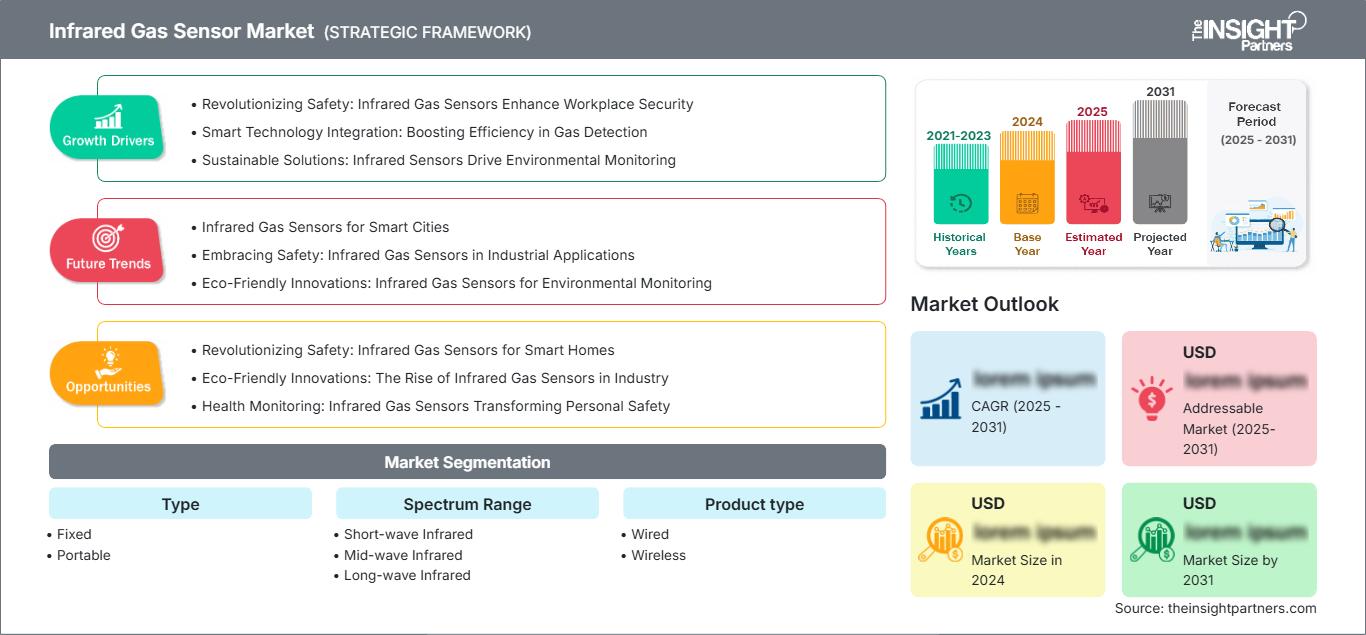
Advanced gas detection technologies are becoming increasingly important as industries strengthen workplace safety, environmental monitoring, emissions management, and process-control capabilities. Infrared sensing is gaining attention because it can provide selective and reliable detection of gases by analyzing how specific molecules absorb infrared radiation. The technology is finding applications across oil and gas, chemicals, manufacturing, automotive, mining, healthcare, environmental monitoring, and other safety-critical environments. Growing industrial automation, connected monitoring systems, stricter safety requirements, and the need for continuous measurement are creating new opportunities for sensor manufacturers and technology providers.
The Infrared Gas Sensor Market is evolving as fixed and portable sensing solutions become more sophisticated, connected, compact, and suitable for demanding operating conditions. According to The Insight Partners, the industry is analyzed by type, spectrum range, product type, and geography, with fixed and portable configurations, short-wave, mid-wave and long-wave infrared technologies, and wired and wireless products forming key segments. The broader industry is also benefiting from the integration of infrared sensing with digital monitoring, industrial automation, and Industrial Internet of Things platforms.
Get a Sample PDF: https://www.theinsightpartners.com/sample/TIPRE00021277
Infrared Gas Sensor Market Size, Share, Trends and Forecast to 2031
The outlook through 2031 indicates continued expansion as industries prioritize early gas-leak detection, worker protection, emissions compliance, and real-time operational intelligence. Key findings include:
- Market Size: The industry is expected to expand steadily through 2031, supported by increasing adoption of infrared-based detection across industrial and environmental applications.
- Market Share: Industrial applications are expected to remain highly influential, while demand for portable and wireless solutions continues to broaden the competitive landscape.
- Market Trends: Miniaturization, wireless connectivity, low-power operation, improved selectivity, smart diagnostics, and integration with connected monitoring platforms are emerging as important trends.
- Technology Outlook: NDIR-based detection remains an important technology area, while advances in optical components, signal processing, and sensing architectures are expanding performance capabilities.
- Forecast: Growth opportunities through 2031 are expected to be strongest where safety regulations, emission monitoring requirements, automation, and digital transformation converge.
The industry is also experiencing a shift from standalone detection equipment toward intelligent sensing ecosystems. Modern solutions increasingly need to deliver reliable measurements while supporting remote monitoring, data logging, predictive maintenance, alarms, and integration with plant-wide control systems. This transition is helping strengthen the role of infrared sensors in connected industrial environments.
Latest Industry Development Strengthens Demand for Infrared Detection
Recent product activity highlights the direction of technological development. In March 2026, Honeywell introduced an NDIR Hydrocarbon Gas Sensor designed to detect flammable gases including methane, propane, and butane in industrial environments. The solution is positioned for applications across mining, oil and gas, petrochemical operations, plastics manufacturing, and other industrial settings. Honeywell emphasized accuracy, precision, and reliability as critical requirements for gas detection and worker protection.
This development reflects a broader industry movement toward specialized infrared detection solutions designed for challenging industrial environments. Product innovation is increasingly focused on improving detection reliability while reducing system complexity and enabling easier integration into safety and monitoring infrastructure.
Key Growth Drivers
The Infrared Gas Sensor Market is being influenced by several structural factors. Industrial safety remains one of the most important drivers because undetected combustible or toxic gases can create significant risks for employees, facilities, and surrounding communities. Infrared technologies can provide selective gas detection and are particularly useful in applications where dependable continuous monitoring is required.
Environmental regulations and growing attention to greenhouse-gas emissions are also increasing the need for monitoring technologies. Methane detection, carbon dioxide monitoring, combustion control, and process optimization are encouraging organizations to invest in more sophisticated sensing solutions.
Another important driver is industrial digitization. As factories, refineries, mines, and processing facilities adopt connected equipment, sensors are becoming data-generating components within larger digital systems. Wireless communication, remote diagnostics, cloud connectivity, and predictive analytics can make gas detection more responsive and easier to manage.
Global and Regional Analysis
North America: North America remains an important technology and adoption center because of its established oil and gas, chemicals, manufacturing, and industrial automation sectors. Strong emphasis on workplace safety, environmental monitoring, and connected industrial infrastructure is expected to support continued deployment through 2031.
Europe: Europe is expected to benefit from stringent environmental policies, industrial safety requirements, energy-efficiency initiatives, and increasing attention to emissions management. Demand for sophisticated monitoring technologies is likely to remain strong across Germany, the UK, France, and other major industrial economies.
Asia-Pacific: Asia-Pacific represents a major growth opportunity due to industrialization, expanding manufacturing capacity, infrastructure development, and increasing adoption of automation. China, Japan, South Korea, and India are important markets for sensor technologies used across manufacturing, energy, automotive, and environmental applications.
South and Central America: Industrial development, energy projects, mining activity, and environmental monitoring requirements are creating opportunities for gas detection technologies. Adoption is expected to increase as organizations modernize safety infrastructure and invest in monitoring systems.
Key Players
The competitive landscape includes established sensor manufacturers and specialized gas-detection technology companies, including:
- Senseair
- AlphaSense Inc.
- Heimann
- SGX Sensortech
- Dräger
- Amphenol Corporation
- Honeywell International Inc.
- Dynament
- SmartGAS
- Figaro Engineering Inc.
These companies are competing through product development, sensor miniaturization, improved detection performance, connectivity, application-specific solutions, and expansion into industrial and environmental monitoring applications. The competitive environment is expected to become increasingly technology-driven as customers seek sensors that can integrate seamlessly with digital safety and automation platforms. The player list is consistent with published industry coverage from Allied Market Research, while The Insight Partners provides the 2031 segmentation framework used for this analysis.
Emerging Trends Shaping the Industry
One of the strongest trends is the movement toward compact and intelligent sensing systems. Smaller components can enable integration into portable instruments, connected equipment, and space-constrained industrial systems. Wireless connectivity is also becoming increasingly relevant because it can simplify deployment and enable remote monitoring.
Another trend is the use of multiple sensing technologies and advanced signal-processing techniques to improve accuracy and reliability. Manufacturers are also focusing on reducing power consumption, extending operating life, improving calibration stability, and developing solutions capable of functioning under harsh environmental conditions.
The growing adoption of Industrial IoT technologies is expected to further change how infrared gas detection systems are deployed. Instead of simply triggering an alarm, connected sensors can potentially contribute continuous data to centralized platforms, enabling operators to identify abnormal conditions earlier and make more informed maintenance and safety decisions.
Get the Premium Research Report @ https://www.theinsightpartners.com/buy/TIPRE00021277
Future Outlook
The Infrared Gas Sensor Market is positioned for sustained development through 2031 as industrial safety, environmental responsibility, automation, and connected operations become increasingly interconnected. Future opportunities are expected to center on wireless and portable detection, intelligent monitoring, advanced optical technologies, low-power designs, and sensor integration with industrial digital platforms. Recent product innovation, including Honeywell’s new NDIR hydrocarbon sensing solution, demonstrates how leading companies are responding to the demand for dependable gas detection in safety-critical environments. As industries continue moving toward proactive safety and real-time environmental intelligence, infrared sensing is likely to become an increasingly important component of next-generation monitoring infrastructure.
Related Reports –
Home Energy Management System Market Regional Share, Trend, and Growth Opportunity
Vision Transformers Market Regional Share, Trend, and Growth Opportunity
Differential-Pressure Mass Flow Controller Market Regional Share, Trend, and Growth Opportunity
About The Insight Partners
The Insight Partners is a leading market research and consulting firm delivering actionable insights through in-depth industry analysis and strategic intelligence. The firm supports clients across various industries in making informed business decisions by providing comprehensive market forecasts, competitive assessments, and growth opportunities.
Contact Us:
If you have any queries about this report or if you would like further information, please contact us:
Contact Person: Ankit Mathur
E-mail: sales@theinsightpartners.com
Phone: +1-646-491-9876
Also Available in :
Korean | German | Japanese | French | Chinese | Italian | Spanish
