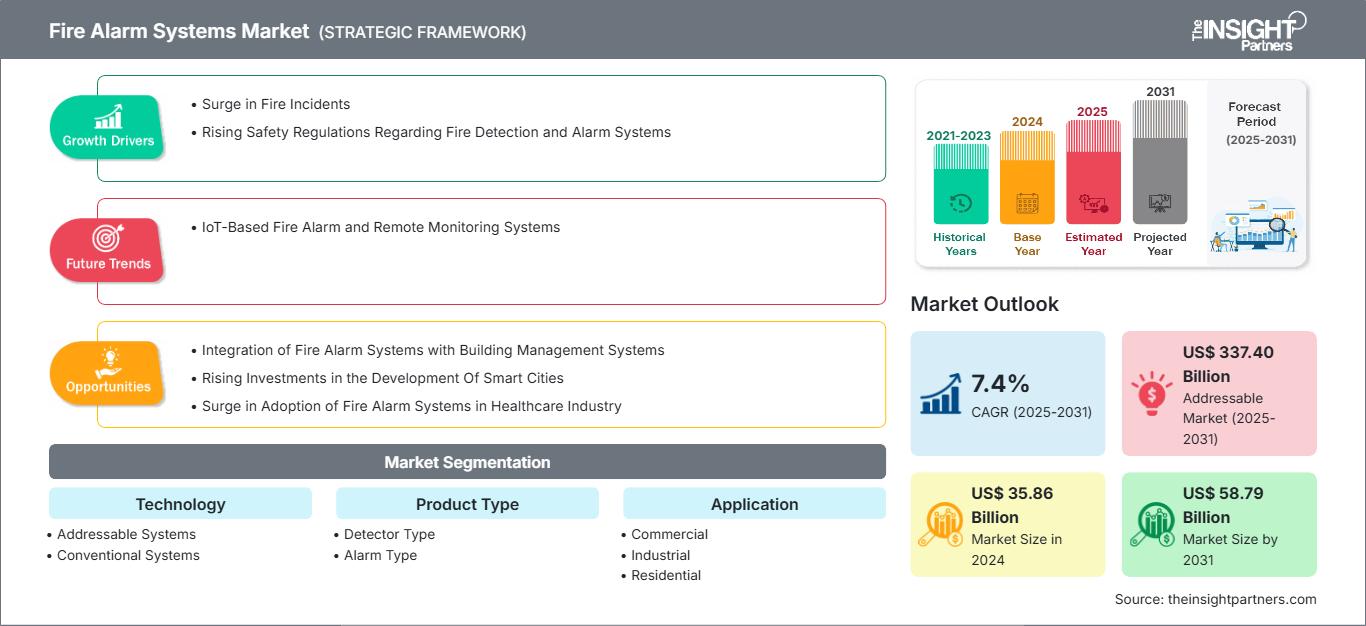
Growing urbanization, expanding commercial infrastructure, stricter fire-safety requirements, and the increasing adoption of connected building technologies are reshaping the global fire protection landscape. Building owners, facility operators, industrial organizations, and public institutions are placing greater emphasis on early fire detection, rapid notification, remote monitoring, and integrated emergency response capabilities. The shift toward intelligent safety infrastructure is creating new opportunities for manufacturers and technology providers across residential, commercial, and industrial applications.
The Fire Alarm Systems Market is witnessing sustained demand as organizations increasingly move from basic detection technologies toward addressable, connected, and remotely monitored solutions. According to The Insight Partners, the global industry is projected to expand significantly through 2031, supported by technological advancements, rising fire-safety awareness, infrastructure development, and growing adoption of IoT-enabled fire detection solutions.
Get a Sample PDF: https://www.theinsightpartners.com/sample/TIPRE00004800
Fire Alarm Systems Market Size, Share, Trends, and Forecast to 2031
The global Fire Alarm Systems Market is expected to experience steady expansion through 2031 as safety regulations and building automation requirements increasingly influence purchasing decisions. The following points summarize the expected direction of the industry:
- Market Size: The industry is expanding as new construction projects, renovation activities, and safety upgrades increase demand for advanced detection and notification technologies.
- Market Share: Addressable systems are gaining a stronger position because they can identify the location of incidents more precisely and provide enhanced monitoring and diagnostic capabilities.
- Market Trends: IoT connectivity, wireless detection, cloud-based monitoring, intelligent sensors, remote diagnostics, and integration with building management systems are emerging as major technology trends.
- Market Analysis: Commercial and industrial facilities remain important demand centers, while residential applications are also benefiting from increased awareness of fire prevention and connected-home technologies.
- Market Forecast: Growth is expected to remain positive through 2031 as smart buildings, data centers, healthcare facilities, manufacturing plants, residential complexes, and infrastructure projects increasingly prioritize integrated life-safety systems.
Technology Transformation Accelerates Industry Development
One of the most important developments influencing the Fire Alarm Systems Market is the transition from conventional systems toward addressable and intelligent platforms. Conventional systems generally identify an alarm condition within a particular zone, whereas addressable technologies can provide more detailed information about individual devices and their locations. This capability can support faster response, improved troubleshooting, and more efficient maintenance.
IoT connectivity is further changing how fire safety systems are operated. Connected detectors, control panels, sensors, and communication platforms can transmit alerts and system-status information to centralized monitoring environments. Remote access allows facility managers and service teams to identify faults, monitor equipment, and respond to potential issues without being physically present at the installation site.
The growing integration of fire detection with building automation is another significant trend. Modern facilities increasingly connect life-safety infrastructure with access control, ventilation, emergency lighting, elevators, surveillance, and other building systems. Such integration can help coordinate emergency responses while improving operational visibility.
Rising Safety Requirements Support Demand
Increasing attention toward building safety is a key factor supporting the Fire Alarm Systems Market. Regulatory authorities and building operators are placing greater emphasis on functioning detectors, alarm notification equipment, emergency exits, inspection procedures, and regular maintenance.
Recent safety inspections demonstrate the importance of reliable fire detection infrastructure. In India, a large-scale inspection of healthcare facilities in Telangana identified deficiencies involving fire alarms, smoke detectors, sprinklers, emergency exits, and staff preparedness. More than 230 hospitals reportedly received notices following inspections, highlighting the continuing importance of compliance and properly maintained fire-safety infrastructure.
Such developments are encouraging facility owners to review aging installations, replace obsolete equipment, and invest in modern detection and notification technologies. The requirement is particularly important in hospitals, hotels, educational institutions, industrial facilities, warehouses, shopping centers, offices, and high-rise residential buildings.
Global and Regional Analysis
North America: North America remains a highly developed region for fire detection technologies, supported by established safety standards, extensive commercial infrastructure, renovation activity, and strong adoption of smart-building solutions. The United States continues to represent an important opportunity because of its large installed base and ongoing demand for upgrades and modernization. The region is also seeing growing attention toward specialized fire detection for data centers, industrial facilities, and high-value infrastructure.
Europe: Europe is benefiting from stringent safety requirements, building modernization programs, and growing investment in energy-efficient and intelligent buildings. Demand for connected fire detection solutions is increasing as facility operators seek improved monitoring, compliance, and integration with building management platforms.
Asia Pacific: Asia Pacific is expected to remain one of the most dynamic regions through 2031. Rapid urbanization, expanding construction activities, smart-city initiatives, industrial development, and infrastructure investment are creating substantial opportunities. Countries such as India and other developing Asian economies are increasingly focusing on fire-safety compliance in commercial, healthcare, residential, and industrial buildings.
Middle East & Africa: Infrastructure expansion, commercial development, hospitality projects, transportation facilities, and large-scale construction programs are supporting adoption across the region. Increasing awareness of life-safety requirements is also encouraging organizations to upgrade detection and alarm infrastructure.
Key Players in the Fire Alarm Systems Market
Leading companies are strengthening their competitive positions through product development, connected technologies, system integration, strategic partnerships, and expansion of intelligent fire-safety portfolios. Prominent participants include:
- ✓ Honeywell International Inc.
- ✓ Johnson Controls
- ✓ Siemens AG
- ✓ Robert Bosch GmbH
- ✓ Schneider Electric
- ✓ Carrier Global Corporation
- ✓ Halma plc
- ✓ Hochiki Corporation
- ✓ Nittan Company, Limited
- ✓ Eaton Corporation plc
These companies are focusing on addressable detection, wireless technologies, intelligent control panels, remote monitoring, advanced sensors, and integrated safety platforms to address changing customer requirements.
Competitive Trends and Industry Analysis
Competition within the Fire Alarm Systems Market is increasingly shifting beyond conventional hardware. Customers are seeking complete solutions that combine detection, notification, connectivity, analytics, monitoring, installation, maintenance, and lifecycle support.
Another emerging priority is system reliability. As buildings become more digitally connected, fire alarm infrastructure must deliver dependable operation while supporting cybersecurity and interoperability requirements. The industry is therefore moving toward platforms capable of integrating multiple building technologies while maintaining high levels of availability and diagnostic visibility.
At the same time, installation and maintenance costs remain important considerations, particularly in developing economies. Limited availability of skilled technicians and the higher upfront cost of advanced addressable and connected systems can slow adoption. Service providers that can offer cost-effective installation, testing, maintenance, and modernization solutions are consequently positioned to benefit from long-term demand.
Updated Industry News and Developments
Recent developments underline the continuing importance of dependable fire detection. Fire-safety authorities are increasing scrutiny of healthcare and high-occupancy buildings, while technology providers continue to develop connected and intelligent detection platforms. Industry discussions are also increasingly focused on interoperability, system modernization, remote diagnostics, and the challenges associated with replacing obsolete proprietary equipment.
These developments indicate that future growth will not depend solely on new building construction. Replacement demand, retrofit projects, regulatory compliance, modernization of aging infrastructure, and integration with smart-building platforms are expected to become increasingly important contributors.
Get the Premium Research Report @ https://www.theinsightpartners.com/buy/TIPRE00004800
Future Outlook
The outlook for the Fire Alarm Systems Market through 2031 remains positive as fire safety becomes an increasingly integrated component of modern building infrastructure. Smart sensors, wireless connectivity, cloud-based monitoring, AI-assisted analytics, remote diagnostics, and building automation integration are expected to influence the next generation of solutions. As organizations place greater emphasis on protecting people, assets, and critical infrastructure, demand is likely to shift toward intelligent systems capable of delivering faster detection, clearer information, centralized monitoring, and improved lifecycle management. The combination of regulatory pressure, technological innovation, infrastructure development, and growing safety awareness is expected to create sustained opportunities for manufacturers, system integrators, technology providers, and service companies worldwide.
Related Reports –
Home Energy Management System Market Regional Share, Trend, and Growth Opportunity
Vision Transformers Market Regional Share, Trend, and Growth Opportunity
Differential-Pressure Mass Flow Controller Market Regional Share, Trend, and Growth Opportunity
About The Insight Partners
The Insight Partners is a leading market research and consulting firm delivering actionable insights through in-depth industry analysis and strategic intelligence. The firm supports clients across various industries in making informed business decisions by providing comprehensive market forecasts, competitive assessments, and growth opportunities.
Contact Us:
If you have any queries about this report or if you would like further information, please contact us:
Contact Person: Ankit Mathur
E-mail: sales@theinsightpartners.com
Phone: +1-646-491-9876
Also Available in :
Korean | German | Japanese | French | Chinese | Italian | Spanish
