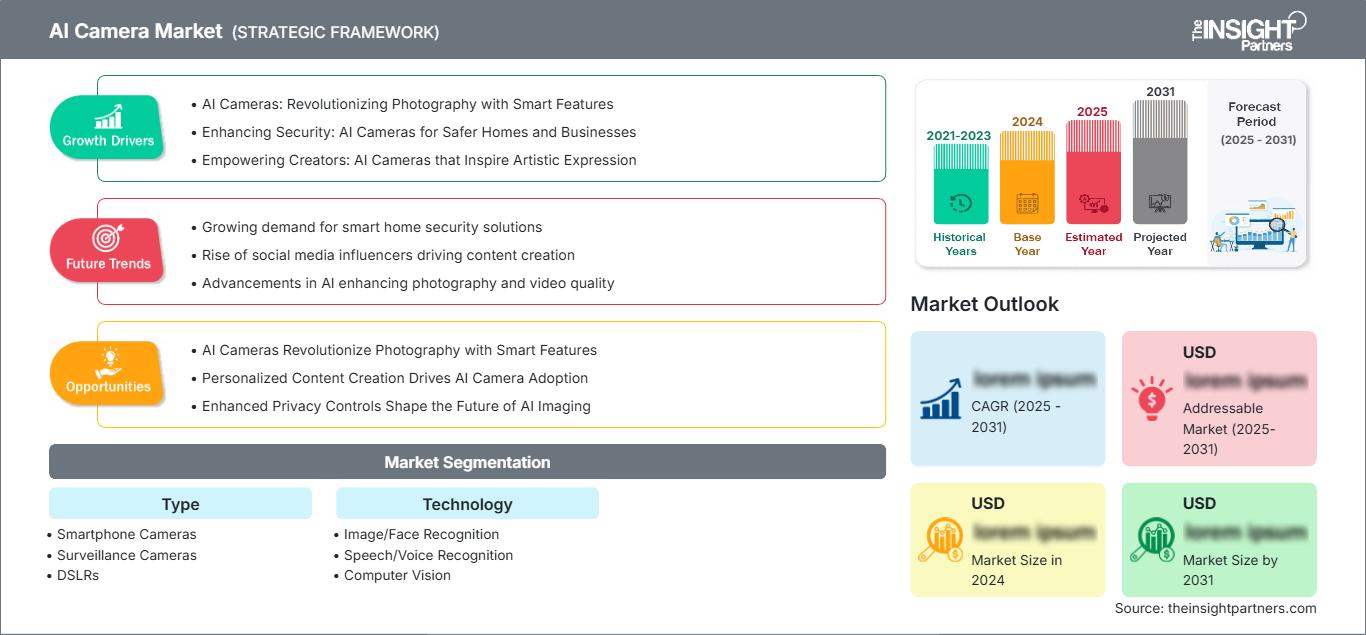
The rapid evolution of computer vision, edge computing, intelligent sensors, and real-time analytics is transforming how organizations capture, interpret, and respond to visual information. Cameras are increasingly moving beyond traditional recording functions to become intelligent systems capable of recognizing objects, identifying patterns, detecting anomalies, monitoring environments, and supporting automated decision-making. This transition is influencing security, transportation, healthcare, retail, manufacturing, automotive, smart cities, and consumer applications worldwide.
The AI Camera Market is entering a significant phase of technological expansion as organizations increasingly prioritize real-time intelligence, automated surveillance, and edge-based processing. AI-enabled cameras can analyze video locally or through connected platforms, reducing dependence on centralized processing while enabling faster responses. Recent industry research indicates that demand is being supported by intelligent surveillance, automotive vision systems, retail analytics, healthcare monitoring, smart infrastructure, and connected-device adoption.
Get a Sample PDF: https://www.theinsightpartners.com/sample/TIPRE00017716
AI Camera Market Size, Share, Trends, Analysis and Forecast to 2031
- Market Size: The AI Camera Market is expected to expand substantially through 2031 as intelligent video processing becomes integrated into mainstream security and automation infrastructure.
- Market Share: Surveillance and security applications continue to represent an important portion of demand, while automotive, retail, industrial, healthcare, and smart-city applications are steadily increasing their contribution.
- Market Trends: Edge AI processing, real-time object detection, advanced video analytics, privacy-aware processing, high-resolution imaging, and cloud-edge integration are among the leading technology trends.
- Market Analysis: Adoption is being driven by the need to transform large volumes of video into actionable intelligence rather than simply storing footage for later review.
- Forecast to 2031: The industry is expected to move toward more autonomous, connected, and application-specific camera platforms, with AI capabilities increasingly embedded directly into imaging hardware.
- Technology Direction: AI accelerators, neural processing units, improved image sensors, 5G connectivity, and increasingly efficient machine-learning models are expected to improve camera intelligence.
- Application Expansion: Intelligent cameras are likely to gain further traction across traffic management, industrial inspection, healthcare monitoring, retail intelligence, logistics, and autonomous mobility.
Rising Adoption of Edge AI and Intelligent Video Analytics
One of the most important developments shaping the AI Camera Market is the migration of artificial intelligence from centralized cloud infrastructure toward the camera and network edge. Edge-enabled cameras can process visual information closer to where it is generated, allowing organizations to identify people, vehicles, events, and unusual activities with reduced latency. This approach can also reduce the volume of video that needs to be transferred to remote servers.
The growing use of intelligent video analytics is creating new opportunities beyond conventional security. Retailers can analyze customer movement and store activity, manufacturers can identify production anomalies, transportation authorities can monitor traffic conditions, and healthcare providers can use camera-based systems for remote observation. Automotive manufacturers are also integrating increasingly sophisticated vision capabilities to support driver-assistance and automated-driving functions.
Latest Industry Developments Strengthen Demand
Recent developments demonstrate how quickly intelligent imaging is moving from pilot projects into practical deployments. In April 2026, MIT announced plans involving more than 500 AI-enabled surveillance cameras across campus locations, with capabilities including real-time face and object detection. The deployment has also generated discussion around the balance between security, facial recognition, and privacy.
India is another important example of large-scale adoption. Bengaluru Police have deployed an extensive network of AI-enabled cameras and automatic number-plate recognition systems to support crime investigation, prevention, and coordination. Such deployments illustrate how computer vision is increasingly being used as an operational intelligence tool rather than simply as a recording mechanism.
The technology ecosystem is also experiencing strategic movement. Recent reports indicate that NXP Semiconductors has been in discussions to acquire Ambarella, a developer of AI-enabled camera chips used in automotive applications. Although the reported transaction is not guaranteed, the development highlights the strategic importance of edge AI silicon for next-generation vision systems.
Global and Regional Analysis
North America: North America remains a highly attractive region because of strong investment in AI infrastructure, security modernization, autonomous vehicles, cloud-connected surveillance, and enterprise analytics. Demand is supported by technology innovation and the increasing adoption of intelligent video solutions across commercial, industrial, transportation, and public-sector environments.
Europe: European adoption is being shaped by smart-city development, industrial automation, automotive innovation, and growing attention to privacy-centric AI. Vendors are increasingly focusing on responsible AI processing, cybersecurity, data governance, and edge-based analytics to address regulatory and operational requirements.
Asia Pacific: Asia Pacific is expected to remain one of the most dynamic growth regions through 2031. Rapid urbanization, smart-city programs, manufacturing automation, transportation infrastructure, and large-scale surveillance deployments are creating strong opportunities. China, Japan, South Korea, and India are important technology and deployment centers. Industry research identifies Asia Pacific as a particularly fast-growing region for AI camera adoption.
Middle East & Africa: Smart-city initiatives, transportation modernization, security investments, and infrastructure development are creating new opportunities. Intelligent surveillance is particularly relevant for airports, highways, commercial districts, industrial facilities, and large public venues.
Latin America: Adoption is gradually increasing as organizations modernize security infrastructure and explore AI-powered traffic monitoring, retail analytics, industrial applications, and public safety systems.
Key Players in the AI Camera Market
Leading companies are strengthening their positions through AI-enabled imaging, edge processing, advanced analytics, partnerships, product launches, and application-specific solutions. Key players include:
- Hikvision Digital Technology Co., Ltd.
- Dahua Technology Co., Ltd.
- Axis Communications AB
- Hanwha Techwin Co., Ltd.
- Bosch Security Systems
- Sony Corporation
- Panasonic Corporation
- Canon Inc.
- Teledyne FLIR
- Avigilon Corporation
- Honeywell International Inc.
- VIVOTEK Inc.
Competition is increasingly shifting from hardware specifications alone toward AI capabilities, processing efficiency, cybersecurity, interoperability, analytics accuracy, and total system value. Vendors that combine high-quality imaging with efficient edge intelligence and scalable software platforms are positioned to capture emerging opportunities.
Challenges and Opportunities
Despite strong adoption potential, the AI Camera Market faces challenges related to privacy, cybersecurity, regulatory compliance, deployment costs, interoperability, and the accuracy of AI models in complex environments. Facial recognition and behavioral analytics in particular require careful governance because they can involve sensitive visual information.
At the same time, these challenges are encouraging innovation. Privacy-preserving AI, on-device processing, anonymization, secure data architectures, explainable analytics, and improved model accuracy are expected to become increasingly important competitive factors. The growing availability of specialized AI processors is also helping manufacturers develop more capable cameras without relying entirely on cloud infrastructure.
Get the Premium Research Report @ https://www.theinsightpartners.com/buy/TIPRE00017716
Future Outlook
The outlook for the AI Camera Market through 2031 remains highly positive as visual intelligence becomes an increasingly important component of digital transformation. Future systems are expected to become more autonomous, context-aware, energy-efficient, and capable of making decisions directly at the edge. The convergence of AI, computer vision, 5G, IoT, advanced sensors, and robotics will expand applications well beyond traditional surveillance. As organizations seek faster insights and more proactive operations, AI cameras are likely to become an essential layer of intelligent infrastructure across cities, businesses, vehicles, factories, healthcare facilities, and connected environments.
Related Reports –
Home Energy Management System Market Regional Share, Trend, and Growth Opportunity
Vision Transformers Market Regional Share, Trend, and Growth Opportunity
Differential-Pressure Mass Flow Controller Market Regional Share, Trend, and Growth Opportunity
About The Insight Partners
The Insight Partners is a leading market research and consulting firm delivering actionable insights through in-depth industry analysis and strategic intelligence. The firm supports clients across various industries in making informed business decisions by providing comprehensive market forecasts, competitive assessments, and growth opportunities.
Contact Us:
If you have any queries about this report or if you would like further information, please contact us:
Contact Person: Ankit Mathur
E-mail: sales@theinsightpartners.com
Phone: +1-646-491-9876
Also Available in :
Korean | German | Japanese | French | Chinese | Italian | Spanish
