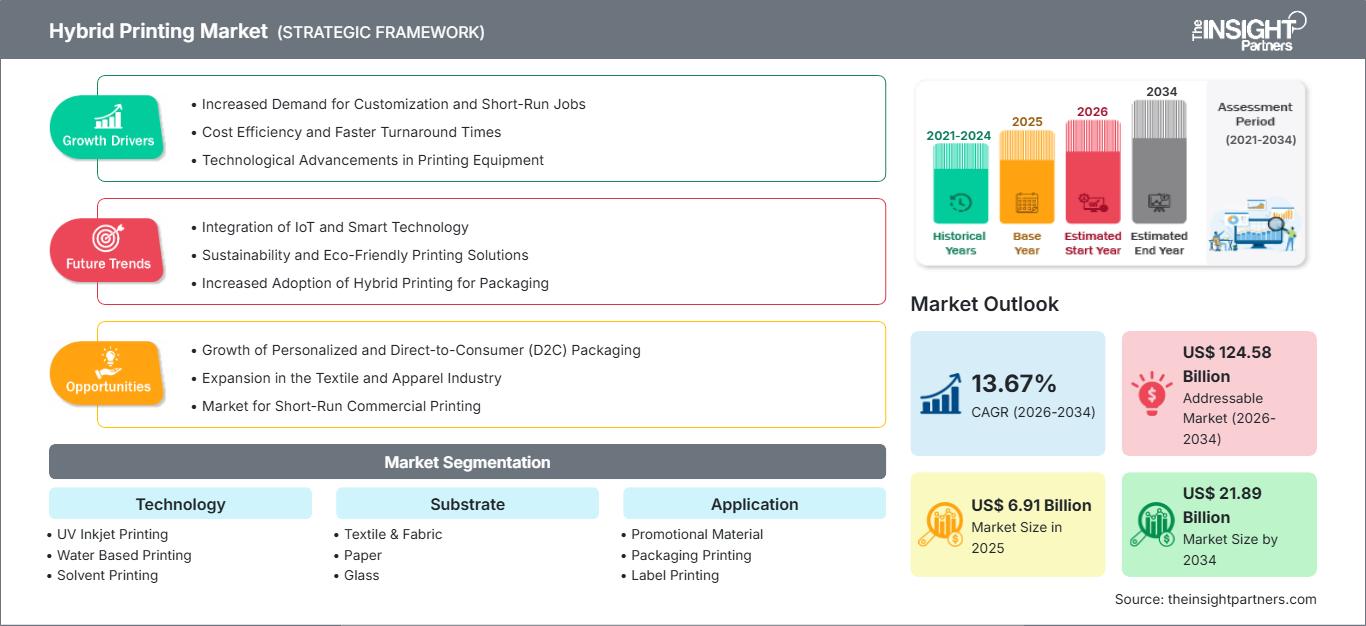
The printing industry is entering a new phase in which speed, flexibility, personalization, and production efficiency are becoming critical to competitiveness. Businesses across packaging, labels, textiles, commercial printing, retail, pharmaceuticals, food and beverages, and electronics are increasingly seeking production systems that can accommodate changing order volumes without compromising quality. The convergence of conventional and digital printing technologies is emerging as an important solution to these evolving requirements. Recent industry developments indicate that printers are increasingly moving toward integrated production environments that combine multiple technologies, automated workflows, advanced inks, and intelligent process management. This shift is also being supported by growing demand for shorter production runs, customized products, faster turnaround times, and more efficient resource utilization.
The Hybrid Printing Market is gaining significant attention as manufacturers and print service providers look for ways to combine the strengths of digital and conventional printing within streamlined production workflows. Hybrid systems can integrate technologies such as UV inkjet, water-based printing, solvent printing, LED-curable systems, and dye sublimation with established printing processes. This approach enables businesses to manage diverse substrates, including paper, plastics, glass, metal, and textiles, while supporting applications such as packaging, labels, promotional materials, and customized commercial output. The Insight Partners identifies customization, short-run production, cost efficiency, faster turnaround, and advances in printing equipment as important factors supporting industry expansion through 2031.
Get a Sample PDF: https://www.theinsightpartners.com/sample/TIPRE00039460
Hybrid Printing Market Size, Share, Trends, Analysis, and Forecast to 2031
- Market Size: The industry is positioned for sustained expansion through 2031 as hybrid production becomes increasingly integrated into commercial, packaging, textile, and industrial printing workflows.
- Market Share: Competitive positioning is influenced by technology capabilities, automation, substrate compatibility, workflow integration, digital print quality, and global service networks.
- Market Trends: Major trends include AI-enabled workflow management, IoT-connected equipment, variable-data printing, personalized packaging, water-based inks, UV-curable technologies, and automated production.
- Market Analysis: Demand is being supported by the need to handle short and long production runs on flexible platforms while reducing setup time, material waste, and operational complexity.
- Market Forecast: Through 2031, adoption is expected to strengthen as print providers modernize equipment, integrate digital technologies, and respond to increasingly customized customer requirements.
Automation and Customization Strengthen Industry Demand
One of the strongest forces influencing the Hybrid Printing Market is the growing requirement for customized and short-run production. Conventional printing remains highly effective for large-volume standardized jobs, while digital systems provide flexibility for variable content and personalized output. Hybrid platforms bring these capabilities together, allowing printers to switch between different production requirements without maintaining completely separate workflows.
The development of intelligent printing equipment is further enhancing this value proposition. IoT connectivity can enable real-time monitoring, predictive maintenance, remote diagnostics, and production optimization. Meanwhile, AI-supported workflow systems can help determine the most appropriate production method for individual jobs, improving scheduling and resource utilization. These developments are moving hybrid printing beyond a simple combination of technologies toward a more connected and automated production environment.
Packaging and Label Printing Create New Opportunities
Packaging is emerging as a particularly important application area. Brands increasingly require packaging that is visually distinctive, personalized, produced in smaller batches, and adapted quickly to changing consumer preferences. Hybrid printing can support these requirements by combining high-volume conventional production with digital customization.
The technology is also relevant to label manufacturers facing greater demand for variable designs, promotional campaigns, product differentiation, and rapid job changes. Cosmetics, food and beverages, pharmaceuticals, and retail are among the industries where customized packaging and labeling can strengthen brand engagement. The combination of digital imaging with conventional printing and finishing capabilities can provide a practical pathway toward greater production flexibility.
Latest Industry Developments Highlight Shift Toward Hybrid Production
Recent industry developments demonstrate how established printing companies are accelerating the transition toward integrated production. In May 2026, HEIDELBERG and Ricoh marked fifteen years of collaboration involving Versafire digital printing systems, with HEIDELBERG integrating Ricoh technology into its digital ecosystem to support hybrid print production. The companies highlighted workflow integration, process stability, and productivity as key customer benefits.
HEIDELBERG has also continued expanding its hybrid-production capabilities through automation and workflow integration. Its Prinect ecosystem connects offset and digital printing, while the company is developing AI-supported production decision-making and automated workflow management. In June 2026, HEIDELBERG reported that Siepmann Printing had invested in hybrid production because shorter print runs and increasing job volumes were creating a stronger need for flexibility and automation.
These developments indicate that hybrid production is increasingly being viewed as an operational strategy rather than simply a printing-machine configuration.
Global and Regional Analysis
North America: North America remains an important region due to strong adoption of digital transformation, advanced commercial printing technologies, packaging innovation, and automated production workflows. The United States and Canada are expected to maintain demand for flexible systems capable of supporting personalized and short-run production.
Europe: Europe is characterized by strong emphasis on automation, sustainability, efficient production, and advanced printing technologies. Germany, the UK, France, Italy, and other European countries are important contributors to technological development and industrial adoption.
Asia Pacific: Asia Pacific is expected to present substantial opportunities as manufacturing activity, e-commerce, packaging demand, textiles, and digital printing adoption continue to expand. China, India, Japan, and Australia represent significant markets for technology suppliers and printing equipment manufacturers.
South and Central America: Increasing packaging requirements, retail activity, and modernization of printing infrastructure are creating opportunities for hybrid production technologies across the region.
Middle East and Africa: Growth in packaging, commercial printing, retail, and industrial applications is supporting opportunities for advanced printing systems, particularly where businesses seek greater production flexibility and improved operational efficiency.
Key Players in the Hybrid Printing Market
- FUJIFILM Holdings Corporation
- HP Development Company
- Ricoh
- Konica Minolta
- Bobst
- Seiko Epson
- Koenig & Bauer AG
- Heidelberger Druckmaschinen AG
- Kento Digital Printing
- Floraprinter
These companies are competing through developments in digital print technology, ink systems, automation, workflow software, substrate compatibility, and integrated production solutions. The competitive environment is increasingly focused on providing end-to-end solutions rather than standalone printing equipment.
Get the Premium Research Report @ https://www.theinsightpartners.com/buy/TIPRE00039460
Future Outlook
The outlook for the Hybrid Printing Market remains promising as the printing industry continues to move toward flexible, connected, and automated production. The combination of digital personalization with conventional high-volume capabilities can help print providers respond to changing customer expectations while improving operational efficiency. Future development is likely to center on AI-driven production decisions, IoT-enabled equipment, advanced color management, sustainable inks, recyclable substrates, automated finishing, and seamless workflow integration. Packaging, labels, textiles, promotional materials, pharmaceuticals, food and beverages, cosmetics, retail, and electronics are expected to remain important areas of opportunity through 2031. As businesses increasingly prioritize productivity, customization, sustainability, and faster delivery, hybrid production is positioned to become an increasingly important component of next-generation printing infrastructure.
Related Reports –
Home Energy Management System Market Regional Share, Trend, and Growth Opportunity
Vision Transformers Market Regional Share, Trend, and Growth Opportunity
Differential-Pressure Mass Flow Controller Market Regional Share, Trend, and Growth Opportunity
About The Insight Partners
The Insight Partners is a leading market research and consulting firm delivering actionable insights through in-depth industry analysis and strategic intelligence. The firm supports clients across various industries in making informed business decisions by providing comprehensive market forecasts, competitive assessments, and growth opportunities.
Contact Us:
If you have any queries about this report or if you would like further information, please contact us:
Contact Person: Ankit Mathur
E-mail: sales@theinsightpartners.com
Phone: +1-646-491-9876
Also Available in :
Korean | German | Japanese | French | Chinese | Italian | Spanish
