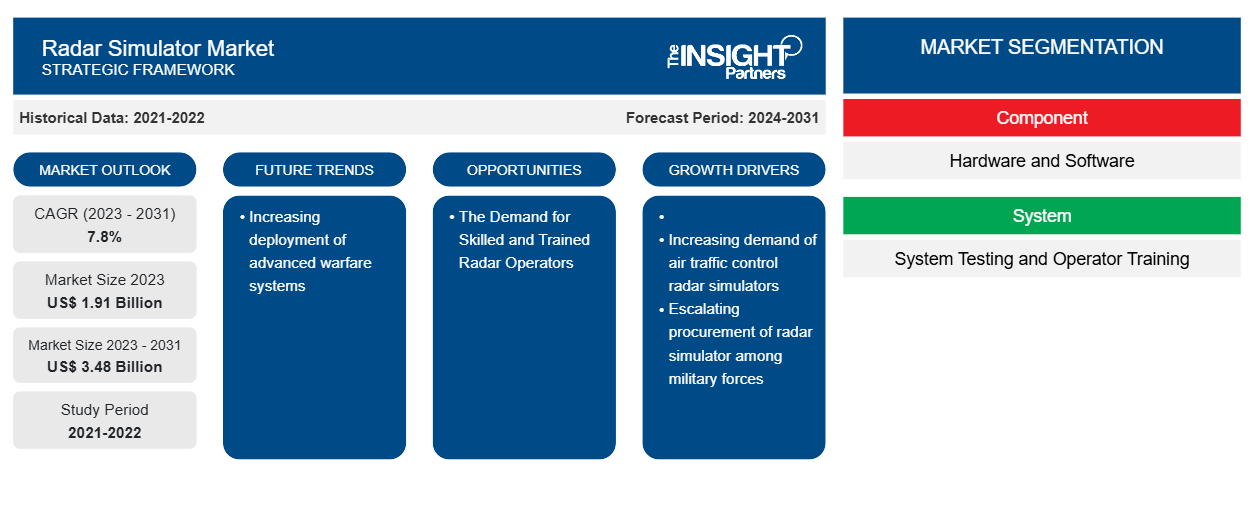
The global military and commercial aerospace sectors are undergoing rapid digital transformation, driven by the need for cost-effective, realistic, and risk-free training environments. Central to this transformation is the radar simulator market, which provides essential hardware and software systems designed to emulate complex electromagnetic environments for operator training, system testing, and operational research.
Get a PDF Sample- https://www.theinsightpartners.com/sample/TIPRE00005422
Key Drivers and Market Dynamics
Radar simulators play a critical role across maritime, airborne, land-based, and space domain applications. By replicating complex radar signatures, weather phenomena, electronic countermeasures (ECM), and multi-target scenarios, these systems allow defense forces and commercial operators to train personnel without incurring the massive operational costs and equipment wear associated with live exercises.
Several primary growth drivers are pushing the market forward:
Modernization of Defense Infrastructure: Navies, air forces, and army units worldwide are replacing legacy radar system trainers with software-defined, highly adaptable simulators capable of simulating next-generation active electronically scanned array (AESA) radars and stealth targets.
Expansion of Civil Air Traffic and Maritime Operations: Rising global passenger traffic and maritime trade necessitate highly trained air traffic controllers (ATC) and vessel traffic services (VTS) operators. Simulators provide a controlled medium to train operators for high-density transport corridors and emergency response.
Rise in Electronic Warfare (EW) Training Requirements: Modern battlefields are heavily contested in the electromagnetic spectrum. Advanced radar simulators now incorporate complex jamming, spoofing, and signal degradation modules to prepare operators for complex EW scenarios.
Market Forecast
According to a comprehensive industry report by The Insight Partners, the Radar Simulator Market size is projected to reach US$ 3.48 billion by 2031 from US$ 1.91 billion in 2023. The market is expected to register a CAGR of 7.8% during 2023–2031. This steady growth reflects heightened global defense budgets, expanding civil aviation networks, and continuous technological advancements in radio frequency (RF) simulation and synthetic environment generation.
Regional Insights: North America
North America holds a dominant position in the radar simulator market, largely driven by substantial defense spending and continuous investments in military modernization programs across the United States and Canada.
The region benefits from the highest defense expenditure globally, with the U.S. Department of Defense heavily funding synthetic training environments (STE) and next-generation flight and naval simulation programs.
Major aerospace and defense prime contractors headquartered in North America actively collaborate with specialized simulator developers to integrate real-time software-in-the-loop and hardware-in-the-loop systems into joint forces training.
Strong commercial aviation hubs and dense airspace networks across North America generate sustained demand for advanced air traffic control (ATC) radar simulators to train incoming air traffic controllers under complex urban and high-volume conditions.
Early adoption of cutting-edge technologies such as cloud-enabled simulation, artificial intelligence, and high-fidelity target modeling further solidifies North America as a primary hub for radar simulator research, deployment, and market revenue.
Key Market Players
The radar simulator market is characterized by a mix of major defense prime contractors, specialized simulation technology vendors, and component suppliers. Prominent organizations operating in this domain include:
Adacel Technologies Limited: A global leader in air traffic management and simulation software, providing high-fidelity ATC and radar training solutions.
ARI Simulation: A specialized provider of marine, offshore, and naval radar simulators designed for comprehensive navigation and vessel traffic management training.
Buffalo Computer Graphics: Renowned for delivering reliable hardware and software radar simulation products tailored for maritime safety, defense, and civilian instruction.
Cambridge Pixel Ltd.: An innovator in radar processing and display solutions, offering modular software tools and target generation engines for simulation integration.
L3Harris Technologies, Inc.: A global defense technology provider delivering scalable flight, naval, and space radar simulation capabilities for multi-domain command operations.
Mercury Systems Inc.: A pioneer in secure, open-architecture processing hardware and radio frequency (RF) synthesis tools essential for real-time radar simulation.
Micro Nav Limited: A focused developer of air traffic control and air defense radar simulators, catering to military airbases and civil airport training centers.
Collins Aerospace: A major aerospace systems developer providing advanced avionics, synthetic vision, and embedded radar training environments for military and commercial platforms.
Textron Systems Corporation: Provider of sophisticated electronic warfare and radar signal simulation systems used for threat emulation and platform testing.
Ultra Electronics Inc.: A specialist in naval, acoustic, and radar signal processing, delivering military-grade target generation and tactical environment simulators.
Get Full Copy of This Report- https://www.theinsightpartners.com/buy/TIPRE00005422
Future Outlook
The future of the radar simulator market is poised for transformative growth as artificial intelligence (AI), machine learning (ML), and cloud architecture become deeply embedded in simulation platforms. Emerging trends point toward autonomous target behavior modeling, where simulated entities adapt dynamically to student decisions, creating unpredictable and highly realistic training conditions. Furthermore, the convergence of multi-domain operations (MDO) will drive demand for interconnected radar simulators that can seamlessly bridge naval, land, airborne, and space surveillance networks into a unified synthetic battleground. As defense forces and civil authorities prioritize cost-efficient readiness and sustainable training alternatives, the global radar simulator market will remain an essential pillar of mission success through 2031 and beyond.
Related Reports–
Airport Surveillance Radar Market
Naval System Surveillance Radar Market
About Us
The Insight Partners is a one-stop industry research provider of actionable intelligence. We help our clients in getting solutions to their research requirements through our syndicated and consulting research services. We specialize in industries such as Semiconductor and Electronics, Aerospace and Defense, Automotive and Transportation, Biotechnology, Healthcare IT, Manufacturing and Construction, Medical Devices, Technology, Media, and Telecommunications, as well as chemicals and Materials.
Contact Us
If you have any queries about this report or if you would like further information, don’t hesitate to get in touch with us:
Contact Person: Ankit Mathur
E-mail: ankit.mathur@theinsightpartners.com
