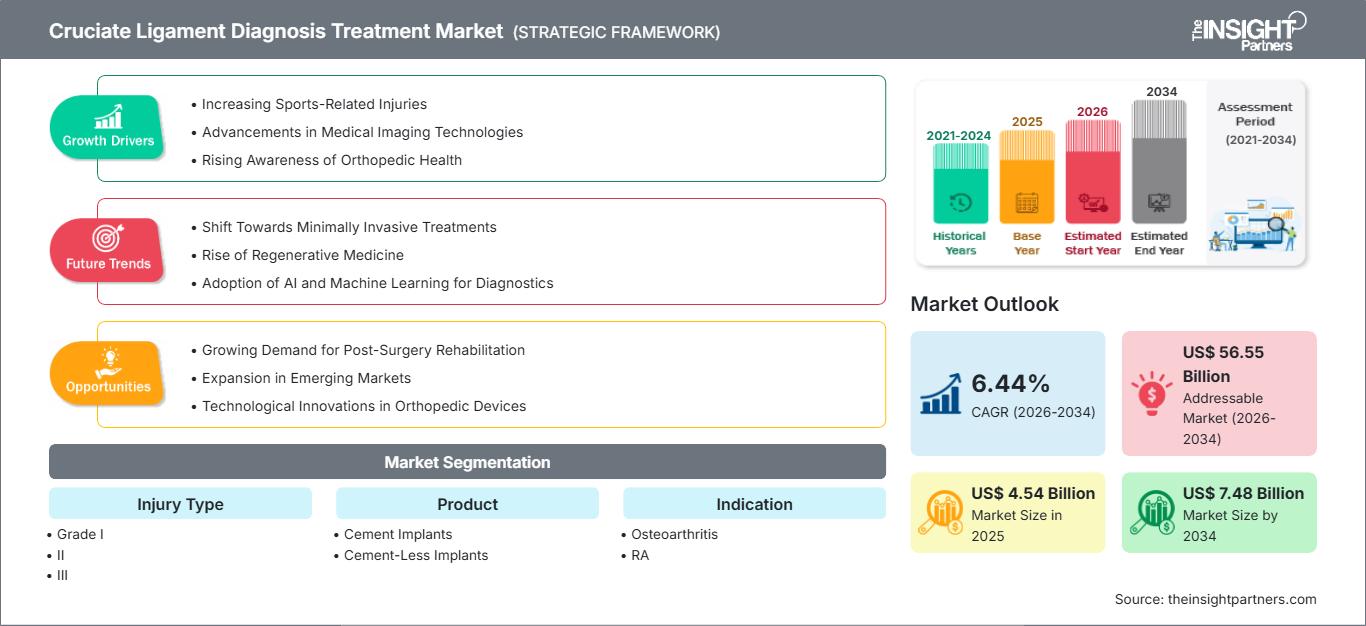
The Cruciate Ligament Diagnosis Treatment Market was valued at US$ 4.54 Billion in 2025 and is projected to reach US$ 7.48 Billion by 2034, registering a CAGR of 6.44% from 2026 to 2034. The market’s expansion reflects increasing demand for accurate diagnosis, effective surgical intervention, advanced fixation systems, and improved rehabilitation technologies.
The market is being influenced by technological progress across imaging systems, surgical instruments, implant designs, and rehabilitation devices. Healthcare facilities are increasingly incorporating magnetic resonance imaging, arthroscopy, advanced fixation systems, and customized treatment programs to improve the management of cruciate ligament injuries. At the same time, manufacturers are focusing on precision engineering and lightweight materials to support improved procedural performance.
Key Factors Driving Market Development
One of the major factors supporting market growth is the increasing incidence of anterior cruciate ligament injuries. Participation in professional and recreational sports has expanded the need for specialized orthopedic diagnosis and treatment. Activities involving jumping, sudden changes in direction, physical contact, and rapid movement can contribute to ligament injuries across different age groups. Greater awareness of early diagnosis is also encouraging patients and healthcare providers to seek timely evaluation and appropriate treatment.
Get Sample PDF – https://www.theinsightpartners.com/sample/TIPRE00040189
Technological advancement is another important growth factor. Improvements in imaging capabilities, implant materials, fixation technologies, surgical tools, and minimally invasive procedures are helping healthcare professionals manage complex ligament conditions with greater precision. These developments are encouraging hospitals and ASCs to invest in modern orthopedic infrastructure and treatment technologies.
The market is also benefiting from the growing healthcare needs of older populations. Aging can increase the prevalence of musculoskeletal conditions and mobility-related problems, creating demand for advanced orthopedic management. Alongside this, younger and physically active populations continue to contribute to injury-related treatment demand.
Product Innovation and Treatment Technologies
Product development remains a significant area of competition within the market. The product segment includes cement implants and cement-less implants. Cement-less implants accounted for the largest segment, representing a 42–46% market share in 2025, and are expected to grow at a CAGR of 6.5–7.2% through 2034. Their increasing adoption is associated with interest in biological fixation approaches and long-term implant integration.
Manufacturers are increasingly developing products based on durability, compatibility, fixation performance, procedural efficiency, and patient-specific requirements. Innovations in materials and engineering are helping healthcare professionals select treatment solutions according to injury severity and clinical needs.
The injury type segment covers Grade I, Grade II, and Grade III injuries. Grade I injuries generally involve less severe ligament damage and can be managed through conservative treatment and rehabilitation. Grade II injuries involve partial disruption and require structured evaluation and treatment planning. Grade III injuries involve complete ligament tears and frequently require surgical intervention, supporting demand for reconstruction procedures and advanced fixation technologies.
Hospitals and Ambulatory Surgical Centers
Hospitals remain important end users because they provide comprehensive diagnostic facilities, surgical capabilities, and multidisciplinary orthopedic services. Complex ligament procedures and patients requiring extensive care continue to support hospital-based demand.
At the same time, ASCs are becoming increasingly important in orthopedic treatment. The segment represented a 24–28% market share in 2025 and is projected to register a CAGR of 7.2–8.0% from 2026 to 2034. Growing adoption of outpatient orthopedic procedures, efficient treatment environments, and shorter recovery pathways is supporting the expansion of ASCs.
The shift toward ambulatory treatment also encourages healthcare providers and manufacturers to develop technologies that can support procedural efficiency while maintaining appropriate treatment outcomes.
Regional Market Trends
North America held a significant position in 2025, accounting for a 34–38% market share. The region is expected to register a CAGR of 6.1–6.8% from 2026 to 2034, supported by advanced healthcare infrastructure, established orthopedic services, sports medicine adoption, and the increasing use of minimally invasive cruciate ligament reconstruction.
The US represents a major contributor to the North American market, accounting for 75–80% of the region’s market share in 2025. High procedure volumes, established surgical infrastructure, and strong demand for sports-related injury treatment are supporting market development.
Europe accounted for 27–31% of the market in 2025 and is projected to grow at a CAGR of 5.8–6.5% between 2026 and 2034. Germany, the UK, France, Italy, and Spain are contributing to regional development through orthopedic innovation, healthcare investment, and increasing use of minimally invasive procedures.
Asia Pacific represented 22–26% of the market in 2025 and is anticipated to expand at the fastest regional CAGR of 7.0–7.8% during 2026–2034. China, Japan, South Korea, and India are key contributors, supported by healthcare investments, expanding orthopedic facilities, modernization of medical infrastructure, and growing awareness of ligament injury treatment.
Competitive Landscape and Top Players
The competitive environment includes established orthopedic and sports medicine companies developing implants, surgical technologies, rehabilitation solutions, and other products used in ligament diagnosis and treatment.
Top players include:
- Stryker Corporation
- Arthrex, Inc.
- Zimmer Biomet Holdings, Inc.
- DePuy Synthes, Inc.
- CONMED Corporation
- Smith & Nephew plc.
- DJO Global, Inc.
- Breg, Inc.
- Bauerfeind AG
- Össur hf.
- Enovis Corporation
These companies are strengthening their market positions through product innovation, portfolio development, strategic expansion, and investments in orthopedic technologies. The competitive landscape is also being shaped by increasing integration of digital healthcare technologies and growing demand for specialized sports medicine solutions.
Opportunities in Emerging Healthcare Markets
Developing healthcare markets represent an important opportunity for companies operating in this sector. Investments in hospitals, specialty centers, diagnostic infrastructure, and surgical capabilities are improving access to orthopedic care across emerging economies. Increasing availability of trained orthopedic professionals and modern medical equipment can further support adoption.
Get Full Copy of This Report @ https://www.theinsightpartners.com/buy/TIPRE00040189
Manufacturers can capitalize on these opportunities through regional expansion, local partnerships, improved distribution networks, training programs, and solutions designed to address evolving healthcare requirements. Affordability and accessibility are expected to remain important considerations as healthcare systems expand.
Future Outlook
The future of the Cruciate Ligament Diagnosis Treatment Market is expected to be shaped by digital technologies, personalized orthopedic care, minimally invasive procedures, and continued implant innovation. Artificial intelligence-assisted imaging analysis, digital rehabilitation platforms, and data-driven treatment approaches are gaining attention as healthcare providers seek faster diagnosis, improved surgical planning, and more personalized recovery strategies.
Personalized treatment is also expected to become increasingly important. Improvements in imaging, implant design, and clinical assessment can enable healthcare professionals to develop treatment and rehabilitation pathways based on individual patient characteristics. This shift is likely to encourage manufacturers to invest in flexible product portfolios and advanced engineering capabilities.
Expansion across developing healthcare markets will provide additional opportunities as orthopedic infrastructure improves and awareness of ligament injuries increases. Meanwhile, continued innovation in minimally invasive surgical instruments, implants, and digital support technologies can help address the growing focus on procedural efficiency and patient outcomes through 2034.
Related Reports @
Knee Pain Management Market Growth, Share & Trends by 2034
Orthopedic Implants Market Size, Trends & Demand by 2034
About Us –
The Insight Partners provides comprehensive syndicated and tailored market research services in the healthcare, technology, and industrial domains. Renowned for delivering strategic intelligence and practical insights, the firm empowers businesses to remain competitive in ever-evolving global markets.
Contact Us:
Contact Person: Ankit Mathur
E-mail: ankit.mathur@theinsightpartners.com
Phone: +1-646-491-9876
