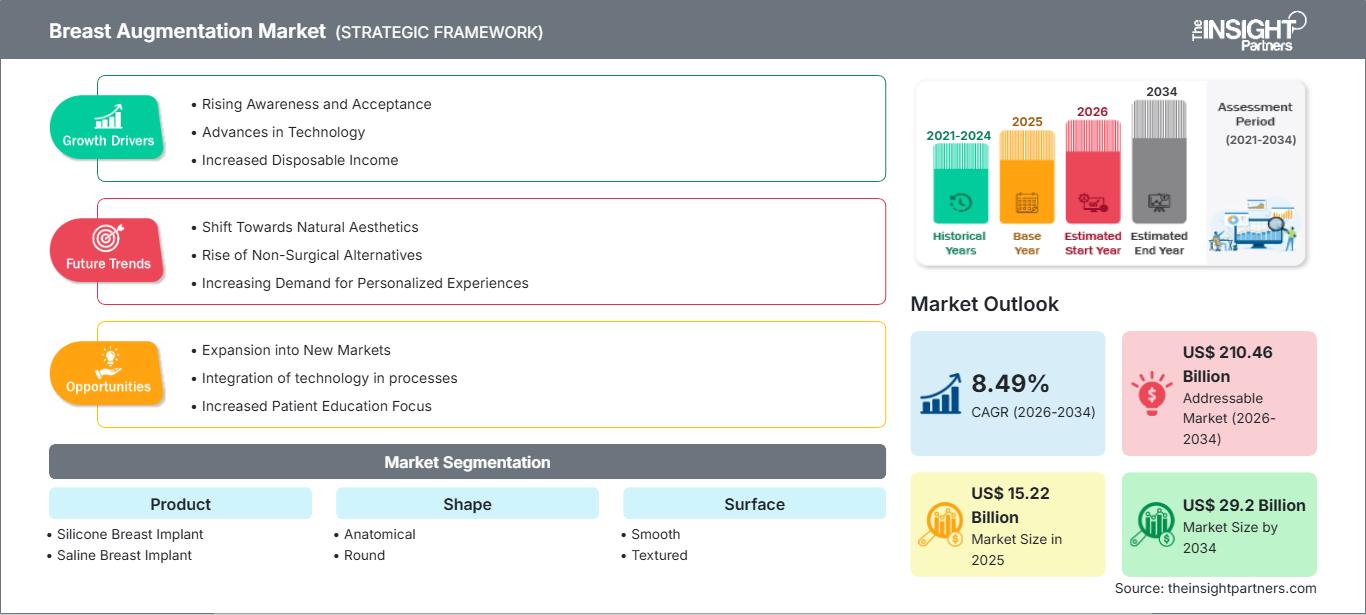
The Breast Augmentation Market is forecast to reach US$ 15.22 billion in 2025 and will further register an 8.49% CAGR during 2026-2034, to achieve US$ 29.2 billion in 2034.
The market is supported by the normalization of elective aesthetic procedures, advancements in implant technology, increasing demand for revision procedures, and breast reconstruction following mastectomy. The market report covers historical data from 2021 to 2024, uses 2025 as the base year, and provides forecasts through 2034. Increasing attention to safety communication, post-market surveillance, product traceability, and natural-feeling implants is also influencing purchasing and treatment decisions.
Rising Demand for Aesthetic and Reconstructive Procedures
A major factor supporting market development is the increasing acceptance of elective aesthetic procedures. Consumers are becoming more informed about available implant options, surgical approaches, recovery considerations, and expected outcomes. This is encouraging patients to engage more actively with surgeons when selecting implant size, shape, surface, and profile.
Get Sample PDF – https://www.theinsightpartners.com/sample/TIPRE00022685
Breast reconstruction following cancer surgery represents another important source of demand. Reconstruction connects implant utilization with established oncology treatment pathways rather than relying exclusively on discretionary cosmetic procedures. The availability of specialized surgeons, reconstruction programs, and advanced implant designs is therefore strengthening demand in developed healthcare markets.
Revision procedures are also contributing to the market. Patients who require implant replacement or additional corrective procedures create recurring demand for products and specialized surgical services. Manufacturers are consequently focusing on broader implant portfolios that can accommodate primary augmentation, revision procedures, and reconstruction.
Silicone Implants Maintain Market Leadership
Product segmentation includes silicone breast implants and saline breast implants. Silicone breast implants represent the largest product segment, holding 78–84% of the market share in 2025. The segment is expected to grow at a CAGR of 8.4–9.0% during 2026–2034.
The strong position of silicone implants is associated with their natural feel, broad availability, different profiles, and familiarity among surgeons. They are strategically important across both aesthetic augmentation and reconstruction procedures. Saline implants continue to serve specific patient and clinical requirements, particularly where adjustability, incision considerations, or pricing influence treatment decisions.
Growing Preference for Smooth-Surface Implants
Surface technology has become an increasingly important consideration in implant selection. Smooth implants held 58–64% of the market share in 2025 and are forecast to grow at a CAGR of 9.0–9.8% through 2034.
The growing preference for smooth surfaces reflects safety-driven purchasing behavior and increased scrutiny of textured implants in several mature markets. Patients and surgeons are placing greater emphasis on clinical evidence, regulatory confidence, transparent product information, and post-market monitoring.
Manufacturers are responding by developing differentiated silicone products, improving product documentation, strengthening safety communication, and investing in surgeon education. These factors are shifting competition toward evidence, product quality, traceability, and regulatory compliance rather than price alone.
Regional Market Growth
North America remains a major revenue-generating region, accounting for 38–42% of the market in 2025. The region is projected to expand at a CAGR of 7.8–8.4% between 2026 and 2034. Specialized plastic surgeons, established reconstruction programs, approved implant offerings, patient education, and implant registry participation support regional demand.
The US represented 82–86% of the North American market in 2025 and is expected to grow at a CAGR of 7.9–8.5% through 2034. Revision procedures, breast reconstruction, implant approvals, surgeon availability, and established healthcare infrastructure are among the factors supporting its market position.
Europe accounted for 24–28% of the market in 2025 and is expected to register a CAGR of 7.2–7.8% from 2026 to 2034. Germany, France, Italy, Spain, and the UK are important markets, supported by specialty clinics, established aesthetic medicine infrastructure, reconstruction services, and regulatory emphasis on traceability.
Asia Pacific is expected to demonstrate particularly strong growth. The region captured 22–26% of the market in 2025 and is projected to grow at a CAGR of 9.2–10.0% during 2026–2034. China, Japan, South Korea, India, and Australia are contributing to expansion through increasing medical aesthetics expenditure, specialist clinic development, surgeon training, and greater acceptance of aesthetic procedures.
Product Innovation and Personalized Treatment
The market is increasingly influenced by personalized implant selection. Patients differ in body frame, anatomy, desired contour, reconstruction history, and aesthetic objectives, creating demand for a broad range of implant profiles, sizes, and designs.
Round implants maintain broad demand because of their availability and predictable fullness, while anatomical implants remain relevant for selected contour-focused and reconstructive applications. Manufacturers are therefore expanding product portfolios to give surgeons greater flexibility in matching implants with individual patient requirements.
Digital consultation and imaging-based planning are also becoming increasingly relevant. These technologies can help patients visualize potential outcomes, support discussions regarding implant size and projection, and improve expectation management. Digital tools may also facilitate follow-up, implant documentation, and revision planning.
Competitive Landscape and Top Players
The competitive environment includes global and regional manufacturers with portfolios spanning silicone and saline implants, different shapes and surfaces, and products designed for aesthetic and reconstructive applications. Key companies analyzed in the market include:
- Mentor Worldwide LLC
- Allergan Aesthetics
- Sientra, a division of Tiger Aesthetics Medical LLC
- Ideal Implant Incorporated
- Laboratoires Arion
- CEREPLAS
- Sebbin SAS
- GC Aesthetics plc
- POLYTECH Health & Aesthetics GmbH
- Guangzhou Wanhe Plastic Materials Co., Ltd.
Competition is becoming increasingly technology-driven. Companies are focusing on implant design, surface characteristics, product portfolios, regulatory compliance, surgeon education, evidence generation, post-market support, and reliable distribution. Portfolio breadth is particularly important because healthcare professionals require different implant options for primary augmentation, revision surgery, and reconstruction.
Market Opportunities Across Emerging Regions
Asia Pacific presents a significant opportunity for manufacturers as private aesthetic clinics expand and medical aesthetics expenditure increases. China, South Korea, Japan, India, and Australia offer different growth opportunities based on healthcare infrastructure, regulatory requirements, surgeon availability, and consumer preferences.
Manufacturers can strengthen their presence through physician education, localized patient information, distributor partnerships, regulatory submissions, and reliable product availability. Premium silicone and smooth-surface products may benefit from increasing emphasis on natural feel, safety, and brand reputation.
Get Full Copy of This Report @ https://www.theinsightpartners.com/buy/TIPRE00022685
Reconstruction-focused hospital partnerships also provide an opportunity to diversify demand. Institutional relationships can connect implant manufacturers with oncology care pathways, hospitals, surgeons, and reconstruction programs, creating a more stable demand base alongside elective aesthetic procedures.
Future Outlook
The breast augmentation market is expected to move toward more personalized, digitally supported, and safety-focused treatment pathways through 2034. Digital consultation, imaging-based implant sizing, patient-specific planning, and structured decision-support tools are likely to become increasingly important as patients seek greater involvement in treatment decisions.
Regulatory confidence and product traceability will remain central to future competition. Manufacturers that provide strong clinical evidence, transparent labeling, post-market support, quality systems, and reliable warranties are positioned to benefit from growing expectations around implant safety and long-term monitoring.
Asia Pacific is expected to remain one of the strongest growth regions, while North America and Europe will continue to provide substantial opportunities through established aesthetic and reconstructive healthcare systems. At the product level, silicone and smooth-surface implants are expected to remain strategically important, supported by demand for natural-feeling products, personalized outcomes, and safety-driven purchasing decisions.
Related Reports @
Breast Cancer Therapeutics Market Developments and Forecast by 2030
Breast Implants Market Size, Demand & Growth by 2034
About Us –
The Insight Partners provides comprehensive syndicated and tailored market research services in the healthcare, technology, and industrial domains. Renowned for delivering strategic intelligence and practical insights, the firm empowers businesses to remain competitive in ever-evolving global markets.
Contact Us:
Contact Person: Ankit Mathur
E-mail: ankit.mathur@theinsightpartners.com
Phone: +1-646-491-9876
Also Available in : Korean German Japanese French Chinese Italian Spanish
