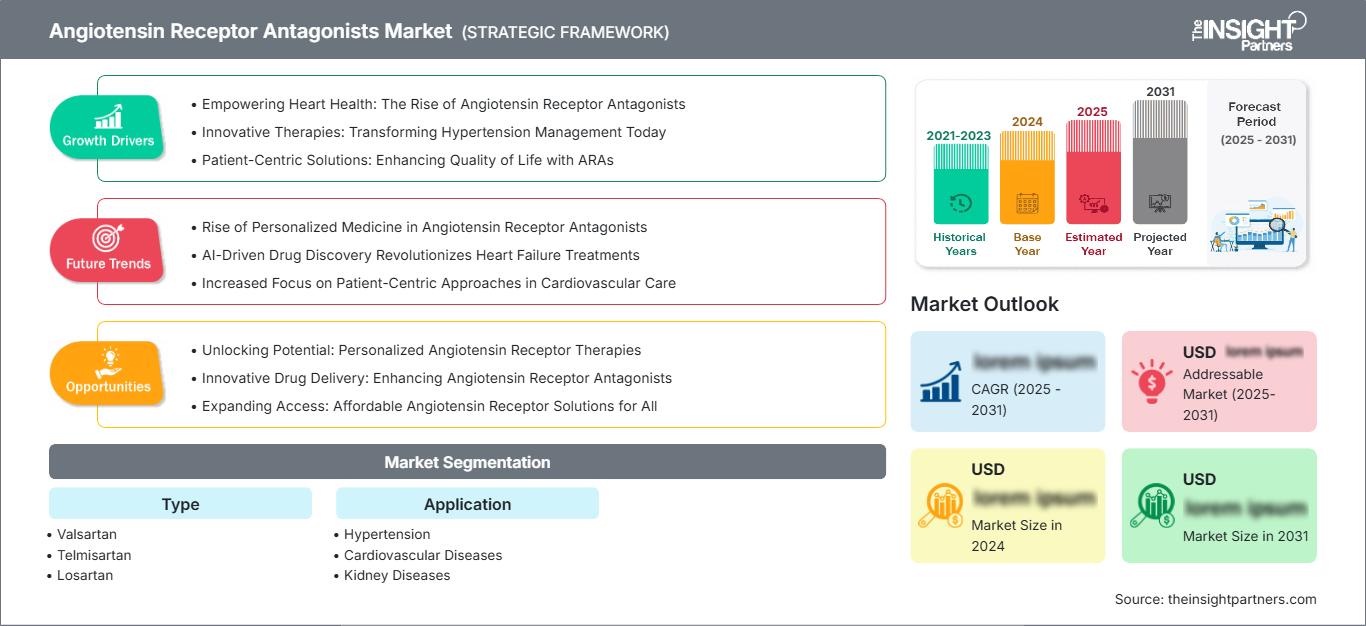
The Angiotensin Receptor Antagonists Market was valued at US$ 15,454.06 Million in 2025 and is expected to reach US$ 26,636.16 Million by 2034, registering a CAGR of 6.24% from 2026 to 2034. The market covers historical data from 2021 to 2024, uses 2025 as the base year, and provides forecasts for 2026–2034. Market expansion is being influenced by rising hypertension prevalence, the increasing cardiovascular disease burden, aging populations, and continued demand for therapies supporting blood pressure management and organ protection.
Rising Hypertension Burden Supports Market Expansion
Hypertension remains one of the principal factors driving demand for angiotensin receptor antagonists. Population aging, physical inactivity, dietary changes, and metabolic disorders are contributing to the increasing number of people requiring long-term blood pressure management. As diagnosis and treatment rates improve, healthcare providers are placing greater emphasis on sustained pharmacological management and prevention of complications.
Get Sample PDF – https://www.theinsightpartners.com/sample/TIPRE00021877
The continued use of receptor-targeted therapies across chronic cardiovascular care is creating a stable demand base for pharmaceutical manufacturers. Hospitals, specialty clinics, outpatient facilities, and pharmacies all contribute to medication utilization, while established treatment pathways support the continued use of well-known therapeutic molecules.
Growing awareness of the risks associated with uncontrolled blood pressure is another factor influencing treatment adoption. Healthcare systems are increasingly prioritizing preventive cardiovascular care and long-term disease management, creating opportunities for manufacturers with established antihypertensive portfolios.
Diverse Therapeutic Molecules Strengthen Treatment Options
The type segment includes valsartan, telmisartan, losartan, irbesartan, azilsartan, and olmesartan. Collectively, these molecules provide healthcare professionals with multiple treatment options for patients with different therapeutic requirements.
Valsartan remains an important therapeutic option because of its established clinical use, safety profile, and physician familiarity. Telmisartan is gaining attention because of its longer duration of action and therapeutic characteristics in chronic blood pressure management. Losartan maintains strong demand due to its early market introduction, broad availability, and cost accessibility.
Irbesartan contributes to treatment approaches involving hypertension and renal complications, while azilsartan represents a newer therapeutic option for blood pressure management. Olmesartan also maintains demand because of its established role in hypertension treatment. The availability of multiple molecules gives physicians flexibility when selecting therapies for individual patients and healthcare requirements.
Hypertension Remains the Leading Application
Hypertension represented the largest application segment, accounting for an estimated 55–60% market share in 2025. The segment is projected to grow at a CAGR of 6.0–6.6% through 2034. Continuous demand for long-term blood pressure management is expected to maintain its leading position.
Cardiovascular diseases represent another important application area as healthcare providers focus on managing cardiovascular risk factors and reducing the potential impact of uncontrolled blood pressure. Angiotensin receptor antagonists are incorporated into broader treatment strategies for eligible patients requiring blood pressure regulation.
Kidney disease is also becoming an increasingly important application. This segment accounted for approximately 15–20% of the market in 2025 and is projected to expand at a CAGR of 7.0–7.8%. The growing recognition of the relationship between hypertension and renal complications is encouraging healthcare providers to consider therapies that address blood pressure control alongside organ protection.
Hospitals and Pharmacies Support Medication Access
Hospitals remain an important end user because they play a central role in diagnosing and managing cardiovascular and kidney conditions. Hospital-based physicians prescribe these therapies as part of integrated chronic disease management programs, particularly for patients requiring ongoing monitoring.
Retail pharmacies also play a critical role by providing continued access to prescription medicines for long-term users. Expanding pharmacy networks and established pharmaceutical distribution systems can improve medication availability and support treatment continuity.
Specialty clinics contribute through focused management of cardiovascular and renal disorders. These facilities support medication monitoring, treatment adjustments, and patient-specific approaches, strengthening the role of specialized healthcare channels in the market. The end-user segment is projected to grow at a CAGR range of 6.1–6.7% during 2026–2034.
Regional Market Trends
North America represented an estimated 35–39% share of the market in 2025 and is projected to grow at a CAGR of 5.8–6.5% from 2026 to 2034. The region benefits from established cardiovascular treatment pathways, high diagnosis rates, pharmaceutical availability, and substantial healthcare spending. The US accounted for approximately 27–31% of the global market in 2025 and is expected to register a CAGR of 5.7–6.4% during the forecast period.
Europe held an estimated 25–29% market share in 2025 and is anticipated to expand at a CAGR of 5.5–6.2% through 2034. Germany, the UK, France, Italy, and Spain contribute to regional development through established healthcare systems, pharmaceutical infrastructure, and chronic disease management programs.
Asia Pacific accounted for approximately 24–28% of the market in 2025 and is expected to register the fastest regional growth, with a CAGR of 6.8–7.5% from 2026 to 2034. China, Japan, India, and South Korea are key contributors. Improving healthcare access, expanding medical infrastructure, rising disease awareness, and growing availability of chronic disease therapies are supporting regional demand.
Competitive Landscape and Top Players
The competitive environment includes multinational pharmaceutical companies with established cardiovascular medicine portfolios and global distribution capabilities. Companies are focusing on portfolio expansion, formulation improvements, manufacturing efficiency, lifecycle management, geographic expansion, and strategic partnerships.
Top players include:
- Pfizer
- Novartis
- Merck KGaA
- AstraZeneca
- Johnson & Johnson
- Eli Lilly and Company
- Sanofi
- Bristol Myers Squibb Company
- Bayer AG
- GSK
Generic competition is also influencing the market by improving affordability and availability across several geographic regions. Pharmaceutical manufacturers are strengthening their positions through manufacturing optimization, portfolio diversification, research collaborations, and expanded distribution networks. Patent transitions and increasing demand for cost-effective hypertension management are also shaping competitive strategies.
Opportunities in Emerging Healthcare Markets
Emerging economies present significant opportunities as healthcare infrastructure expands and access to prescription medicines improves. Asia Pacific, Latin America, and parts of the Middle East are strengthening healthcare coverage and increasing investment in medical facilities. These developments can improve diagnosis rates for hypertension and related cardiovascular and renal disorders.
Manufacturers can benefit from developing efficient supply networks, strengthening local partnerships, and improving access to cost-effective therapies. Patient education initiatives and broader healthcare coverage can also reduce treatment barriers. Countries investing in pharmaceutical manufacturing and healthcare modernization may become increasingly important markets during the forecast period.
Patient-centric treatment solutions represent another opportunity. Convenient formulations, combination products, lifecycle management strategies, and digital health services can support medication adherence and improve the management of chronic conditions. Companies investing in formulation innovation and healthcare partnerships may be better positioned to respond to changing treatment expectations.
Get Full Copy of This Report @ https://www.theinsightpartners.com/buy/TIPRE00021877
Future Outlook
The future of the angiotensin receptor antagonists market is expected to be shaped by healthcare modernization, digital disease management, combination therapy, and expansion into developing markets. Digital health technologies, remote monitoring platforms, connected devices, and other technology-enabled services can help healthcare professionals monitor blood pressure and support treatment adherence.
Combination therapy is expected to remain an important area of development as healthcare providers seek approaches that can improve blood pressure control while simplifying medication regimens when clinically appropriate. Pharmaceutical companies are likely to focus on formulation improvements, clinical evidence, lifecycle management, and diversified cardiovascular portfolios.
Expansion across emerging markets will remain another important growth opportunity through 2034. Improving healthcare access, rising awareness of hypertension complications, government initiatives, pharmaceutical distribution development, and increasing investment in chronic disease management can support continued adoption. As healthcare systems increasingly prioritize preventive cardiovascular care and patient-centric treatment, established receptor-targeted therapies are positioned to remain an important component of long-term hypertension and related disease management.
Related Reports @
Angiotensin II Receptor Blockers Market Size, Share & Trends by 2034
Angiotensin Converting Enzyme (ACE) Inhibitors Market Size, Trends & Growth by 2034
About Us –
The Insight Partners provides comprehensive syndicated and tailored market research services in the healthcare, technology, and industrial domains. Renowned for delivering strategic intelligence and practical insights, the firm empowers businesses to remain competitive in ever-evolving global markets.
Contact Us:
Contact Person: Ankit Mathur
E-mail: ankit.mathur@theinsightpartners.com
Phone: +1-646-491-9876
Also Available in : Korean German Japanese French Chinese Italian Spanish
