Optical sorting equipment uses cameras, lasers, near-infrared technologies, hyperspectral imaging, and combined sensing systems to identify and separate materials according to characteristics such as color, shape, size, composition, and quality. These systems help improve sorting accuracy, reduce manual intervention, minimize material waste, and enhance productivity across food processing, mining, metallurgy, pharmaceuticals, and waste management operations.
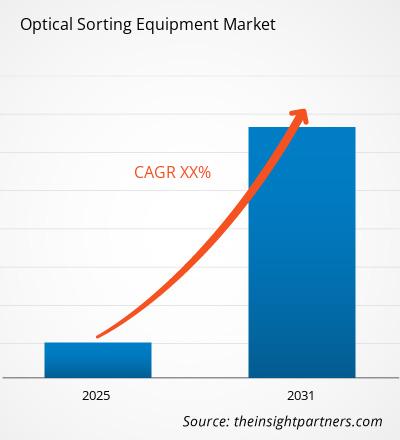
According to The Insight Partners, the Optical Sorting Equipment Market was valued at US$ 2.81 Billion in 2025 and is projected to reach US$ 6.37 Billion by 2034, registering a CAGR of 9.52% during 2026–2034. Increasing automation, demand for high-quality products, sustainability initiatives, recycling requirements, and the adoption of AI-enabled sorting technologies are expected to support industry growth.
Key Market Insights
- Market Size in 2025: US$ 2.81 Billion
- Projected Market Size by 2034: US$ 6.37 Billion
- CAGR (2026–2034): 9.52%
- Total Addressable Market (2026–2034): Approximately US$ 40.96 Billion
- Key Platforms: Belt, Freefall, Lane, Hybrid
- Key Technologies: Cameras, Lasers, NIR Sorters, Hyperspectral, Cameras and Combined Sorters
- Key End Users: Food Processing, Mining and Metallurgy, Pharmaceutical Industry, Waste Management
- Forecast Period: 2026–2034
Get a Sample PDF of the Report: https://www.theinsightpartners.com/sample/TIPRE00018564
Market Growth Drivers
The increasing adoption of automation across industrial processing facilities is a major factor supporting demand for optical sorting equipment. Automated sorting systems can process large volumes of material with greater consistency and speed than manual inspection. This allows companies to improve operational efficiency while maintaining quality standards and reducing labor-intensive processes.
The growing focus on food quality and safety is also supporting adoption. Food processors increasingly require technologies capable of identifying foreign materials, defective products, and variations in color, size, or quality. Camera-based and advanced optical systems can help improve product consistency and reduce contamination risks during processing.
Waste management and recycling represent another important growth opportunity. Governments and industries are increasingly emphasizing recycling, resource recovery, and waste reduction. Optical sorting systems can identify and separate different materials based on their physical and optical properties, helping recycling facilities improve recovery rates and operational efficiency.
Mining and metallurgy operations are also adopting advanced sorting technologies to improve material separation. Optical systems can assist in identifying differences between materials and supporting more efficient processing, potentially reducing unnecessary processing and improving resource utilization.
Technology Trends
Artificial intelligence and machine learning are increasingly influencing optical sorting systems. AI-enabled algorithms can analyze large amounts of image and sensor data to identify complex material characteristics and improve sorting decisions. These capabilities can increase accuracy when materials have similar colors, shapes, or surface characteristics.
Near-infrared and hyperspectral technologies are expanding the ability of sorting equipment to identify materials beyond visible characteristics. These technologies can provide information about chemical composition and material properties, supporting applications where conventional camera-based systems may have limitations.
Combined sorting technologies are also gaining importance. Integrating cameras, lasers, NIR sensors, and other detection technologies allows equipment manufacturers to address multiple sorting criteria within a single processing system. This can improve flexibility for facilities handling diverse materials.
Equipment manufacturers are also focusing on higher throughput, improved energy efficiency, easier maintenance, and integration with automated production lines. Digital monitoring and connected equipment can provide operators with greater visibility into sorting performance and operational conditions.
Get the Premium Research Report @ https://www.theinsightpartners.com/buy/TIPRE00018564
Regional Outlook
North America represents an important regional opportunity due to the growing adoption of automation, recycling infrastructure, food processing technologies, and advanced industrial equipment. The US is a key contributor, supported by investments in waste management, food quality, mining technologies, and automated processing systems.
Europe is supported by sustainability initiatives, recycling requirements, food quality standards, and industrial automation. Growing emphasis on resource recovery and efficient material utilization is encouraging companies to adopt advanced optical sorting technologies across waste management, food processing, and industrial applications.
Asia Pacific represents a significant growth opportunity due to rapid industrialization, expanding food processing activities, increasing mining operations, and growing investments in recycling infrastructure. Countries including China, Japan, India, and other economies are adopting automated processing and sorting technologies to improve productivity and product quality.
South and Central America are benefiting from developments in food processing, mining, agriculture-related processing, and resource recovery. The growing need to improve processing efficiency and product quality is creating opportunities for advanced sorting equipment.
The Middle East and Africa region is also witnessing opportunities through investments in mining, food processing, waste management, and industrial modernization. Increasing attention to resource efficiency and automated processing is expected to support technology adoption.
Market Segmentation
By platform, the market is segmented into Belt, Freefall, Lane, and Hybrid. Belt-based systems are suitable for continuous processing and controlled material movement, while freefall systems are useful for applications where materials pass through a sorting zone at high speed. Lane and hybrid platforms provide additional flexibility for specialized processing requirements.
By type, the market includes Cameras, Lasers, NIR Sorters, Hyperspectral, and Cameras and Combined Sorters. Camera-based systems can identify visible characteristics such as color, shape, and size, while laser and NIR technologies enable detection based on additional physical and material properties.
By end user, the market covers Food Processing, Mining and Metallurgy, Pharmaceutical Industry, and Waste Management. Food processing applications benefit from improved quality inspection and product separation, while mining and metallurgy applications focus on material identification and efficient resource processing.
Waste management is increasingly important as recycling and resource recovery initiatives expand. Optical sorting can help facilities separate recyclable materials and improve the efficiency of automated waste processing operations.
Competitive Landscape
Competition is increasingly focused on sorting accuracy, throughput, sensor integration, AI capabilities, energy efficiency, equipment reliability, and software-based monitoring. Leading companies are developing integrated systems that combine optical technologies with advanced analytics and automated processing capabilities.
Key companies analyzed in the report include:
- TOMRA
- Binder+Co AG
- Bühler Group
- Cimbria
- Greefa
- Key Technology
- National Recovery Technologies
- Satake Corporation
- The Allgaier Group
Future Outlook
The Optical Sorting Equipment Market is expected to maintain strong growth through 2034 as industries increase investments in automation, recycling, resource efficiency, and quality control. The combination of AI, machine learning, hyperspectral imaging, NIR sensing, advanced cameras, laser detection, and integrated sorting platforms is expected to expand the capabilities of automated material separation.
Future opportunities are likely to emerge from smart recycling facilities, automated food processing, sustainable resource recovery, mining optimization, and pharmaceutical quality control. Companies that provide accurate, scalable, energy-efficient, and intelligent sorting solutions are likely to strengthen their competitive position as industries increasingly transition toward automated and data-driven processing.
Related Market Research Reports
Digital Thread Market Growth, Demand & Size by 2034
Electrical Protective Equipment Market Top Players by 2031
Display Technology Market Share, Growth & Forecast by 2034
Next Generation Data Storage Market Insights | Size, Share by 2030
About The Partners
The Insight Partners is a Insight global leader in market research, delivering comprehensive analysis and actionable insights across diverse industries. The company empowers decision-makers with data-driven intelligence to navigate evolving markets and accelerate growth.
Contact Us:
- Contact Person: Ankit Mathur
- E-mail: ankit.mathur@theinsightpartners.com
- Phone: +1-646-491-9876
Also Available in :
