Artificial intelligence technologies, including machine learning, computer vision, natural language processing, and predictive modeling, are fundamentally altering traditional safety operations. By analyzing massive streams of multi-source data from surveillance cameras, biometric sensors, social feeds, and digital records, AI solutions provide real-time situational awareness and actionable intelligence, enabling proactive incident management and faster emergency responses.
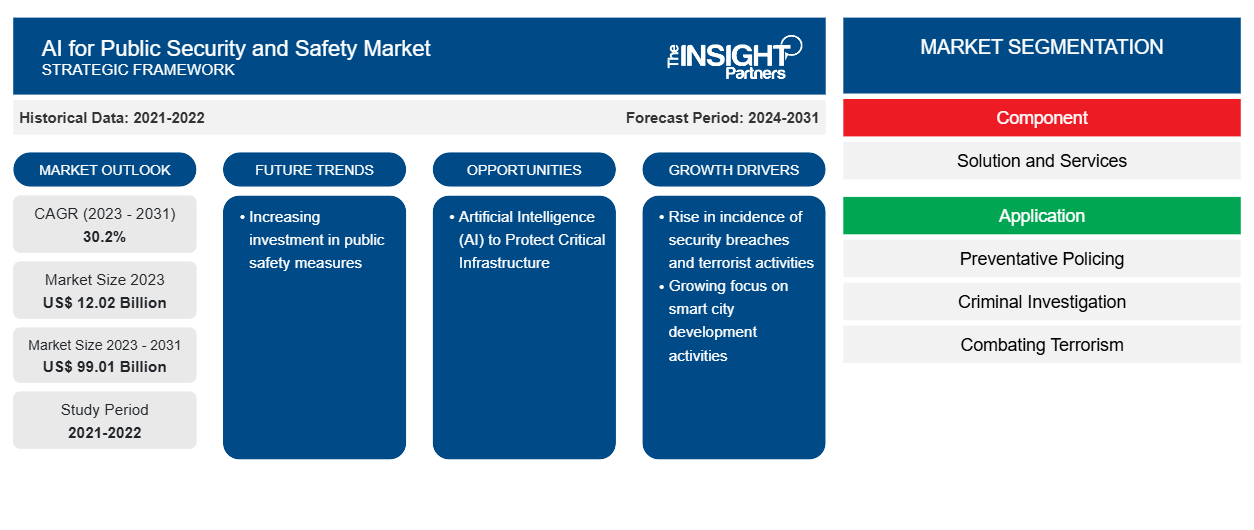
The AI for Public Security and Safety market is projected to grow from US$ 12.02 billion in 2023 to US$ 99.01 billion by 2031; it is expected to expand at a CAGR of 30.2% from 2023 to 2031.
Key Drivers Fueling Market Growth
- Rise in Security Breaches and Global Terrorist Threats: The growing complexity of physical security breaches, cyber threats, and transnational criminal activities mandates advanced technological countermeasures. AI algorithms empower security personnel to identify anomalous behaviors, detect potential hazards early, and automate threat mitigation.
- Rapid Expansion of Smart City Projects: Municipal governments across the world are investing heavily in digital infrastructure. Integrating AI capabilities into urban surveillance frameworks, traffic management networks, and public transit systems drastically improves civic security and operational efficiency.
- Need for Faster Criminal Investigation and Data Processing: Law enforcement agencies deal with overwhelming volumes of unstructured digital evidence. AI tools accelerate investigations by automatically correlating patterns, cross-referencing records, and extracting criminal insights far quicker than manual analysis allows.
- Government Investments in National Defense and Intelligence: Federal intelligence agencies continue to allocate substantial budgets toward AI-driven threat intelligence, border monitoring, and strategic defense assets.
Download Sample Report@ https://www.theinsightpartners.com/sample/TIPRE00027023
Strategic Opportunities in the Market
- Protection of Critical Infrastructure: Power grids, transportation hubs, water treatment facilities, and communication networks face heightened risks from physical and cyber attacks. AI-enabled physical security systems optimize perimeter defense by reducing false alarms caused by hardware glitches or environmental factors, ensuring security teams focus on genuine threats.
- Drone Technology and Autonomous Surveillance Integration: Integrating self-evolving AI algorithms into uncrewed aerial vehicles (UAVs) offers vast growth potential. Drones equipped with real-time video analytics provide crucial aerial intelligence during search and rescue missions, disaster recovery, and crowd control.
- Predictive Policing and Advanced Analytics: Predictive modeling enables public safety departments to forecast high-risk areas and deploy patrolling personnel efficiently, preventing incidents before they escalate.
Market Segmentation Analysis
The AI for public security and safety market is structured across three main segments:
- By Component
- Solutions: Software tools, predictive analytics suites, computer vision systems, facial recognition engines, and biometric platforms held the dominant market share in 2023 and are expected to retain leadership through 2031.
- Services: Professional services, system integration, consulting, deployment, and managed maintenance services are growing steadily as agencies require tailored implementations.
- By Application
- Preventative Policing: Utilizing historical data and machine learning to optimize resource allocation and crime prevention strategies.
- Criminal Investigation: Streamlining forensic analysis, evidence digital processing, and pattern recognition.
- Combating Terrorism: Analyzing cross-border intelligence feeds, digital communications, and threat feeds in real time.
- Emergency Response and Disaster Management: Enhancing first-responder dispatch workflows, situational awareness during natural disasters, and casualty risk management.
- Others: Border control, traffic monitoring, and cyber defense systems.
- By End User
- Law Enforcement Agencies: State, local, and municipal police departments deploying surveillance, body-worn camera analytics, and dispatch solutions.
- Federal Intelligence and Security: Defense departments, homeland security, counter-terrorism divisions, and national intelligence organizations.
- Others: Public transit operators, critical infrastructure managers, and municipal emergency services.
Regional Insights
- North America: Held a significant revenue share in 2023, driven by early technology adoption, extensive smart city investments, robust defense budgets, and the presence of top industry technology providers in the United States and Canada.
- Asia Pacific: Projected to register the highest CAGR between 2024 and 2031. Growth in this region is propelled by expanding urban infrastructure, rising regional security initiatives, and supportive government policies across countries such as China, India, and Japan.
- Europe, Latin America, and Middle East & Africa: Experiencing sustained growth as governments modernize law enforcement capabilities and protect national assets against evolving threats.
Market News and Recent Developments
- ideaForge and Skylark Labs Strategic Partnership: In May 2024, drone technology provider ideaForge Technology partnered with U.S.-based AI software provider Skylark Labs to integrate proprietary self-evolving AI models directly into uncrewed aerial platforms, significantly enhancing real-time public safety analytics and autonomous threat detection capabilities.
- Expansion of Video Analytics and Cloud Deployments: Leading safety solution vendors continue to launch edge-computing AI platforms that process video streams at the camera level, lowering latency and bandwidth requirements for smart municipal networks.
Market Analysis and Competitive Landscape
The competitive landscape of the AI for public security and safety market is characterized by intense competition, continuous product innovation, strategic mergers, acquisitions, and technology partnerships. Market leaders focus on delivering interoperable, cloud-native, and edge-AI solutions that seamlessly integrate with legacy security infrastructure.
Key Market Players
- Hexagon AB
- Motorola Solutions, Inc.
- Honeywell International Inc.
- Hitachi, Ltd.
- IBM Corporation
- Palantir Technologies Inc.
- Veritone, Inc.
- NEC Corporation
- Atos SE
- Voyager Labs Ltd.
- Quanergy Solutions, Inc.
- Genetec Inc.
- BAE Systems
- Elbit Systems Ltd.
- Axis Communications
Get Full Copy of This Report @ https://www.theinsightpartners.com/buy/TIPRE00027023
Future Outlook
The AI for public security and safety market is positioned for remarkable growth leading up to 2031. As technological breakthroughs in computer vision, generative AI, edge computing, and autonomous aerial platforms mature, public safety organizations will transition from reactive security models to fully proactive, data-informed frameworks. Addressing key considerations around data privacy, ethical AI deployment, and regulatory compliance will remain essential for market participants looking to maximize adoption and build public trust in AI-driven public safety infrastructure.
About The Insight Partners
The Insight Partners provides comprehensive syndicated and tailored market research services in the healthcare, technology, and industrial domains. Renowned for delivering strategic intelligence and practical insights, the firm empowers businesses to remain competitive in ever-evolving global markets.
Contact Information
- Email: sales@theinsightpartners.com
- Website: theinsightpartners.com
- Phone: +1-646-491-9876
