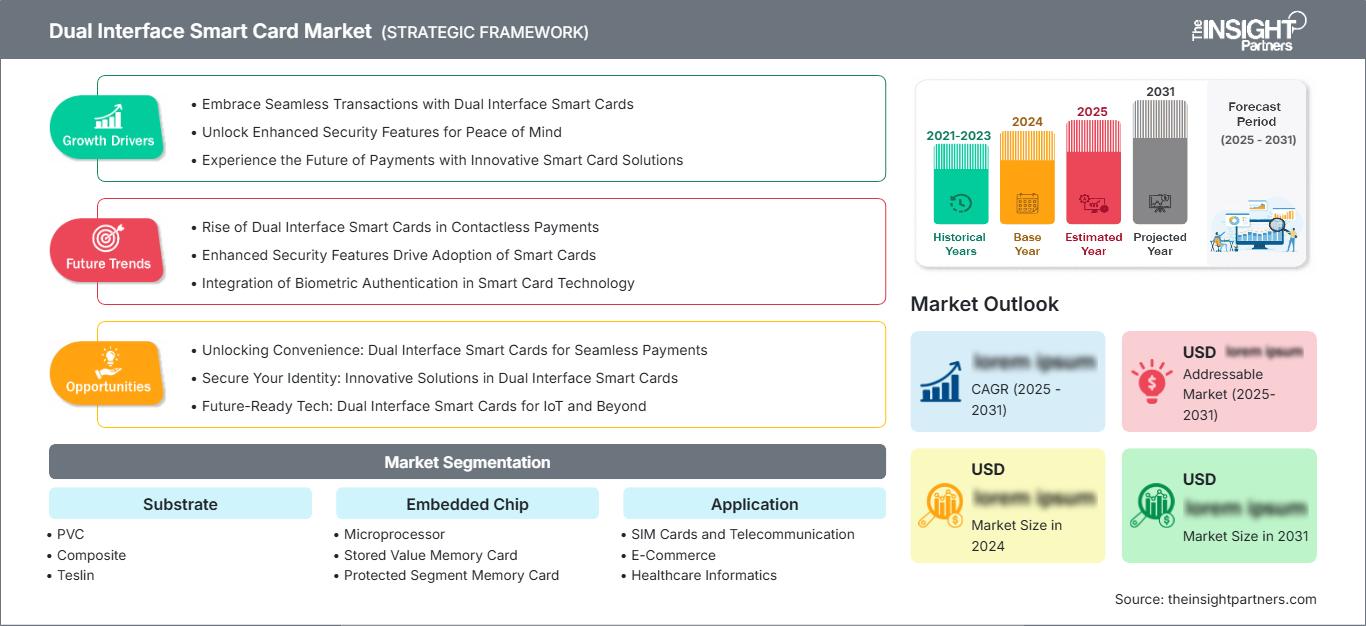
The global dual interface smart card market is undergoing rapid expansion, driven by the shift toward seamless, secure, and contact-free transactional ecosystems. Dual interface smart cards incorporate both contact and contactless interfaces within a single embedded chip, allowing consumers to insert or tap the card at point-of-sale terminals, transit gates, and access points.
The Dual Interface Smart Card Market size is expected to reach US$ 28.46 Billion by 2034 from US$ 11.53 Billion in 2025. The market is estimated to record a CAGR of 10.56% from 2026 to 2034.
Key Market Drivers
- Accelerated Shift Toward Contactless Payments: Consumer preference for quick, friction-free payment experiences is fueling the deployment of dual interface cards. Retailers and financial institutions are upgrading payment terminals to support NFC technology, making dual interface cards essential for maintaining multi-channel payment interoperability.
- Government Mandates and EMV Compliance: Regulatory authorities across Europe, Asia-Pacific, and the Americas continue to enforce EMV compliance standards. Governments are mandating secure chip technology for banking and identity, driving mass issuance of dual interface cards for national IDs, driver licenses, and social security programs.
- Multi-Application Integration: Modern dual interface cards can support multiple applications on a single microchip. A single card can store banking credentials, transit pass data, and corporate physical access rights, reducing administrative costs and boosting cardholder convenience.
- Enhanced Security Features: Rising concern over electronic fraud and identity theft is prompting organizations to adopt advanced smart card architectures. Dual interface cards utilize high-strength cryptographic encryption, tokenization, and dynamic data generation to protect credentials during both contact and contactless interactions.
Download Sample Report@ https://www.theinsightpartners.com/sample/TIPRE00015047
Strategic Market Opportunities
- Biometric Smart Card Integration: Combining fingerprint authentication sensors with dual interface smart cards offers a massive market growth opportunity. Biometric dual interface cards eliminate the need for PIN entry during high-value contactless transactions, significantly boosting security while preserving transaction speed.
- Expansion in Healthcare and Patient ID: Electronic health record modernization is opening massive opportunities. Healthcare providers are deploying dual interface cards to authenticate medical staff, verify patient identities, prevent insurance fraud, and maintain secure offline health data access.
- Mobility-as-a-Service (MaaS) and Transit Networks: Urban public transit systems are transitioning from closed loop ticketing to open-loop dual interface payment systems. This transition enables commuters to pay for bus, rail, toll, and ride-sharing services using standard bank-issued dual interface cards.
- Emerging Economies and Financial Inclusion: Unbanked and underbanked populations in regions across Africa, Latin America, and Southeast Asia present substantial untapped market potential as regional governments and financial institutions roll out digital banking and dual interface identity programs.
Market Segmentation Analysis
The dual interface smart card market is segmented across several core categories:
By Type
- Plastic Dual Interface Cards: Standard Polyvinyl Chloride (PVC) and Polycarbonate (PC) cards dominate overall issuance volume due to cost-effective manufacturing and high durability.
- Metal Dual Interface Cards: Premium metal cards are experiencing rapid adoption within the luxury banking and high-net-worth individual market segments due to high structural quality and status appeal.
By Component
- Microcontrollers: The core processing units that execute cryptographic algorithms and manage secure data transmission across both contact and contactless channels.
- Memory Cards: High-capacity storage chips used primarily for static data retention in access control and identity systems.
By Application / End-Use
- Banking, Financial Services, and Insurance (BFSI): Represents the largest market share, driven by credit, debit, and prepaid card issuance programs.
- Government and Healthcare: Fast-growing segment focused on national electronic identity cards (eIDs), e-passports, health insurance, and voting credentials.
- Transportation and Logistics: High-volume segment utilizing cards for transit ticketing, tolling, and fleet management.
- Retail and Corporate Access Control: Enterprise deployments for physical building access, logical network login, and customer loyalty programs.
Market News and Recent Developments
- Next-Generation Biometric Card Rollouts: Leading card issuers have partnered with semiconductor manufacturers to pilot battery-free biometric dual interface cards that harvest RF energy directly from point-of-sale readers.
- Sustainability and Eco-Friendly Materials: Major market players are launching dual interface cards manufactured from recycled ocean plastics, polylactic acid (PLA), and wood composites to meet corporate sustainability goals.
- Advanced Cryptography Standards: Security providers are updating smart card operating systems to support post-quantum cryptographic algorithms, future-proofing government eID programs against emerging security threats.
Competitive Landscape and Top Players
The global dual interface smart card market features a competitive landscape dominated by established security technology firms, semiconductor developers, and specialized card manufacturers. Companies compete on technology innovation, security certification levels, supply chain resilience, and custom OS capabilities.
Key Market Players
- Thales Group: A global leader in augmented identity, smart card manufacturing, and secure digital platforms.
- IDEMIA: Prominent manufacturer providing biometric and dual interface payment and identity cards globally.
- Giesecke+Devrient (G+D): Renowned provider of payment card issuance, eSIM management, and secure smart card architectures.
- Infineon Technologies AG: Leading semiconductor producer delivering microcontrollers optimized for dual interface transaction speeds.
- NXP Semiconductors N.V.: Major supplier of high-performance contactless and dual interface secure IC solutions.
- HID Global: Key innovator in physical access control, corporate credentials, and secure identity issuance.
- CPI Card Group: Leading provider of financial payment card solutions and metal card manufacturing.
- Watchdata Technologies: Major provider of digital security products and smart card solutions across Asia and global markets.
Get Full Copy of This Report @ https://www.theinsightpartners.com/buy/TIPRE00015047
Future Outlook
Looking ahead toward 2034, the dual interface smart card industry is poised for sustained innovation. The convergence of biometric authentication, energy-harvesting microchips, and eco-friendly substrates will transform standard plastic cards into highly sophisticated digital tools. As open-loop transit systems and digital national identity initiatives expand worldwide, dual interface smart cards will maintain their role as a fundamental bridge between physical credentials and secure digital payment ecosystems.
About The Insight Partners
The Insight Partners provides comprehensive syndicated and tailored market research services in the healthcare, technology, and industrial domains. Renowned for delivering strategic intelligence and practical insights, the firm empowers businesses to remain competitive in ever-evolving global markets.
Contact Information
- Email: sales@theinsightpartners.com
- Website: theinsightpartners.com
- Phone: +1-646-491-9876
