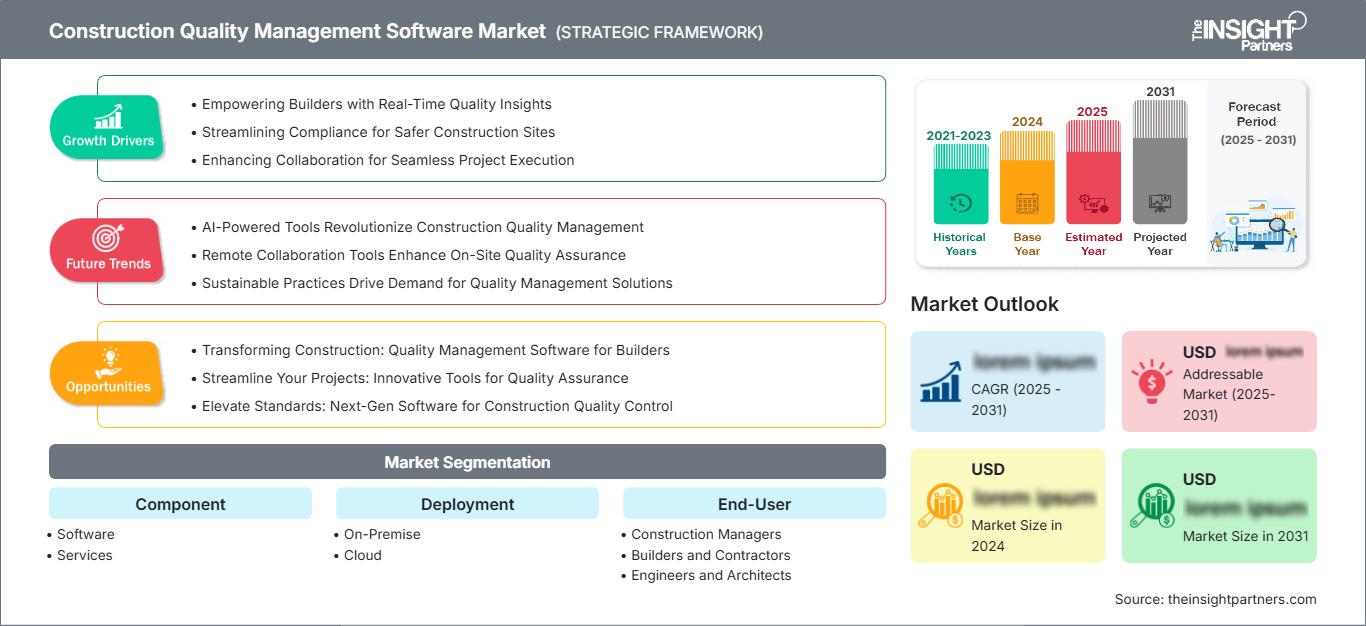
The global construction quality management software market is experiencing robust expansion as the commercial and civil infrastructure sectors accelerate digital transformation initiatives. Construction quality management software empowers project managers, site engineers, quality control inspectors, and general contractors to digitize field workflows, streamline inspection protocols, enforce compliance standards, and resolve punch lists in real time.
The Construction Quality Management Software Market size is expected to reach US$ 2.77 Billion by 2034 from US$ 1.35 Billion in 2025. The market is estimated to record a CAGR of 8.34% from 2026 to 2034.
Key Drivers
Several critical industry factors are driving sustained demand in the construction quality management software market:
- Urgent Need to Minimize Rework and Overhead Costs: Unplanned construction rework accounts for a substantial proportion of overall project expenditure. Quality management platforms enable immediate defect identification, automated non-conformance reporting, and faster resolution, preventing localized field mistakes from turning into expensive delays.
- Tightening Regulatory Mandates and Building Codes: Regional regulatory authorities and municipal planning boards are enforcing stricter safety and quality compliance standards. Digital software offers verifiable audit trails, automated inspection logs, and standardized quality documentation required for formal regulatory handovers.
- Widespread Adoption of Cloud Computing and Mobile Devices: Modern cloud platforms allow field teams to access up-to-date blueprints, submit inspection reports, and track quality checklists directly from tablets and smartphones. Seamless synchronization between office executives and field personnel ensures rapid risk mitigation.
- Integration with Building Information Modeling (BIM): Linking quality management software with 3D BIM frameworks enables field personnel to verify actual site construction directly against architectural design models, driving higher accuracy in structural execution.
Download Sample Report@ https://www.theinsightpartners.com/sample/TIPRE00028887
Strategic Market Opportunities
The evolving technological landscape presents several prominent expansion opportunities for software vendors and industry stakeholders through 2034:
- Artificial Intelligence and Computer Vision Integration: The deployment of AI algorithms and computer vision offers vast potential. High-resolution imagery captured by site cameras, field tablets, and autonomous drones can be automatically analyzed by AI algorithms to detect workmanship anomalies, structural misalignments, and material defects before final sign-offs.
- Expansion into High-Growth Emerging Economies: Developing countries across Asia-Pacific, Latin America, and the Middle East are executing ambitious civil infrastructure programs, smart city builds, and industrial expansions. Capturing these rapidly digitizing regional markets represents a high-value opportunity for software providers.
- Connected Jobsite Ecosystems and IoT Telemetry: Integrating Internet of Things (IoT) hardware, such as concrete curing sensors, environmental monitors, and wearable safety trackers, with quality software platforms enables continuous automated monitoring and predictive quality alerts.
Market Segmentation Analysis
The global construction quality management software market is categorized based on deployment model, component, enterprise size, and end-user vertical:
- By Deployment Type: Cloud-based solutions command the highest market share due to lower upfront capital requirements, scalable subscription pricing, flexible updates, and instant field-to-office connectivity. On-premises deployments retain a smaller market share among defense or specialized government projects requiring local data sovereignty.
- By Component: The market is divided into Software Platforms (comprising modules for Quality Planning, Inspection Management, Punch List Tracking, and Non-Conformance Management) and Professional Services (including system implementation, integration, training, and customer support).
- By Enterprise Size: Large construction enterprises maintain dominant adoption rates owing to multi-site megaprojects requiring enterprise-grade standardization. However, small and medium-sized enterprises (SMEs) represent the fastest-growing customer segment, incentivized by accessible Software-as-a-Service (SaaS) models.
- By End-User Industry: Key user segments encompass Commercial Building, Residential Construction, Industrial Infrastructure, and Civil Infrastructure (such as transportation networks, bridges, utilities, and energy facilities).
Recent Market News and Industry Developments
The global market environment is characterized by active technology investments, continuous platform enhancements, and strategic partner ecosystem expansions:
- Enhanced Offline Mobile Functionality: Solution providers are prioritizing offline sync technology, allowing field inspectors operating in remote areas, subterranean sites, or poor connectivity zones to capture data seamlessly and synchronize once connected.
- Accelerated M&A Activity and Suite Consolidation: Major enterprise software brands are selectively acquiring specialized quality control startups to expand their native product capabilities across pre-construction, quality execution, and post-build facility management.
- Open API Frameworks and Platform Interoperability: Software developers are building comprehensive app marketplaces and open API protocols. This enables friction-free data exchange between quality platforms, financial systems, project scheduling software, and enterprise resource planning (ERP) systems.
Competitive Landscape and Top Market Players
The competitive landscape of the construction quality management software market features a mix of global construction technology leaders and dedicated vertical software providers. Market contenders compete on functional depth, mobile usability, predictive analytics features, and enterprise-grade security standards.
Top key players in the global market include:
- Procore Technologies, Inc.
- Autodesk, Inc. (Autodesk Build / PlanGrid)
- Trimble Inc.
- Bentley Systems, Incorporated
- Oracle Corporation (Oracle Aconex / Primavera)
- Fieldwire (Hilti Group)
- Viewpoint, Inc. (A Trimble Company)
- SafetyCulture (iAuditor)
- Buildup
- Qualer Inc.
These leading companies are consistently expanding their software ecosystems through deep software integrations, field-centric usability updates, and advanced machine learning models designed to transform raw job site imagery into actionable quality intelligence.
Get Full Copy of This Report @ https://www.theinsightpartners.com/buy/TIPRE00028887
Future Outlook
Looking ahead to 2034, the construction quality management software market is set for sustained dynamic evolution. As global construction demands scale and digitized job sites become the industry baseline, quality management solutions will shift from reactive inspection tracking tools to fully predictive quality control ecosystems. The convergence of automated field sensing, computer vision analytics, and cloud-native project management platforms will establish new standards for structural reliability, regulatory compliance, and cost efficiency across global construction projects.
About The Insight Partners
The Insight Partners provides comprehensive syndicated and tailored market research services in the healthcare, technology, and industrial domains. Renowned for delivering strategic intelligence and practical insights, the firm empowers businesses to remain competitive in ever-evolving global markets.
Contact Information
- Email: sales@theinsightpartners.com
- Website: theinsightpartners.com
- Phone: +1-646-491-9876
