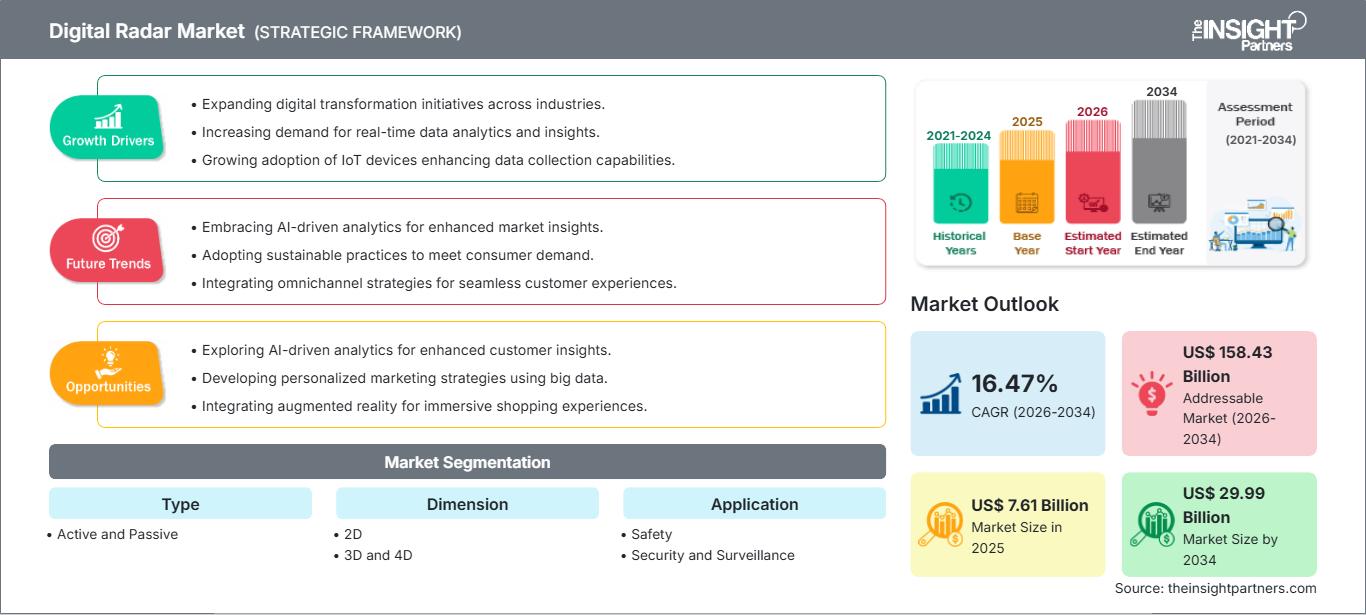
Digital sensing and advanced signal-processing technologies are rapidly transforming how defense, aerospace, automotive, maritime, and industrial systems detect, track, and interpret objects. The shift toward intelligent, high-resolution sensing is creating new opportunities for radar manufacturers as users seek faster response, improved situational awareness, greater accuracy, and flexible system architectures. Increasing investments in electronic warfare, autonomous platforms, air defense, and advanced driver-assistance technologies are further strengthening demand for next-generation radar solutions.
The Digital Radar Market is gaining momentum as radar architectures increasingly combine digital beamforming, artificial intelligence, software-defined processing, advanced semiconductor technologies, and high-speed data conversion. According to recent industry research, the sector is expected to maintain a strong growth trajectory through the next decade, supported by expanding adoption across defense and aerospace, automotive, marine, surveillance, and industrial applications.
Get a Sample PDF: https://www.theinsightpartners.com/sample/TIPRE00039815
Digital Radar Market Size, Share, Trends, Analysis, and Forecast to 2031
The Digital Radar Market is transitioning from conventional radar hardware toward highly programmable and software-intensive sensing platforms. Industry assessments indicate strong double-digit growth momentum, with advanced radar increasingly becoming a core component of connected and autonomous systems.
- Market Size: The global Digital Radar Market is expanding rapidly as defense modernization, automotive sensing, aerospace upgrades, and industrial automation increase demand for digitally enabled radar systems.
- Market Share: Defense and aerospace remain among the most influential application areas, while automotive and autonomous mobility are gaining an increasing share of demand.
- Key Trend: Integration of artificial intelligence, digital beamforming, advanced semiconductor devices, and software-defined architectures is reshaping radar system development.
- Technology Analysis: Active electronically scanned array systems, 3D and 4D sensing, high-resolution imaging, and multifunction radar architectures are becoming increasingly important.
- Application Analysis: Radar adoption is broadening across air surveillance, missile defense, autonomous vehicles, maritime monitoring, border security, weather observation, and industrial sensing.
- Regional Analysis: North America maintains a strong position because of defense modernization and advanced aerospace capabilities, while Asia Pacific is emerging as a major growth center due to expanding defense investments and technology development.
- 2031 Forecast: The Digital Radar Market is expected to witness sustained expansion through 2031, supported by demand for multifunction sensing, autonomous platforms, electronic warfare capabilities, and real-time data processing.
AI and Software-Defined Architectures Accelerate Adoption
One of the most important trends influencing the Digital Radar Market is the growing use of artificial intelligence and software-defined technologies. Modern radar platforms can process large volumes of information in real time, allowing systems to identify targets, classify objects, optimize beam patterns, and respond to changing operational conditions.
Software-defined radar architectures are particularly valuable because they can support upgrades through software rather than requiring complete hardware replacement. This capability can reduce lifecycle costs while allowing operators to introduce new operational modes and algorithms as requirements evolve.
AI-enabled radar processing is also becoming increasingly relevant in environments where traditional sensing methods face challenges. Machine learning can support target recognition, clutter suppression, anomaly detection, and predictive analysis, helping operators make faster decisions from complex radar data.
Defense Modernization Remains a Major Growth Engine
Defense modernization continues to be a central demand driver. Governments and defense organizations are investing in advanced surveillance, integrated air defense, fighter aircraft upgrades, unmanned systems, missile warning, and electronic warfare capabilities.
Recent industry developments demonstrate the continued importance of advanced radar modernization. Northrop Grumman recently reported delivery of its 1,000th Scalable Agile Beam Radar, or SABR, supporting upgrades for F-16 aircraft operated by multiple countries. The program highlights the continuing demand for electronically scanned radar technology and the long-term role of radar modernization in extending the operational capabilities of existing military platforms.
At the same time, radar development is moving toward higher levels of integration. Modern systems increasingly combine sensing, tracking, imaging, and electronic warfare functions within flexible architectures. This creates opportunities for manufacturers capable of delivering compact, high-performance, multifunction radar platforms.
Automotive and Autonomous Mobility Create New Opportunities
The automotive sector represents another important opportunity for the Digital Radar Market. Advanced driver-assistance systems increasingly rely on radar for object detection, distance measurement, collision avoidance, adaptive cruise control, and blind-spot monitoring.
Radar offers advantages in challenging environmental conditions, including darkness, rain, and fog. As vehicle manufacturers move toward higher levels of automation, the ability to combine radar data with cameras, LiDAR, and other sensors is becoming increasingly important.
The development of high-resolution 4D radar is particularly significant. These systems can provide information relating to range, angle, velocity, and elevation, allowing vehicles to create a more detailed understanding of their surroundings. The trend is expected to support further adoption in premium vehicles, autonomous platforms, and next-generation mobility systems.
Regional Analysis
North America continues to represent a major technology and investment center. Strong defense spending, aerospace modernization programs, advanced automotive development, and the presence of leading radar technology companies support regional demand. The region is also benefiting from research into AI-enabled sensing and next-generation electronically scanned radar systems.
Europe is focusing on defense readiness, air surveillance, maritime security, automotive safety, and advanced sensing technologies. Increased attention to autonomous platforms and integrated defense capabilities is expected to create additional opportunities for radar suppliers.
Asia Pacific is emerging as one of the most dynamic regions. Rising defense expenditure, aerospace development, naval modernization, automotive production, and domestic radar development are supporting regional expansion. Industry research identifies Asia Pacific as a particularly attractive growth region for digital radar technologies.
Middle East & Africa are also expected to create opportunities through investments in border surveillance, air defense, critical infrastructure protection, and maritime security. Latin America is expected to experience gradual adoption as governments and industries modernize surveillance and transportation infrastructure.
Key Players in the Digital Radar Market
Leading companies and technology providers are strengthening their positions through product development, strategic partnerships, defense programs, radar upgrades, and advanced sensing research.
- ✓ Saab AB
- ✓ Israel Aerospace Industries Ltd.
- ✓ Leonardo S.p.A.
- ✓ BAE Systems plc
- ✓ Thales Group
- ✓ RTX Corporation
- ✓ L3Harris Technologies, Inc.
- ✓ Lockheed Martin Corporation
- ✓ NXP Semiconductors N.V.
- ✓ Magna International Inc.
- ✓ Teledyne FLIR LLC
- ✓ Indra Sistemas, S.A.
- ✓ Northrop Grumman Corporation
Industry competition is increasingly centered on detection performance, system flexibility, size, weight, power efficiency, software capabilities, signal-processing performance, and integration with broader sensor networks.
Get the Premium Research Report @ https://www.theinsightpartners.com/buy/TIPRE00039815
Future Outlook
The future of the Digital Radar Market is closely linked to the broader transition toward intelligent, connected, and autonomous systems. Radar technology is expected to become increasingly software-driven, AI-enabled, multifunctional, and integrated with other sensing platforms. Continued defense modernization, autonomous vehicle development, smart infrastructure, maritime surveillance, and industrial automation will provide multiple avenues for expansion through 2031. As radar systems become capable of delivering richer information with greater flexibility, manufacturers that combine advanced hardware, semiconductor innovation, software intelligence, and scalable architectures are likely to gain a competitive advantage.
Related Reports –
Home Energy Management System Market Regional Share, Trend, and Growth Opportunity
Vision Transformers Market Regional Share, Trend, and Growth Opportunity
Differential-Pressure Mass Flow Controller Market Regional Share, Trend, and Growth Opportunity
About The Insight Partners
The Insight Partners is a leading market research and consulting firm delivering actionable insights through in-depth industry analysis and strategic intelligence. The firm supports clients across various industries in making informed business decisions by providing comprehensive market forecasts, competitive assessments, and growth opportunities.
Contact Us:
If you have any queries about this report or if you would like further information, please contact us:
Contact Person: Ankit Mathur
E-mail: sales@theinsightpartners.com
Phone: +1-646-491-9876
