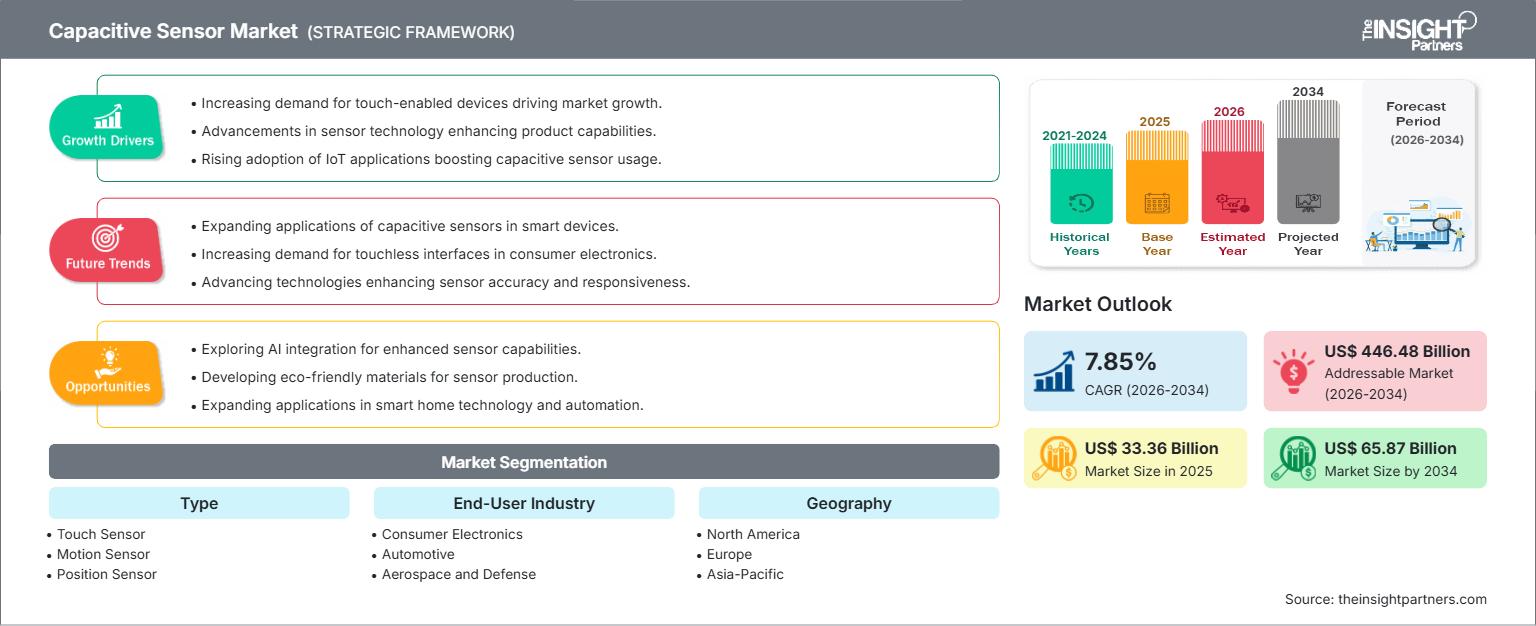
Growing demand for intuitive interfaces, automation, connected devices, and intelligent electronics is reshaping the global sensor industry. Manufacturers across consumer electronics, automotive, healthcare, industrial automation, aerospace and defense, and food and beverage applications are increasingly adopting sensing technologies that provide accurate detection while supporting compact and energy-efficient designs.
The Capacitive Sensors Market is expected to register a CAGR of 4.8% from 2025 to 2031, according to The Insight Partners. The technology is gaining importance as manufacturers seek reliable solutions for touch, motion, position, proximity, and gesture detection. Its ability to detect changes in electrical capacitance without requiring mechanical contact makes it particularly attractive for modern electronic interfaces and connected systems.
Get a Sample PDF: https://www.theinsightpartners.com/sample/TIPRE00008263
Capacitive Sensors Market Size, Share, Trends, Analysis, and Forecast by 2031
• Market size: The global industry is projected to expand steadily through 2031, supported by rising deployment across consumer electronics, automotive systems, industrial equipment, healthcare devices, and connected products
• Market share: Consumer electronics remains an important demand center because smartphones, wearables, tablets, interactive displays, and smart home products increasingly depend on responsive touch and proximity technologies
• Market trends: Integration with IoT devices, touchless interfaces, flexible sensing technologies, gesture recognition, miniaturization, and low-power electronics are emerging as significant technology trends
• Market analysis: Touch sensors represent a major application area, while motion and position sensing are gaining relevance across automotive, industrial, healthcare, and smart-device applications
• Market forecast: Industry demand is expected to maintain a positive trajectory through 2031 as manufacturers combine capacitive sensing with connected electronics, intelligent controls, and advanced human-machine interfaces
The growth of touch-based consumer electronics remains one of the strongest factors supporting adoption. Modern devices increasingly require interfaces that are responsive, durable, compact, and capable of supporting multi-touch interactions. Capacitive technology addresses these requirements while enabling manufacturers to develop increasingly seamless user experiences.
Automotive applications are also creating new opportunities. Vehicle manufacturers are incorporating touch-sensitive controls, proximity detection, gesture interfaces, and advanced human-machine interaction technologies into increasingly digital vehicle interiors. Capacitive sensing can support controls and interfaces without the mechanical wear associated with conventional switches, making the technology relevant to next-generation vehicle architectures. The Insight Partners identifies growing automotive adoption as a key trend through 2031.
Industry Trends Strengthening Demand
The transition toward connected products is expanding the role of sensors beyond traditional touchscreens. IoT-enabled appliances, wearable devices, smart home equipment, healthcare technologies, and industrial systems increasingly require sensors capable of detecting human interaction and environmental changes.
Another important trend is the development of flexible and non-glass sensing solutions. Flexible sensor designs can support curved surfaces, lightweight electronics, wearable products, and new industrial interfaces. Research published in 2026 also demonstrates the expanding role of flexible capacitive sensing in robotics, including touch activation and near-field hand tracking, highlighting opportunities beyond conventional consumer electronics.
Artificial intelligence and advanced signal processing are further influencing sensor development. Intelligent algorithms can help improve recognition accuracy, compensate for environmental variations, and support more sophisticated gesture and touch detection. As connected devices become more context-aware, sensor systems are increasingly expected to deliver not only detection but also meaningful interaction data.
Global and Regional Analysis
North America is positioned as an important technology and innovation center, supported by advanced electronics development, industrial automation, healthcare technology, automotive innovation, and strong adoption of connected devices. Demand for sophisticated human-machine interfaces and smart industrial equipment is expected to create additional opportunities through 2031.
Europe continues to benefit from developments in automotive electronics, industrial automation, healthcare equipment, aerospace and defense technologies, and smart manufacturing. The region’s emphasis on advanced engineering and energy-efficient electronic systems supports the integration of compact sensing technologies across multiple applications.
Asia Pacific represents a major growth engine because of its extensive consumer electronics manufacturing ecosystem and expanding automotive and industrial sectors. China, Japan, South Korea, and India are important contributors to regional demand. Increasing production of smartphones, wearables, connected appliances, electric vehicles, and industrial electronics is expected to strengthen adoption during the forecast period.
South and Central America is expected to experience gradual expansion as manufacturers and end users increase investments in automation, connected equipment, consumer electronics, and modern healthcare technologies. Growing digitalization can create new opportunities for sensor suppliers across both established and emerging applications.
Key Players in the Capacitive Sensors Market
According to The Insight Partners, prominent companies operating in this space include:
• ✓ Cypress Semiconductor Corporation
• ✓ Infineon Technologies AG
• ✓ Microchip Technology Inc.
• ✓ Micro-Epsilon
• ✓ NXP Semiconductors
• ✓ OMRON Corporation
• ✓ Renesas Electronics Corporation
• ✓ STMicroelectronics
• ✓ Synaptics Incorporated
• ✓ Texas Instruments Inc.
Competition is increasingly centered on sensing accuracy, miniaturization, power efficiency, integration capabilities, application-specific solutions, and the ability to support emerging interface requirements. Companies are also focusing on technologies that can operate reliably across challenging industrial and automotive environments.
Recent Industry Developments
Recent research activity demonstrates how capacitive sensing is expanding into emerging applications. In June 2026, researchers reported a highly flexible conductive fiber capable of functioning as both a touch and near-field capacitive sensor for robotic applications. The work demonstrated applications including robot-arm activation and hand-following, indicating the potential for flexible sensing architectures in soft robotics and human-machine interaction.
Other recent research has explored soft and deformable capacitive sensors for robotics, including structures capable of converting mechanical deformation into measurable capacitance changes. Such developments point toward a broader evolution from conventional rigid sensors toward flexible, embedded, and application-specific sensing systems.
Challenges and Opportunities
Despite strong opportunities, manufacturers face challenges related to electromagnetic interference, environmental sensitivity, calibration, material selection, manufacturing complexity, and the need for consistent performance across different operating conditions. These factors become especially important in automotive, industrial, healthcare, and aerospace applications where reliability is critical.
At the same time, the expansion of wearables, smart vehicles, industrial robotics, connected healthcare devices, and IoT ecosystems creates significant opportunities. Flexible materials, improved signal processing, embedded sensing, and intelligent calibration could broaden the range of applications while improving user experience.
Get the Premium Research Report @ https://www.theinsightpartners.com/buy/TIPRE00008263
Future Outlook
The future of the capacitive sensors industry is closely connected to the broader shift toward intelligent, connected, and human-centered electronics. Through 2031, demand is expected to benefit from the continued digitization of vehicle interiors, expansion of IoT ecosystems, growth of wearable devices, industrial automation, smart healthcare equipment, and emerging robotics applications. The Insight Partners forecasts continued growth through 2031, with touch, motion, and position sensing remaining important technology areas.
As sensor manufacturers continue improving flexibility, sensitivity, integration, and energy efficiency, capacitive sensing is likely to move further beyond traditional touch interfaces. Its growing role in robotics, connected devices, automotive systems, and intelligent industrial equipment could make it an increasingly important component of next-generation electronic architectures.
Related Reports –
Home Energy Management System Market Regional Share, Trend, and Growth Opportunity
Vision Transformers Market Regional Share, Trend, and Growth Opportunity
Differential-Pressure Mass Flow Controller Market Regional Share, Trend, and Growth Opportunity
About The Insight Partners
The Insight Partners is a leading market research and consulting firm delivering actionable insights through in-depth industry analysis and strategic intelligence. The firm supports clients across various industries in making informed business decisions by providing comprehensive market forecasts, competitive assessments, and growth opportunities.
Contact Us:
If you have any queries about this report or if you would like further information, please contact us:
Contact Person: Ankit Mathur
E-mail: sales@theinsightpartners.com
Phone: +1-646-491-9876
Also Available in :
Korean | German | Japanese | French | Chinese | Italian | Spanish
