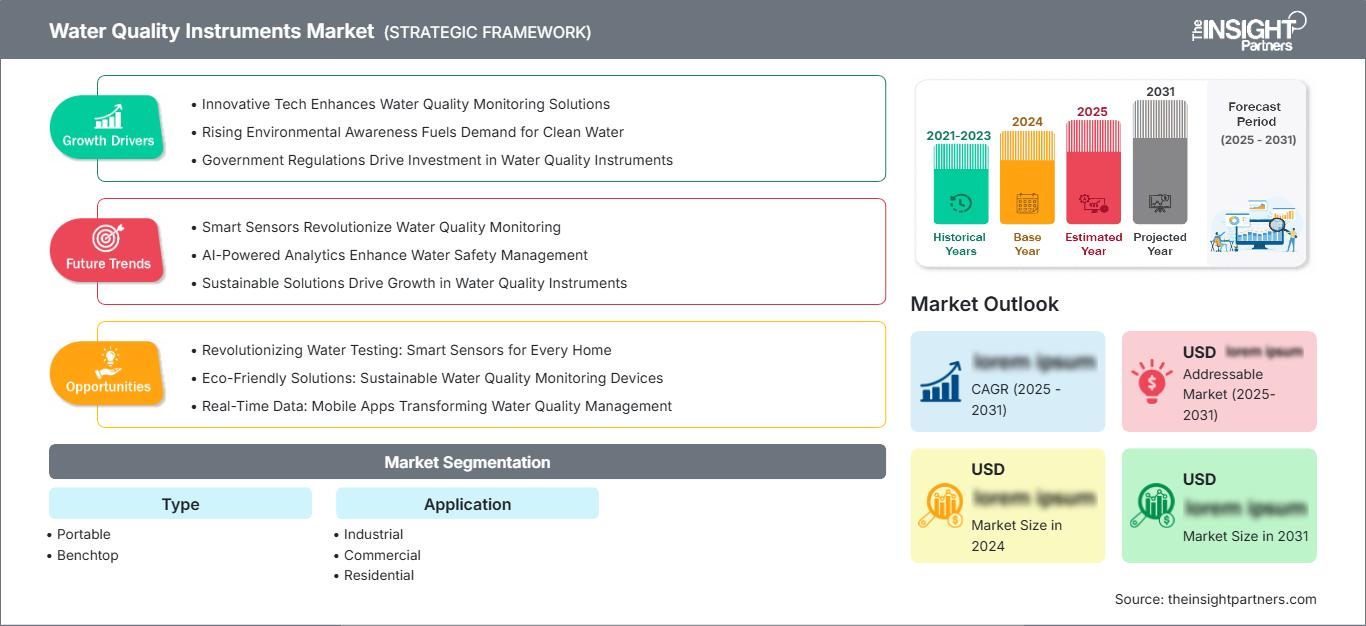
Water safety is becoming a strategic priority for governments, utilities, industries, and communities as pollution, urbanization, industrial discharge, and climate-related water stress increase the need for reliable monitoring. Advances in connected sensors, portable testing devices, automation, and data analytics are transforming how water conditions are measured and managed across drinking water, wastewater, industrial, commercial, and residential applications.
The Water Quality Instruments Market is gaining momentum as organizations seek faster, more accurate, and continuous visibility into critical parameters such as pH, dissolved oxygen, conductivity, turbidity, temperature, and contaminants. According to The Insight Partners research, the study covers portable and benchtop instruments across industrial, commercial, and residential applications, with analysis extending through 2031.
Get a Sample PDF: https://www.theinsightpartners.com/sample/TIPRE00022493
Water Quality Instruments Market Size, Share, Trends, and Forecast to 2031
The Water Quality Instruments Market is expected to maintain a positive growth trajectory through 2031, supported by stricter water-quality requirements, expanding wastewater treatment infrastructure, industrial process monitoring, and rising awareness of safe drinking water. The competitive environment is also evolving as manufacturers focus on sensor accuracy, connectivity, portability, automation, and easier data interpretation.
Key market insights and forecast through 2031:
- Market Size: Expansion is expected through 2031 as municipalities, industries, laboratories, and environmental agencies increase investments in water monitoring infrastructure
- Market Share: Established instrumentation providers are expected to retain significant shares while technology-focused companies gain opportunities through connected and specialized monitoring solutions
- Market Trends: IoT-enabled sensors, real-time monitoring, portable analyzers, multi-parameter systems, cloud connectivity, and automated alerts are emerging as important technology trends
- Growth Analysis: Demand is being supported by water pollution concerns, regulatory compliance requirements, industrialization, urban development, and the need for efficient wastewater management
- Forecast to 2031: Adoption is expected to broaden across industrial, commercial, residential, municipal, environmental, and laboratory applications as monitoring becomes increasingly data-driven
- Technology Outlook: Sensor miniaturization, wireless connectivity, edge analytics, artificial intelligence, and remote diagnostics are likely to influence product development
Technology and Industry Trends Reshaping Water Monitoring
One of the most important trends in the Water Quality Instruments Market is the movement from periodic testing toward continuous monitoring. Conventional laboratory-based analysis remains important, but connected instruments can provide faster visibility into changing conditions and help operators identify abnormal readings before they develop into larger problems.
IoT integration is further strengthening this shift. Instruments can transmit readings to centralized dashboards, allowing operators to monitor multiple locations remotely. This capability is particularly valuable for distributed water infrastructure, industrial facilities, treatment plants, and environmental monitoring networks.
Portable instruments are another important area of development. Compact devices enable field personnel to conduct testing closer to the point of use, reducing dependence on centralized laboratories for basic measurements. At the same time, benchtop systems continue to serve laboratories and facilities that require detailed and repeatable analysis.
Recent technology developments also demonstrate the growing emphasis on affordable and intelligent monitoring. Research published in 2026 described an IoT-based water monitoring framework combining multiple parameters with edge processing and cloud analytics, reflecting the industry’s broader movement toward connected and accessible monitoring solutions.
Global Water Quality Instruments Market Analysis
Globally, demand is being shaped by the need to protect freshwater resources, improve wastewater management, comply with environmental standards, and strengthen drinking water safety. Industrial users represent an important opportunity because reliable measurement can support process optimization, treatment control, environmental compliance, and operational efficiency.
Commercial and residential applications are also becoming increasingly relevant as awareness of water safety expands. The availability of easy-to-use portable instruments and digital testing solutions is helping extend water-quality monitoring beyond traditional laboratories and large treatment facilities.
The Water Quality Instruments Market is also benefiting from greater emphasis on preventive monitoring. Instead of responding only after contamination has occurred, utilities and organizations are increasingly interested in early detection, automated alerts, historical data analysis, and predictive approaches.
Regional Analysis
North America: North America remains an important region because of its established water infrastructure, strong environmental standards, advanced instrumentation ecosystem, and high adoption of digital monitoring technologies. Demand is supported by municipal utilities, industrial facilities, laboratories, and environmental agencies.
Europe: Europe continues to emphasize water conservation, environmental protection, wastewater treatment, and regulatory compliance. The region’s focus on sustainability and resource efficiency creates opportunities for advanced monitoring and automation technologies.
Asia Pacific: Asia Pacific is expected to offer substantial growth opportunities through 2031 as urbanization, industrial expansion, infrastructure development, and water pollution concerns increase demand for reliable testing and monitoring. China, India, Japan, and Australia represent important markets within the region covered by the report.
South and Central America: Investment in water infrastructure and growing awareness of water safety are supporting opportunities for monitoring technologies across municipal, industrial, and environmental applications.
Middle East and Africa: Water scarcity, desalination, wastewater reuse, and infrastructure development are increasing the importance of accurate water monitoring. Demand for dependable instruments is expected to rise as governments and industries seek efficient water-resource management.
Updated Industry Developments
Water-quality monitoring is becoming increasingly visible in public infrastructure programs. In India, the Ministry of Jal Shakti reported in March 2026 that field testing kits under the Jal Jeevan Mission are being promoted for community-based drinking-water surveillance at locations including villages, schools, and Anganwadi Centres. The initiative highlights the growing importance of decentralized testing and early identification of basic contamination indicators.
More recently, Andhra Pradesh introduced an action plan for drinking-water monitoring across urban local bodies, including field-level testing, upgraded laboratories, digital testing kits, real-time reporting, and risk-based surveillance. Such initiatives illustrate how water monitoring is moving toward more structured, frequent, and digitally supported approaches.
Research and technology development are also broadening the possibilities for lower-cost monitoring. Recent work has explored sensor-based systems capable of detecting contaminants such as lead in water, demonstrating continued interest in real-time and accessible analytical technologies.
Key Players in the Water Quality Instruments Market
The competitive landscape includes established instrumentation and automation companies offering analytical systems, sensors, monitoring platforms, and related technologies:
- ✓ ABB Ltd.
- ✓ Emerson Electric
- ✓ Endress+Hauser
- ✓ HACH
- ✓ Honeywell International Inc.
- ✓ SUEZ
- ✓ Thermo Scientific
- ✓ Yokogawa
- ✓ Horiba Ltd.
These companies are positioned across different parts of the value chain and continue to compete through product innovation, technological integration, application-specific solutions, partnerships, and expanded monitoring capabilities.
Get the Premium Research Report @ https://www.theinsightpartners.com/buy/TIPRE00022493
Future Outlook
The Water Quality Instruments Market is moving toward a more connected, automated, portable, and intelligence-driven future. Through 2031, the combination of regulatory requirements, water scarcity, industrial development, wastewater treatment expansion, and increasing public awareness is expected to sustain demand. The strongest opportunities are likely to emerge around real-time monitoring, multi-parameter sensing, IoT connectivity, cloud-based analytics, automated alerts, and compact field instruments. As water management becomes increasingly data-driven, manufacturers that combine accuracy, affordability, connectivity, and ease of use will be well positioned to capture emerging opportunities.
Related Reports –
Home Energy Management System Market Regional Share, Trend, and Growth Opportunity
Vision Transformers Market Regional Share, Trend, and Growth Opportunity
Differential-Pressure Mass Flow Controller Market Regional Share, Trend, and Growth Opportunity
About The Insight Partners
The Insight Partners is a leading market research and consulting firm delivering actionable insights through in-depth industry analysis and strategic intelligence. The firm supports clients across various industries in making informed business decisions by providing comprehensive market forecasts, competitive assessments, and growth opportunities.
Contact Us:
If you have any queries about this report or if you would like further information, please contact us:
Contact Person: Ankit Mathur
E-mail: sales@theinsightpartners.com
Phone: +1-646-491-9876
Also Available in :
Korean | German | Japanese | French | Chinese | Italian | Spanish
