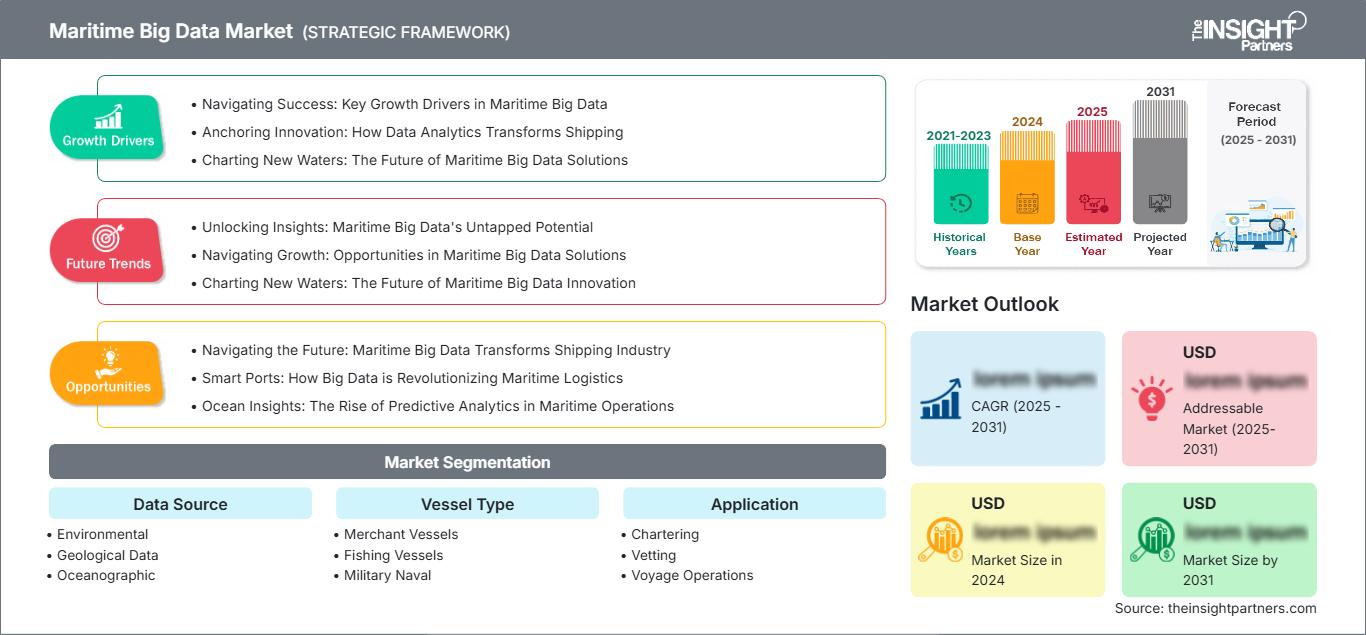
Maritime big data platforms aggregate and process continuous streams of structured and unstructured information generated by Automatic Identification System (AIS) transponders, onboard Internet of Things (IoT) sensors, oceanographic weather feeds, engine diagnostics, and port telematics. By applying advanced predictive analytics, machine learning, and artificial intelligence to these vast data reservoirs, ship managers and vessel owners can optimize fuel consumption, lower operational costs, enhance crew safety, and ensure seamless regulatory compliance across global trade routes.
The Maritime Big Data Market size is expected to reach US$ 8.96 Billion by 2031. The market is anticipated to register a CAGR of 11.8% during 2025-2031.
Key Market Drivers
- Accelerated Digitalization of Marine Transport: Modern commercial vessels are increasingly equipped with smart IoT sensor networks that transmit continuous operational metrics. The shift toward cloud-based fleet monitoring and edge computing drives high demand for specialized big data analytical platforms.
- Stringent Environmental Mandates: Regulations established by the International Maritime Organization (IMO), including the Carbon Intensity Indicator (CII) and Energy Efficiency Existing Ship Index (EEXI), compel operators to monitor emissions precisely. Big data solutions provide the necessary visibility to evaluate carbon output, manage fuel profiles, and satisfy regulatory audits.
- Need for Fuel Optimization and Cost Efficiency: Fuel represents the largest variable expense for vessel operations. Maritime big data tools utilize real-time ocean currents, dynamic sea state forecasts, and engine telemetry to recommend weather-aware voyage routes and optimal speed profiles, resulting in substantial fuel savings.
- Expansion of Global Seaborne Trade: As global trade volumes expand across critical trade lanes, port congestion and supply chain bottlenecks create a critical need for predictive Arrival Time (ETA) modeling and port call optimization solutions.
Download Sample Report@ https://www.theinsightpartners.com/sample/TIPRE00003235
Emerging Market Opportunities
- Generative AI and Automated Decision Systems: Integrating artificial intelligence with big data infrastructure offers significant growth opportunities. AI-powered decision support platforms can dynamically adjust voyage parameters, forecast equipment degradation, and optimize vessel trim in real-time.
- Expansion of Unmanned and Autonomous Vessels: The development of Maritime Autonomous Surface Ships (MASS) relies heavily on high-throughput big data processing. Systems that aggregate radar, LIDAR, optical sensors, and navigation databases will be crucial for autonomous spatial orientation and collision avoidance.
- Predictive Maintenance Services: Unplanned vessel downtime incurs severe financial penalties. Big data analytics tools that continuously track engine vibration, thermal dynamics, and oil quality enable condition-based maintenance strategies, preventing costly catastrophic mechanical failures prior to dry-docking.
- Port-to-Ship Integration and Green Corridors: As maritime hubs build smart port ecosystems, big data platforms that bridge port authority operations with incoming fleet schedules will unlock valuable opportunities for just-in-time port arrivals.
Market Segmentation Analysis
The maritime big data market is segmented across multiple operational categories to address diverse marine stakeholders:
By Data Type
- Vessel Performance Data: Fuel consumption telemetry, engine performance metrics, hull condition tracking, and propeller efficiency ratings.
- Environmental & Oceanographic Data: Real-time sea surface temperature, ocean current velocities, wave height models, and atmospheric weather patterns.
- Operational Data: Cargo handling records, container location telemetry, port call logs, and charter party documentation.
- Geographical & AIS Data: Vessel positional tracking, spatial navigation logs, and maritime corridor traffic density analysis.
By Application
- Fleet Management: Comprehensive operational visibility, asset health tracking, and portfolio benchmarking across vessel fleets.
- Navigation and Voyage Optimization: Dynamic weather routing, speed optimization, and hydrographic charting.
- Predictive Maintenance: Anomaly detection for main propulsion systems, auxiliary machinery, and rotating equipment.
- Regulatory Compliance & Environmental Monitoring: CII tracking, EU ETS allowance calculations, and automated emissions reporting.
By End-User
- Commercial Shipping: Liner operators, container carriers, dry bulk transport, and liquid chemical tanker fleets.
- Naval Forces & Defense: Coast guard, hydrographic research, and military vessel monitoring systems.
- Offshore Oil & Gas: Offshore support vessels, floating production assets, and subsea operation platforms.
Market News and Recent Developments
- Strategic Technology Partnerships: Leading maritime software providers are actively forming alliances with satellite communications providers to enhance ship-to-shore bandwidth, enabling seamless real-time big data transmission from mid-ocean locations.
- Cloud Platform Expansions: Major cloud infrastructure vendors have launched specialized maritime data lakes, allowing vessel management firms to unify siloed operational data across thousands of active ships.
- Acquisitions in Maritime Analytics: Established industrial engineering conglomerates continue to acquire niche maritime software startups to bolster their digital twin capabilities and end-to-end voyage management suites.
Competitive Landscape and Key Players
The global maritime big data market features a blend of established technology enterprises, marine engineering specialists, and specialized analytics providers. Top market players focus on continuous product innovation, strategic mergers, and cloud native platform expansion to maintain competitive advantage.
Top Key Players
- IBM Corporation
- Oracle Corporation
- Siemens AG
- Splunk, Inc.
- Teradata Corporation
- Wärtsilä Corporation
- Kongsberg Gruppen ASA
- ABB Marine & Ports
- Inmarsat plc
- Planet Labs PBC
- OceanWise Ltd.
- BigOceanData
Get Full Copy of This Report @ https://www.theinsightpartners.com/buy/TIPRE00003235
Future Outlook
Looking toward 2031, the maritime big data market is positioned for sustained structural growth as data-driven decision-making becomes standard practice across the maritime industry. The transition toward low-carbon fuels and autonomous navigation will further accelerate investment in advanced analytics platforms. Organizations that successfully integrate big data across fleet management, predictive maintenance, and environmental reporting will lead the global maritime logistics ecosystem in efficiency, profitability, and compliance.
About The Insight Partners
The Insight Partners provides comprehensive syndicated and tailored market research services in the healthcare, technology, and industrial domains. Renowned for delivering strategic intelligence and practical insights, the firm empowers businesses to remain competitive in ever-evolving global markets.
Contact Information
- Email: sales@theinsightpartners.com
- Website: theinsightpartners.com
- Phone: +1-646-491-9876
