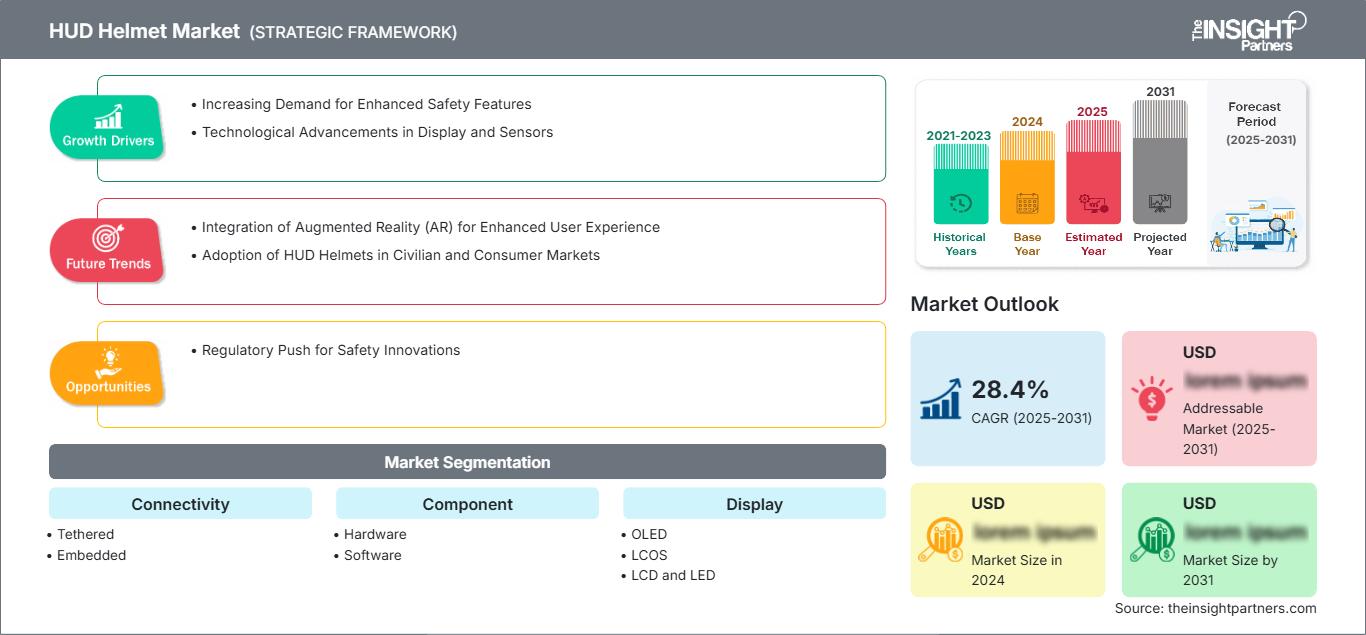
Rising demand for connected riding experiences is transforming the way riders interact with navigation, communication, safety alerts, and vehicle information. Advances in augmented reality, compact displays, wireless connectivity, and smart sensors are enabling manufacturers to integrate digital information into helmets without compromising core protective functions. As motorcycle technology becomes increasingly connected, intelligent helmet solutions are moving from experimental concepts toward commercially viable products.
The HUD Helmet Market is gaining momentum as riders, technology companies, and helmet manufacturers increasingly seek hands-free access to critical information. The Insight Partners projects the industry to register a strong CAGR during 2025–2031, supported by advances in conventional and augmented reality head-up display technologies. The study covers connectivity, components, display technologies, outer shell materials, technology types, and major geographic regions.
Get a Sample PDF: https://www.theinsightpartners.com/sample/TIPRE00007966
HUD Helmet Market Size, Share, Trends, and Forecast to 2031
The global HUD Helmet Market is entering an important commercialization phase, with growing attention toward products that combine protective equipment with digital interfaces. The following highlights summarize the expected direction through 2031:
- Market Size: The industry is expected to expand substantially through 2031 as smart helmet adoption increases across consumer riding, professional applications, and connected mobility.
- Market Share: Companies offering integrated displays, advanced optics, connectivity, and rider-focused software are expected to strengthen their competitive positions.
- Growth Trend: Augmented reality HUD solutions are emerging as a major technology trend, particularly for navigation, communication, safety alerts, and real-time vehicle information.
- Technology Outlook: Conventional HUD systems are expected to remain relevant, while AR HUD solutions gain greater attention as display quality, brightness, compactness, and processing capabilities improve.
- Connectivity Trend: Embedded connectivity is becoming increasingly important as riders demand seamless integration with smartphones, navigation platforms, communication systems, and voice assistants.
- Forecast to 2031: Strong expansion is anticipated as technology costs gradually improve, consumer awareness increases, and manufacturers introduce more practical and safety-focused products.
Augmented Reality Is Reshaping Smart Riding
One of the most significant trends influencing the HUD Helmet Market is the integration of augmented reality into motorcycle helmets. AR HUD technology can place navigation instructions, speed information, alerts, and communication notifications within the rider’s field of view. This approach can reduce the need to repeatedly look down at a motorcycle instrument cluster or smartphone.
Recent product developments demonstrate that the technology is moving beyond prototypes. Shoei and French technology company EyeLights have introduced the GT-Air 3 Smart, combining a premium motorcycle helmet with an EyeLights HUD system. The technology uses a bright Nano OLED display and supports features including navigation, calls, radar alerts, music, and rider communication. Shoei’s official product information confirms ECE 22.06 homologation for the GT-Air 3 Smart helmet.
This development is significant because it demonstrates how HUD technology can be incorporated into a production helmet while maintaining the conventional functions expected from premium protective equipment. Industry coverage has also highlighted the system’s ability to place important riding information directly within the rider’s line of sight.
Key Trends Driving the HUD Helmet Market
The transition toward connected mobility is creating several opportunities for HUD helmet manufacturers. Smartphone integration remains one of the most important developments, allowing riders to access GPS navigation, calls, music, and voice assistants without physically interacting with a phone.
Another important trend is the development of brighter and smaller displays. Advances in OLED, microdisplay, waveguide, and optical technologies are helping manufacturers deliver clearer information while working within the limited space and demanding environmental conditions of a helmet.
Safety is also becoming central to product development. Rather than focusing only on entertainment, newer systems are increasingly designed around navigation assistance, hazard notifications, communication, and situational awareness. This shift could help position smart helmets as functional safety and mobility technologies rather than premium accessories.
Global HUD Helmet Market Analysis
North America remains an important region because of its mature technology ecosystem, strong presence of connected mobility companies, and demand for advanced motorcycle accessories. The region is expected to continue supporting product development, software integration, and commercialization of smart helmet technologies.
Europe is another significant market, supported by established motorcycle manufacturers, premium helmet brands, stringent safety expectations, and growing interest in connected mobility. Product developments involving European technology companies and established helmet manufacturers are helping strengthen the regional ecosystem.
Asia Pacific is expected to present substantial long-term opportunities due to its large motorcycle user base, expanding two-wheeler industry, increasing technology adoption, and growing interest in premium riding products. Countries such as Japan, China, and India are particularly relevant to the development and adoption of connected motorcycle technologies.
South and Central America also offer emerging opportunities as motorcycle ownership expands and consumers increasingly seek navigation, communication, and safety-oriented technologies.
Segmentation Outlook
According to The Insight Partners, the HUD Helmet Market is analyzed across several important segments. By connectivity, the industry includes tethered and embedded solutions. By component, it covers hardware and software. Display technologies include OLED, LCOS, LCD, and LED, while outer shell materials include carbon fiber, Kevlar, plastic, and glass fiber. Technology segmentation covers conventional HUD and AR HUD solutions.
The AR HUD segment is expected to attract increasing attention because it provides opportunities to combine real-world riding environments with contextual digital information. Software will also become more influential as manufacturers seek recurring opportunities through navigation, connectivity, updates, voice interaction, and intelligent safety features.
Key Players in the HUD Helmet Market
The competitive landscape includes established helmet manufacturers, technology providers, defense companies, display specialists, and smart mobility companies. Industry reports identify several prominent participants, including:
- ✓ BAE Systems plc
- ✓ BMW Motorrad GmbH
- ✓ DigiLens Inc.
- ✓ Garmin International, Inc.
- ✓ Gentex Corporation
- ✓ L3Harris Technologies, Inc.
- ✓ NUVIZ, Inc.
- ✓ SHOEI Co., Ltd.
- ✓ Sena Technologies, Inc.
- ✓ Skully Technologies
- ✓ Thales Group
- ✓ Nolan S.p.A.
- ✓ Northrop Grumman Corporation
- ✓ Raytheon Technologies Corporation
Competitive strategies are increasingly centered on product innovation, optical performance, connectivity, partnerships, and integration with established helmet platforms. The collaboration between Shoei and EyeLights illustrates how specialist display technology can be combined with an established helmet manufacturer’s engineering and safety expertise.
Get the Premium Research Report @ https://www.theinsightpartners.com/buy/TIPRE00007966
Future Outlook
The future of the HUD Helmet Market will depend on how effectively manufacturers balance technology, safety, comfort, battery life, affordability, and usability. Products that provide meaningful information without creating additional distraction are likely to gain the strongest consumer acceptance. Greater integration with smartphones, navigation systems, voice assistants, cameras, rider-to-rider communication, and motorcycle sensors could further expand the role of smart helmets.
Through 2031, the industry is expected to move toward more compact displays, improved optical clarity, smarter software, stronger connectivity, and greater adoption of AR-based interfaces. As technology becomes more accessible and manufacturers gain experience integrating electronics into certified protective equipment, HUD helmets could become an increasingly recognizable part of the connected mobility ecosystem. The Insight Partners’ analysis highlights this transition and evaluates the opportunities emerging across technologies, components, connectivity types, materials, and regions.
Related Reports –
Home Energy Management System Market Regional Share, Trend, and Growth Opportunity
Vision Transformers Market Regional Share, Trend, and Growth Opportunity
Differential-Pressure Mass Flow Controller Market Regional Share, Trend, and Growth Opportunity
About The Insight Partners
The Insight Partners is a leading market research and consulting firm delivering actionable insights through in-depth industry analysis and strategic intelligence. The firm supports clients across various industries in making informed business decisions by providing comprehensive market forecasts, competitive assessments, and growth opportunities.
Contact Us:
If you have any queries about this report or if you would like further information, please contact us:
Contact Person: Ankit Mathur
E-mail: sales@theinsightpartners.com
Phone: +1-646-491-9876
Also Available in :
Korean | German | Japanese | French | Chinese | Italian | Spanish
