Wi-Fi connectivity is becoming a critical foundation for homes, enterprises, educational institutions, healthcare facilities, retail environments, and connected public infrastructure. As the number of connected devices continues to rise, users increasingly expect reliable performance, lower latency, stronger security, and seamless connectivity across dense environments. These changing requirements are encouraging organizations and consumers to upgrade wireless infrastructure and adopt advanced networking equipment.
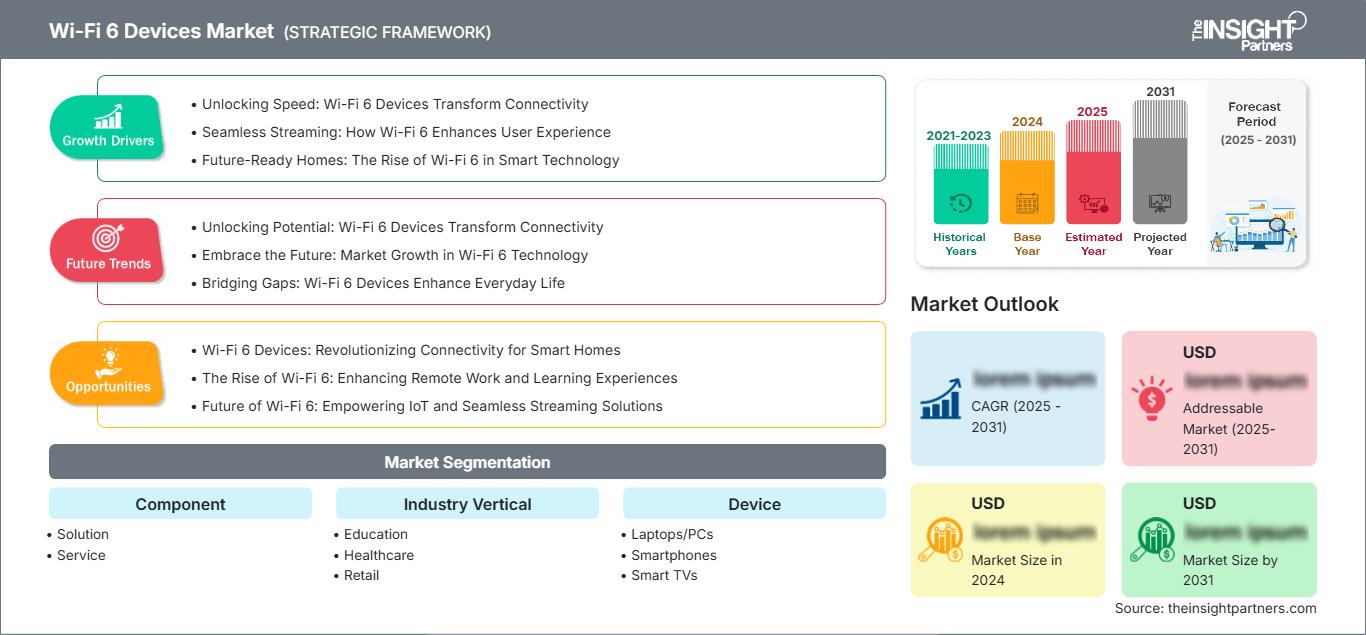
The Wi-Fi 6 Devices Market is gaining momentum as businesses and consumers seek efficient wireless connectivity capable of supporting smartphones, laptops, smart TVs, routers, IoT equipment, and other connected products. The Insight Partners report evaluates the industry through components, industry verticals, device categories, and major geographic regions, providing a detailed view of evolving demand through 2031.
Get a Sample PDF: https://www.theinsightpartners.com/sample/TIPRE00020299
Wi-Fi 6 Devices Market: Key Insights Through 2031
- Market Size: The market is positioned for sustained expansion as Wi-Fi 6-enabled smartphones, laptops, routers, smart TVs, and networking equipment continue moving through replacement and upgrade cycles
- Market Share: Enterprise networking, routers and extenders, and connected computing devices remain important areas of competitive activity, while adoption varies according to infrastructure maturity and device replacement patterns
- Market Trends: Higher device density, cloud applications, smart homes, video streaming, IoT connectivity, remote collaboration, and network modernization are strengthening demand for advanced wireless technologies
- Market Analysis: Demand is increasingly influenced by performance requirements rather than speed alone, with efficiency, network capacity, security, reliability, and total deployment cost becoming important purchasing considerations
- 2031 Forecast: Expansion is expected to continue through 2031, supported by device upgrades, enterprise digitization, connected environments, and the need to accommodate growing numbers of wireless endpoints
Industry Trends Reshaping Wi-Fi 6 Device Adoption
One of the most important developments is the transition from conventional wireless connectivity toward networks designed for high-density environments. Wi-Fi 6 uses technologies such as Orthogonal Frequency Division Multiple Access and improved multi-user capabilities to manage numerous connected devices more efficiently. This makes the technology relevant to offices, campuses, hospitals, retail stores, manufacturing facilities, hotels, and residential environments where multiple devices compete for network capacity.
Another important trend is the growth of smart-home ecosystems. Consumers are connecting televisions, security systems, appliances, speakers, gaming systems, cameras, smartphones, and computers to the same wireless environment. Wi-Fi 6 infrastructure can provide a stronger foundation for these increasingly connected households, particularly when multiple users simultaneously stream content, participate in video calls, play online games, or operate cloud-connected devices.
Enterprise modernization is also supporting adoption. Organizations are deploying more cloud-based applications, wireless endpoints, collaboration platforms, and IoT solutions. Consequently, wireless infrastructure is becoming a strategic component of digital transformation rather than simply a connectivity utility.
Latest Industry Developments
The competitive environment is changing rapidly as newer generations of wireless technology enter the enterprise. IDC reported that Wi-Fi 7 accounted for 44.5% of enterprise dependent access-point revenue in the first quarter of 2026, while Wi-Fi 6 represented 34.8% and Wi-Fi 6E accounted for 20%. This indicates that Wi-Fi 6 is increasingly moving toward refresh, value-oriented, and mid-market deployments as organizations evaluate newer generations.
The development does not eliminate the relevance of Wi-Fi 6. Instead, it creates a more diverse replacement environment in which organizations can select technologies according to performance requirements, budgets, installed infrastructure, and application needs. Recent product developments also demonstrate that service providers are expanding next-generation wireless portfolios across residential and small-business deployments, accelerating the broader wireless upgrade cycle.
Security is another increasingly important consideration. Recent vulnerabilities affecting enterprise wireless networking equipment have highlighted the importance of firmware maintenance, secure device management, authentication, and network segmentation. As wireless equipment becomes more deeply integrated into business operations, cybersecurity is expected to remain an important factor in purchasing and deployment decisions.
Global and Regional Analysis
North America is expected to remain an important region because of its advanced digital infrastructure, strong enterprise technology adoption, established cloud ecosystem, and continued investments in wireless networking. Enterprises, education providers, healthcare organizations, and large commercial facilities are among the key users supporting demand.
Europe is experiencing continued demand as organizations modernize IT infrastructure and expand connected workplace, industrial, healthcare, hospitality, and smart-building applications. Data security, network efficiency, and reliable connectivity remain central considerations for technology deployments across the region.
Asia Pacific represents a significant growth opportunity due to rapid digitalization, expanding smartphone and consumer electronics adoption, smart-home development, industrial connectivity, and large-scale investments in telecommunications infrastructure. China, India, Japan, South Korea, and other economies are contributing to the region’s expanding wireless ecosystem. Industry research also identifies Asia as a leading region for broader Wi-Fi 6 adoption.
South and Central America are expected to benefit from increasing digital services, broadband expansion, connected consumer electronics, and modernization of commercial and residential networking infrastructure.
Middle East and Africa are also developing opportunities as governments, enterprises, hospitality providers, educational institutions, and other organizations increase investments in digital connectivity and smart infrastructure.
Segmentation and Competitive Landscape
The industry is analyzed across solution and service components, while applications span education, healthcare, retail, transportation, government, manufacturing, hospitality, sports and leisure, and other sectors. Device categories include laptops and PCs, smartphones, smart TVs, routers and extenders, and other connected products.
Key players identified by The Insight Partners include:
- ✓ Dell Inc.
- ✓ Apple Inc.
- ✓ Samsung Electronics Co., Ltd.
- ✓ Qualcomm Technologies, Inc.
- ✓ BBK Electronics Corporation
- ✓ ASUSTeK Computer Inc.
- ✓ Huawei Technologies Co., Ltd.
- ✓ Lenovo
- ✓ TP-Link Corporation Limited
- ✓ Xiaomi Corporation
These companies compete through product innovation, chipset development, device integration, networking performance, ecosystem expansion, and strategic technology investments.
Get the Premium Research Report @ https://www.theinsightpartners.com/buy/TIPRE00020299
Future Outlook
The outlook through 2031 remains positive as wireless connectivity becomes increasingly embedded in digital lifestyles and enterprise operations. Although Wi-Fi 7 is accelerating adoption in high-performance enterprise environments, Wi-Fi 6 continues to offer a practical combination of performance, efficiency, compatibility, and deployment economics for many users. The coexistence of multiple Wi-Fi generations is therefore likely to define the next phase of wireless infrastructure development.
Continued growth in IoT deployments, connected homes, cloud computing, remote collaboration, smart buildings, industrial automation, and high-density wireless environments will create opportunities for device manufacturers, chipset suppliers, network providers, and technology integrators. At the same time, cybersecurity, interoperability, spectrum availability, and technology refresh cycles will remain important factors shaping competitive strategies.
The Insight Partners’ Wi-Fi 6 Devices Market analysis provides stakeholders with a comprehensive assessment of industry trends, regional opportunities, competitive developments, segment dynamics, and growth prospects through 2031.
Related Reports –
Home Energy Management System Market Regional Share, Trend, and Growth Opportunity
Vision Transformers Market Regional Share, Trend, and Growth Opportunity
Differential-Pressure Mass Flow Controller Market Regional Share, Trend, and Growth Opportunity
About The Insight Partners
The Insight Partners is a leading market research and consulting firm delivering actionable insights through in-depth industry analysis and strategic intelligence. The firm supports clients across various industries in making informed business decisions by providing comprehensive market forecasts, competitive assessments, and growth opportunities.
Contact Us:
If you have any queries about this report or if you would like further information, please contact us:
Contact Person: Ankit Mathur
E-mail: sales@theinsightpartners.com
Phone: +1-646-491-9876
Also Available in :
Korean | German | Japanese | French | Chinese | Italian | Spanish
