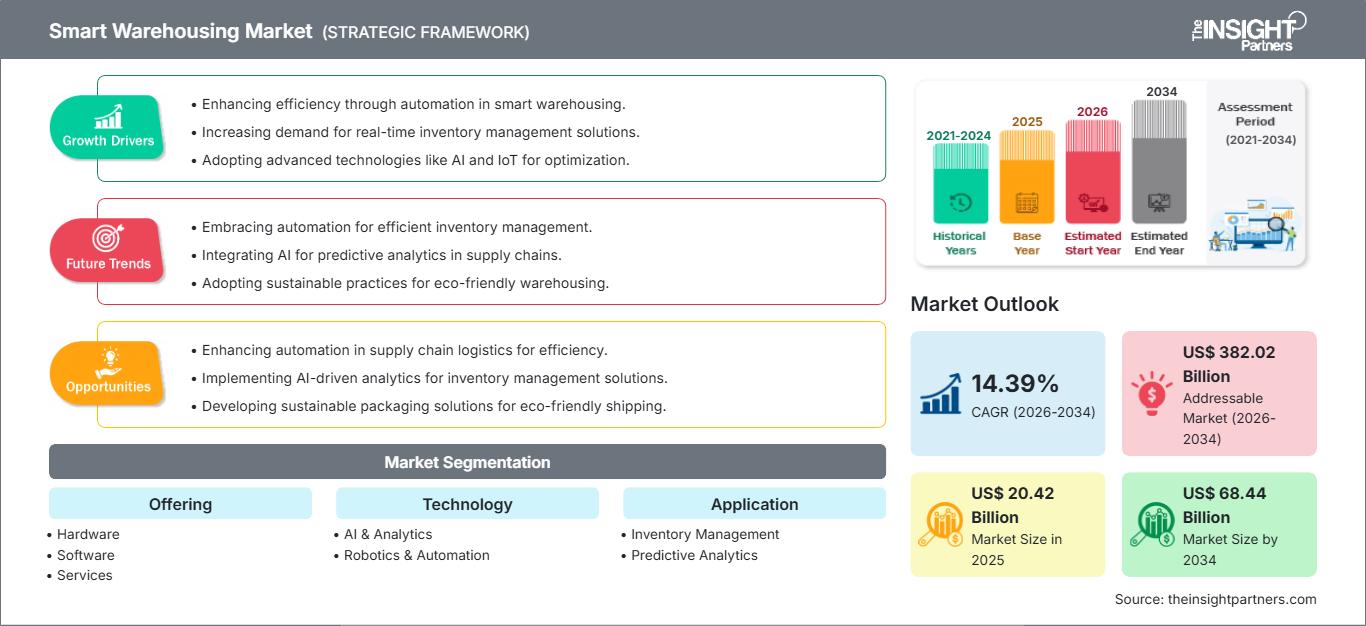
The rapid evolution of logistics and fulfillment operations is reshaping how companies manage inventory, storage, and order processing. Increasing e-commerce activity, changing consumer expectations, labor constraints, supply chain disruptions, and the need for faster fulfillment are encouraging businesses to modernize warehouse operations with connected and automated technologies. The shift is creating strong opportunities for technology providers and logistics companies to develop more intelligent, flexible, and data-driven warehouse environments.
The Smart Warehousing Market is gaining momentum as businesses integrate artificial intelligence, robotics, Internet of Things technologies, warehouse management software, automated storage and retrieval systems, and advanced analytics into daily operations. According to The Insight Partners, the industry is analyzed across hardware, software, and services, with technology coverage including AI and analytics and robotics and automation. Applications include inventory management and predictive analytics, while the regional assessment covers North America, Europe, Asia Pacific, the Middle East and Africa, and South and Central America.
Get a Sample PDF: https://www.theinsightpartners.com/sample/TIPRE00039635
Smart Warehousing Market Size, Share, Trends, and Forecast to 2031
The industry is moving from isolated automation toward connected warehouse ecosystems in which machines, software platforms, sensors, and employees work together. The increasing adoption of autonomous mobile robots, real-time inventory tracking, predictive maintenance, machine vision, and cloud-based warehouse management platforms is supporting this transition.
Key analysis through 2031:
- Market Size: The addressable opportunity is expected to expand steadily as retailers, manufacturers, distributors, and logistics providers modernize warehouse infrastructure and adopt scalable automation solutions
- Market Share: Technology suppliers offering integrated robotics, AI, analytics, warehouse management software, and connected infrastructure are positioned to capture a growing portion of enterprise spending
- Growth Trend: Automation, AI-powered decision-making, real-time visibility, and autonomous material handling are expected to remain among the most influential growth trends through 2031
- Technology Outlook: Robotics and automation are expected to become increasingly integrated with AI, IoT, machine vision, digital twins, and predictive analytics
- Application Outlook: Inventory management and predictive analytics are likely to remain central applications as companies seek greater accuracy, lower operational waste, and improved demand planning
- Forecast to 2031: Adoption is expected to broaden beyond large enterprises as modular, cloud-based, and scalable solutions make advanced warehouse technologies more accessible to mid-sized businesses
AI and Robotics Transform Warehouse Operations
Artificial intelligence is becoming an important component of modern warehouse management. AI-enabled systems can analyze operational data, identify demand patterns, optimize inventory levels, support workforce allocation, and improve decision-making. The integration of AI with warehouse management systems can also help businesses move from reactive operations toward predictive and increasingly autonomous workflows.
Robotics is another major transformation area. Autonomous mobile robots can support picking, replenishment, transportation, and inventory-related activities while automated storage and retrieval systems can improve the utilization of warehouse space. Recent industry developments also demonstrate growing interest in multi-purpose autonomous robots capable of performing different fulfillment activities within the same environment.
IoT connectivity further strengthens these capabilities by allowing warehouses to collect real-time information about inventory, equipment, environmental conditions, and asset movement. This creates greater operational visibility and can support predictive maintenance while reducing avoidable downtime.
E-Commerce and Fulfillment Expectations Drive Adoption
The expansion of online retail continues to influence warehouse modernization. Customers increasingly expect rapid delivery, accurate order status, flexible fulfillment options, and reliable product availability. These expectations place pressure on warehouse operators to improve throughput without compromising accuracy.
The growing complexity of inventory is also encouraging businesses to adopt automated systems. Warehouses may need to handle larger product assortments, seasonal fluctuations, returns, and increasingly fragmented order volumes. Smart technologies provide companies with tools to optimize storage layouts, automate repetitive activities, and coordinate workflows in real time.
Recent industry research also highlights supply chain resilience, labor shortages, demand volatility, and sustainability as important forces behind smart warehouse adoption. Emerging approaches include cyber-physical systems, digital twins, collaborative robots, and advanced learning techniques designed to make warehouse operations more resilient and sustainable.
Global and Regional Analysis
North America: North America remains an important center for warehouse automation and intelligent logistics adoption. Strong technology infrastructure, advanced retail operations, established logistics networks, and investments in AI and robotics support the region’s position. The US is expected to remain a major contributor as retailers, manufacturers, and third-party logistics providers pursue higher fulfillment efficiency.
Europe: European adoption is being supported by automation investments, sustainability initiatives, advanced manufacturing, and the need to improve warehouse productivity. Germany, the UK, France, and other major economies are expected to contribute to continued technology deployment.
Asia Pacific: Asia Pacific represents a significant growth opportunity due to expanding e-commerce, manufacturing activity, industrial automation, and technology adoption. China, Japan, India, and Australia are expected to remain important markets as businesses modernize distribution infrastructure and develop increasingly connected supply chains.
Middle East and Africa: Investments in logistics infrastructure, e-commerce, retail modernization, and regional distribution networks are creating new opportunities for intelligent warehouse technologies. Demand is expected to increase as organizations seek more efficient and digitally connected logistics operations.
South and Central America: The region is gradually adopting warehouse automation as e-commerce penetration, modern retail, and logistics infrastructure develop. Brazil and other major economies are expected to provide opportunities for technology vendors and logistics service providers.
Key Players in the Smart Warehousing Market
The competitive landscape includes technology companies and solution providers focusing on warehouse management, automation, analytics, industrial software, and connected supply chain operations.
- ✓ Manhattan Associates
- ✓ Körber
- ✓ Oracle
- ✓ SAP
- ✓ Tecsys
- ✓ PSI Logistics
- ✓ PTC
- ✓ Infor
- ✓ IBM
The Insight Partners identifies these companies among the market leaders and important company profiles covered in its smart warehousing analysis.
Industry Trends Shaping the Future
Several trends are expected to influence the industry through 2031. Autonomous mobile robots are gaining traction because they can provide flexible material movement without requiring fixed routes. AI and machine learning are increasingly being combined with warehouse data to improve forecasting and operational decisions. IoT-connected systems are expanding real-time visibility, while cloud-based software is making warehouse management capabilities easier to deploy and scale.
Sustainability is also becoming a more important consideration. Energy-efficient equipment, optimized inventory management, reduced waste, and better resource utilization can help businesses improve operational performance while supporting environmental objectives. The convergence of automation and sustainability is expected to encourage more organizations to evaluate technology investments based on both productivity and long-term resource efficiency.
Get the Premium Research Report @ https://www.theinsightpartners.com/buy/TIPRE00039635
Future Outlook
The future of smart warehousing will increasingly center on connected, adaptive, and intelligent fulfillment environments. Rather than relying on standalone automation tools, businesses are expected to integrate robotics, AI, IoT, warehouse management systems, analytics, and real-time data into unified operational platforms. Through 2031, greater emphasis on flexibility, predictive decision-making, human-machine collaboration, and sustainable operations is expected to create new opportunities for solution providers. Companies that can deliver scalable technologies while addressing integration, cybersecurity, workforce training, and return-on-investment challenges will be well positioned to participate in the next phase of warehouse transformation.
Related Reports –
Home Energy Management System Market Regional Share, Trend, and Growth Opportunity
Vision Transformers Market Regional Share, Trend, and Growth Opportunity
Differential-Pressure Mass Flow Controller Market Regional Share, Trend, and Growth Opportunity
About The Insight Partners
The Insight Partners is a leading market research and consulting firm delivering actionable insights through in-depth industry analysis and strategic intelligence. The firm supports clients across various industries in making informed business decisions by providing comprehensive market forecasts, competitive assessments, and growth opportunities.
Contact Us:
If you have any queries about this report or if you would like further information, please contact us:
Contact Person: Ankit Mathur
E-mail: sales@theinsightpartners.com
Phone: +1-646-491-9876
Also Available in :
Korean | German | Japanese | French | Chinese | Italian | Spanish
