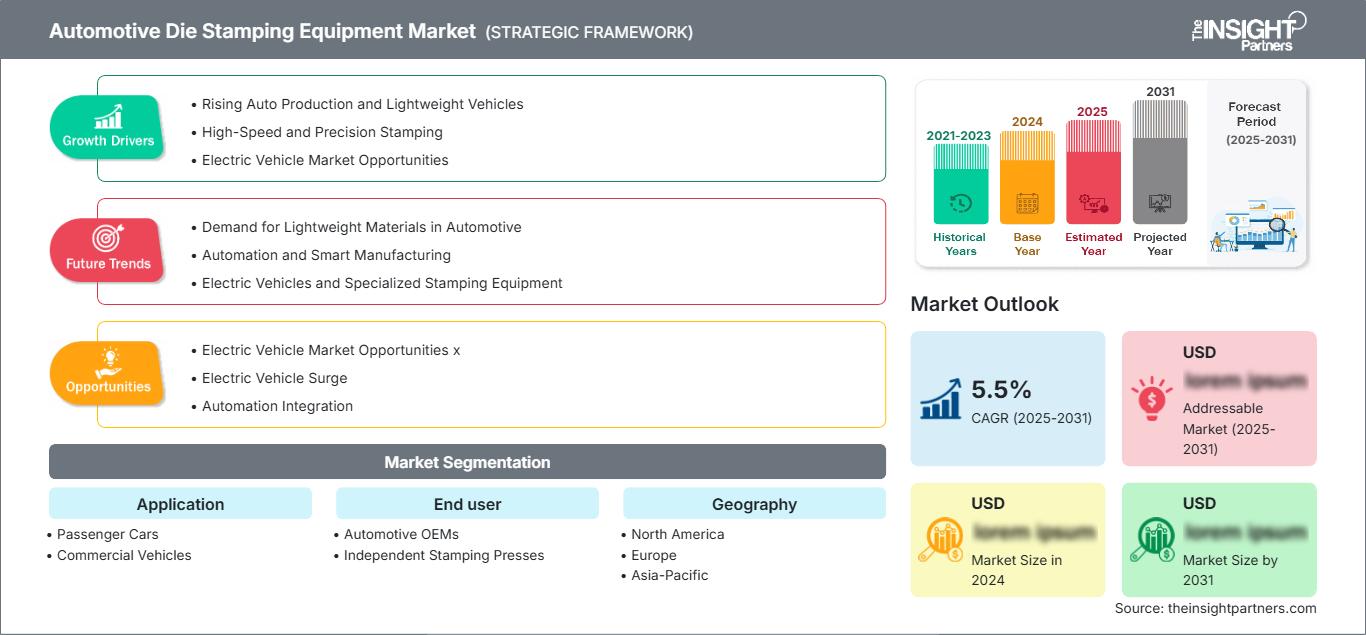
The automotive industry is undergoing a profound transformation driven by rapid technological advancements, evolving emission standards, and the accelerated adoption of electric vehicles (EVs). At the core of this manufacturing evolution lies die stamping equipment a fundamental technology required to produce complex body-in-white (BIW) structural components, lightweight body panels, chassis components, and battery enclosures. As vehicle manufacturers focus on structural safety, weight reduction, and precision engineering, the global demand for modern, high-precision metal stamping machinery continues to rise significantly.
Get a PDF Sample- https://www.theinsightpartners.com/sample/TIPRE00007030
North America Automotive Die Stamping Equipment Market
The North America automotive die stamping equipment market holds a prominent position globally, driven by a robust automotive manufacturing ecosystem across the United States, Canada, and Mexico. Regional OEM investments are increasing rapidly to support local electric vehicle production facilities and modernize existing press shops with high-efficiency servo press machinery. Furthermore, stringent US corporate average fuel economy (CAFE) standards are compelling regional manufacturers to adopt hot stamping technology for advanced high-strength steel structural safety parts. The strong presence of leading tool-and-die suppliers alongside Tier-1 automotive component manufacturers continues to bolster market growth across North America.
Market Forecast & Industry Overview
The global Automotive Die Stamping Equipment Market size is projected to reach US$ 9.95 billion by 2034 from US$ 5.7 billion in 2025. The market is anticipated to register a CAGR of 6.39% during the forecast period 2026-2034.
This sustained growth is heavily supported by the increasing global production of original equipment manufacturer (OEM) passenger cars, light commercial vehicles (LCVs), and heavy commercial vehicles. Manufacturers are investing heavily in automated, energy-efficient, and high-speed pressing lines to maximize throughput, minimize material waste, and streamline overall assembly processes.
Key Growth Drivers and Market Dynamics
Several core factors are fueling the expansion of the automotive die stamping equipment sector globally:
Vehicular Lightweighting Initiatives: To meet stringent carbon emission regulations and increase the operating range of electric vehicles, OEMs are shifting from traditional heavy steel toward high-strength steels (AHSS), aluminum alloys, and composite materials. Stamping lightweight materials requires specialized press force, precise die tooling, and hot-stamping (press hardening) technology, driving capital expenditure on next-generation stamping systems.
Transition Toward Electric Mobility: The rapid growth of electric vehicles demands newly engineered stamping dies for specialized components, including battery housings, structural shieldings, and electric motor core laminations.
Integration of Automation and Industry 4.0: Press shops worldwide are adopting robotic automation, servo-driven mechanical presses, and IoT-enabled predictive maintenance systems. Industry 4.0 integration improves operational uptime, precise force management, and die life span, optimizing manufacturing costs.
Competitive Landscape & Key Industry Players
The global market for automotive die stamping equipment is highly competitive, characterized by prominent machinery manufacturers and specialized precision tool makers. Leading companies focus on developing energy-efficient servo presses, customized press lines, and advanced hot-stamping capabilities to maintain a competitive edge.
Key Players Operating in the Market Include:
AMADA HOLDINGS CO., LTD.
AIDA Engineering, Ltd.
ANDRITZ AG
Batesville Tool and Die, Inc.
Fagor Arrasate
G and M Manufacturing Corp.
Komatsu Ltd.
Macrodyne Technologies Inc.
Schuler AG
TALAN PRODUCTS, INC.
These market participants frequently engage in strategic partnerships, product innovations, and geographic expansion initiatives to cater to the evolving needs of global automotive OEMs and Tier-1 suppliers.
Get Full Copy of This Report- https://www.theinsightpartners.com/buy/TIPRE00007030
Market Segmentation Highlights
By Application
- Passenger Cars
- Commercial Vehicles
By End user
- Automotive OEMs
- Independent Stamping Presses
Future Outlook
The future outlook for the automotive die stamping equipment market remains highly positive, defined by continuous technological innovation and the structural shift toward sustainable manufacturing. Over the coming decade, press shops will increasingly adopt hybrid pressing technologies, intelligent die monitoring sensors, and fully automated robotic loading/unloading lines to meet rising OEM output targets with minimal human intervention. Furthermore, as the automotive sector deepens its focus on circular economy practices and energy conservation, die stamping equipment developers will prioritize eco-friendly servo-electric architectures that lower energy consumption per stroke. With electric vehicle architectures maturing and lightweighting remaining a top industry imperative, the demand for high-precision, versatile, and high-tonnage stamping equipment will experience steady expansion through 2034.
Related Reports-
The Insight Partners is a one-stop industry research provider of actionable intelligence. We help our clients in getting solutions to their research requirements through our syndicated and consulting research services. We specialize in industries such as Semiconductor and Electronics, Aerospace and Defense, Automotive and Transportation, Biotechnology, Healthcare IT, Manufacturing and Construction, Medical Devices, Technology, Media, and Telecommunications, as well as chemicals and Materials.
Contact Us
If you have any queries about this report or if you would like further information, don’t hesitate to get in touch with us:
Contact Person: Ankit Mathur
E-mail: ankit.mathur@theinsightpartners.com
