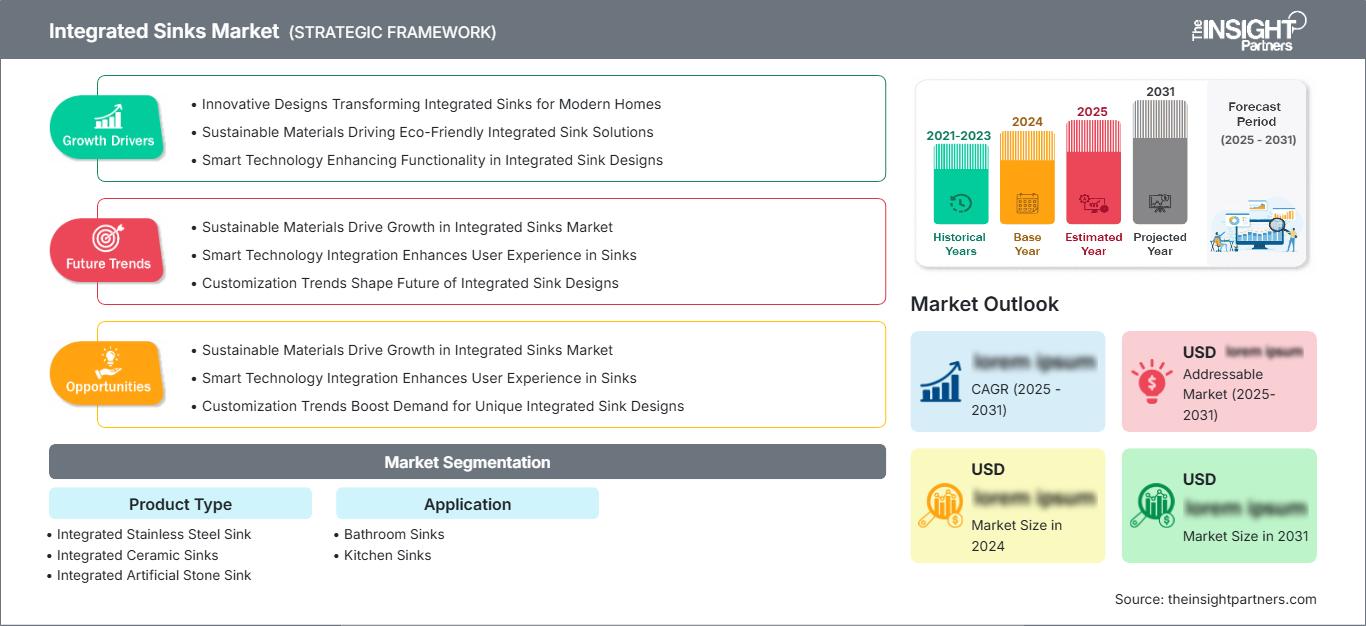
The global integrated sinks market is experiencing steady expansion driven by modern architectural preferences, evolving kitchen and bathroom design trends, and an increasing consumer shift toward seamless aesthetic solutions. Integrated sinks, which are seamlessly fused or molded directly into the countertop material, eliminate unsightly rim seams and crevice gaps that traditional drop-in or undermount sinks usually feature. This smooth transition between sink basin and countertop not only enhances visual appeal but also provides significant functional benefits, such as superior hygiene, effortless cleaning, and enhanced structural durability. As homeowners and commercial developers invest heavily in premium interior finishes, integrated sinks have transitioned from a niche luxury offering into a core standard for contemporary residential and commercial construction projects worldwide.
Get a PDF Sample- https://www.theinsightpartners.com/sample/TIPRE00014801
North America Integrated Sinks Market
North America holds a dominant position in the global integrated sinks market, propelled by high disposable incomes, extensive kitchen renovation projects, and a growing preference for seamless modern home designs. The region’s market expansion is heavily supported by strong residential construction activities and robust demand for premium quartz, granite composite, and stainless steel integrated sinks. Leading plumbing fixtures manufacturers and custom countertop fabricators in the US and Canada are increasingly collaborating to offer customized, integrated sink-and-countertop solutions. Additionally, strict hygiene standards and consumer inclination toward easy-to-clean, non-porous surfaces continue to sustain steady revenue growth across both residential and commercial sectors in North America.
Market Forecast
The Integrated Sinks Market size is projected to grow from US$ 2.66 Billion in 2025 to US$ 4.1 Billion by 2034; it is expected to register a CAGR of 4.91% during 2026–2034.
This robust growth is supported by expanding urbanization, rising disposable incomes, and widespread home remodeling initiatives across major geographies. Furthermore, expanding commercial sectors such as hospitality, healthcare facilities, upscale corporate offices, and luxury real estate developments are increasingly prioritizing integrated plumbing solutions to combine modern minimalism with low-maintenance operational standards.
Key Market Drivers and Trends
Several macro-economic and design factors are propelling the growth of the integrated sinks market. One of the primary catalysts is the global resurgence in residential remodeling and kitchen upgrades. Modern consumers increasingly view kitchens as central living and entertaining hubs, elevating demand for high-end material options including quartz, solid surface materials, natural stone composite, stainless steel, and high-performance ceramics.
Another primary driver is the growing emphasis on kitchen and bathroom hygiene. Standard sink installations feature joints and silicone sealant lines that gather dirt, mold, and bacteria over time. Integrated sinks provide a continuous, non-porous surface that prevents grime build-up and withstands harsh chemical cleansers. Additionally, advancements in solid surface fabrication and precision molding technologies have enabled manufacturers to produce complex geometries, custom basin dimensions, and integrated drainboards, expanding design possibilities for interior architects and custom fabricators.
Key Players
The competitive landscape of the integrated sinks market is characterized by strategic product launches, technological innovations in material synthesis, and expansion of regional distribution networks. Key players operating in the global market include:
LIXIL Corporation
BLANCO GmbH + Co KG
Zurn Elkay Water Solutions Corporation
Franke Holding AG
FULEKA
Houzer Inc.
Kohler Co.
Kraus USA Plumbing LLC
Fortune Brands Innovations, Inc.
Ruvati USA
Duravit AG
These industry leaders focus on expanding their product portfolios through advanced composite materials, ergonomic basin profiles, and eco-friendly manufacturing techniques. Strategic partnerships with interior designers, countertop fabricators, and large-scale builders remain central to maintaining market share in an increasingly competitive environment.
Get Full Copy of This Report- https://www.theinsightpartners.com/buy/TIPRE00014801
Future Outlook
The future outlook for the integrated sinks market remains highly promising as smart home integration, eco-conscious material innovations, and personalized interior aesthetics redefine home design standards. Over the coming decade, manufacturers are anticipated to invest heavily in bio-based solid surfaces, recycled composite materials, and anti-microbial surface coatings to cater to environmentally conscious and health-focused consumers. Furthermore, automation in solid surface fabrication and 3D precision molding will streamline production costs, making custom integrated sink solutions more accessible across broader middle-market segments. As urbanization accelerates and design priorities lean further toward sleek minimalism and functional hygiene, integrated sinks will continue to strengthen their position across global building and construction markets.
About Us
The Insight Partners is a one-stop industry research provider of actionable intelligence. We help our clients in getting solutions to their research requirements through our syndicated and consulting research services. We specialize in industries such as Semiconductor and Electronics, Aerospace and Defense, Automotive and Transportation, Biotechnology, Healthcare IT, Manufacturing and Construction, Medical Devices, Technology, Media, and Telecommunications, as well as chemicals and Materials.
Contact Us
If you have any queries about this report or if you would like further information, don’t hesitate to get in touch with us:
Contact Person: Ankit Mathur
E-mail: ankit.mathur@theinsightpartners.com
