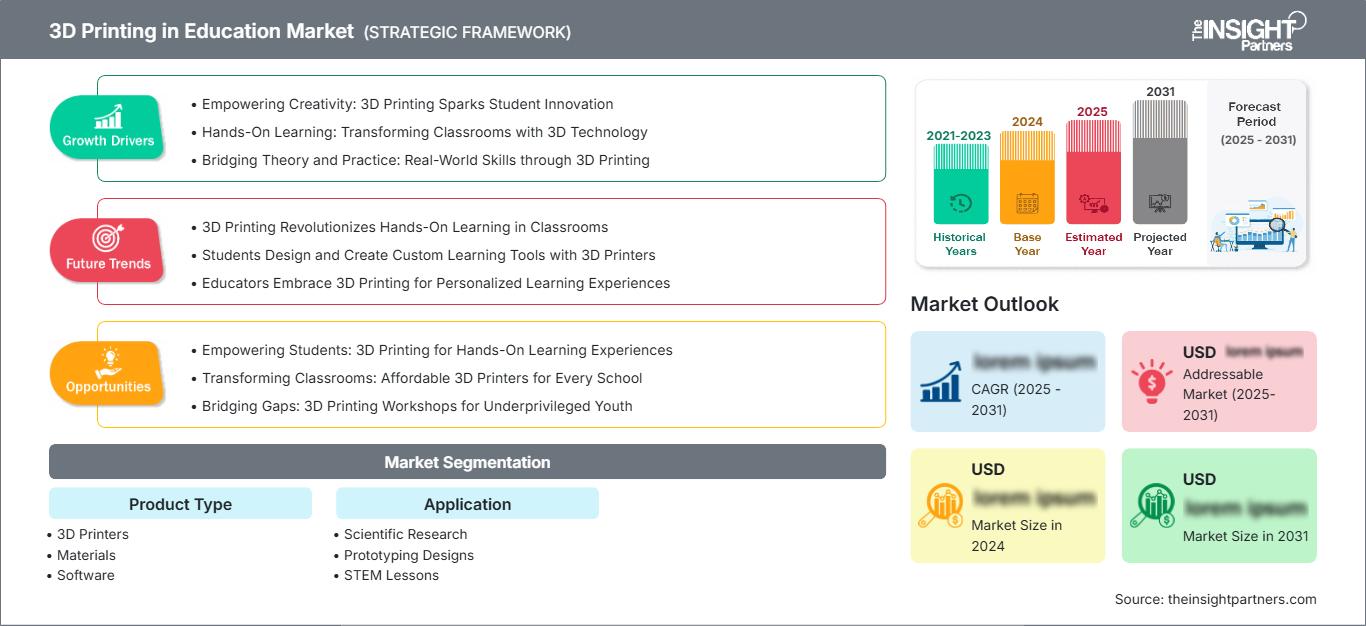
The global 3D printing in education market is undergoing a structural shift as modern academic frameworks move from rote memorization toward hands-on, project-based learning. Educational institutions across primary, secondary, and higher education are rapidly integrating additive manufacturing technologies into their curricula. By enabling students to convert digital concepts into physical, tactile prototypes, 3D printing bridges theoretical knowledge and practical application across Science, Technology, Engineering, Arts, and Mathematics (STEAM) disciplines.
The 3D printing in education market was valued at US$ 1.57 Billion in 2025 and is anticipated to reach US$ 3.47 Billion by 2034, registering a CAGR of 9.23% during 2026–2034.
Key Market Drivers
Several underlying factors are accelerating the adoption of 3D printing across academic environments:
- Shift Toward Experiential and STEAM Learning: Academic policy makers and educators increasingly emphasize experiential learning models. 3D printing allows students to visualize complex concepts in geometry, chemistry, architectural design, and mechanical engineering, improving comprehension and spatial reasoning.
- Workforce Preparedness and Industry Demand: Modern industries such as aerospace, automotive, healthcare, and industrial manufacturing rely heavily on additive manufacturing. Academic institutions are adopting these tools to equip students with practical skills in computer-aided design (CAD), rapid prototyping, and digital manufacturing.
- Technological Accessibility and Lower Cost: The decreasing cost of desktop 3D printers, combined with safer enclosed operating chambers, child-safe filaments, and intuitive slicing software, has removed entry barriers for schools operating under tight budgets.
- Personalized and Adaptive Learning Tools: Teachers use 3D printing to create custom tactile teaching aids, including anatomical models for medical students or embossed historical artifacts, catering to visually impaired students and diverse learning styles.
Download Sample Report@ https://www.theinsightpartners.com/sample/TIPRE00009323
Strategic Opportunities
The expanding ecosystem offers multiple revenue and growth channels for technology providers and educational institutions:
- Curriculum-Integrated Hardware Solutions: Software developers and hardware manufacturers have substantial opportunities to offer bundled packages that include hardware, certified educator training, cloud-managed fleet software, and standards-aligned lesson plans.
- Expansion in Vocational and Trade Training: As global economies address skilled labor shortages, technical institutes and community colleges represent a high-growth avenue for advanced desktop and industrial-grade additive units.
- Eco-Friendly and Sustainable Consumables: Rising environmental awareness in schools is creating strong demand for bio-based, non-toxic, and recyclable filaments, along with closed-loop recycling equipment for classroom waste.
- Cloud-Connected Design and Fleet Management: Centralized software platforms that allow teachers to monitor print queues, manage safety limits, and assess student submissions remotely present scalable recurring revenue opportunities.
Market Segmentation
By Component
- Hardware (3D Printers): Captures the largest share of initial capital investment, ranging from affordable entry-level Fused Deposition Modeling (FDM) units to advanced resin and Stereolithography (SLA) systems.
- Materials: Generates consistent recurring revenue through filaments (PLA, ABS, TPU), photopolymer resins, and specialty composites used in coursework.
- Software: Encompasses CAD platforms, slicing programs, and cloud-based printer management networks tailored for educational environments.
- Services: Includes professional development, maintenance contracts, curriculum development, and technical support.
By Application / End-User
- K-12 Education: Focuses on creative design, foundational geometry, and interactive science projects utilizing safe, easy-to-use desktop units.
- Higher Education: Involves universities and colleges using advanced industrial systems for engineering research, industrial design, architectural modeling, and medical prototyping.
- Vocational and Vocational Training Centers: Utilizes functional tooling and prototyping equipment to prepare students for technical trades.
Market News and Recent Developments
- Hardware-Software Alliances: Leading additive manufacturing vendors are partnering with K-12 learning platforms to deliver turn-key classroom kits with pre-approved safety certifications.
- Focus on Multi-Material and High-Speed Printing: Recent product launches focus on high-speed desktop printers that reduce build times, enabling students to finish print cycles within a standard class period.
- Stem Funding Programs: State and national educational grants in North America, Europe, and Asia-Pacific continue to allocate direct funds toward school fabrication labs and robotics centers.
Market Analysis and Competitive Landscape
The competitive landscape of 3D printing in education is characterized by a mix of established additive manufacturing giants and specialized, education-focused desktop hardware providers. Companies compete on hardware safety, ease of maintenance, software ecosystem maturity, and educational support content rather than raw industrial specifications.
Regional analysis highlights North America as a leading hub due to robust STEM funding and early technology adoption. Meanwhile, Asia-Pacific represents the fastest-growing regional market, propelled by massive government spending on educational infrastructure, vocational expansion, and national digital literacy drives in countries like China, India, and South Korea.
Get Full Copy of This Report @ https://www.theinsightpartners.com/buy/TIPRE00009323
Top Key Players
Key industry participants driving innovation and market expansion include:
- Stratasys Ltd.
- UltiMaker (including MakerBot)
- Formlabs Inc.
- 3D Systems Corporation
- Materialise NV
- Prusa Research a.s.
- Bambu Lab
- FlashForge Corporation
- XYZprinting, Inc.
- Afinia 3D
Future Outlook
Looking ahead to 2034, 3D printing will transition from an innovative elective tool to a fundamental pillar of global education. The convergence of artificial intelligence in design software, faster print speeds, and affordable multi-material capabilities will enable classrooms to run real-time design iterations during single class periods. As educational institutions continue to prioritize hands-on problem solving and technical literacy, additive manufacturing will play a defining role in preparing the next generation of engineers, designers, and innovators.
About The Insight Partners
The Insight Partners provides comprehensive syndicated and tailored market research services in the healthcare, technology, and industrial domains. Renowned for delivering strategic intelligence and practical insights, the firm empowers businesses to remain competitive in ever-evolving global markets.
Contact Information
- Email: sales@theinsightpartners.com
- Website: theinsightpartners.com
- Phone: +1-646-491-9876
