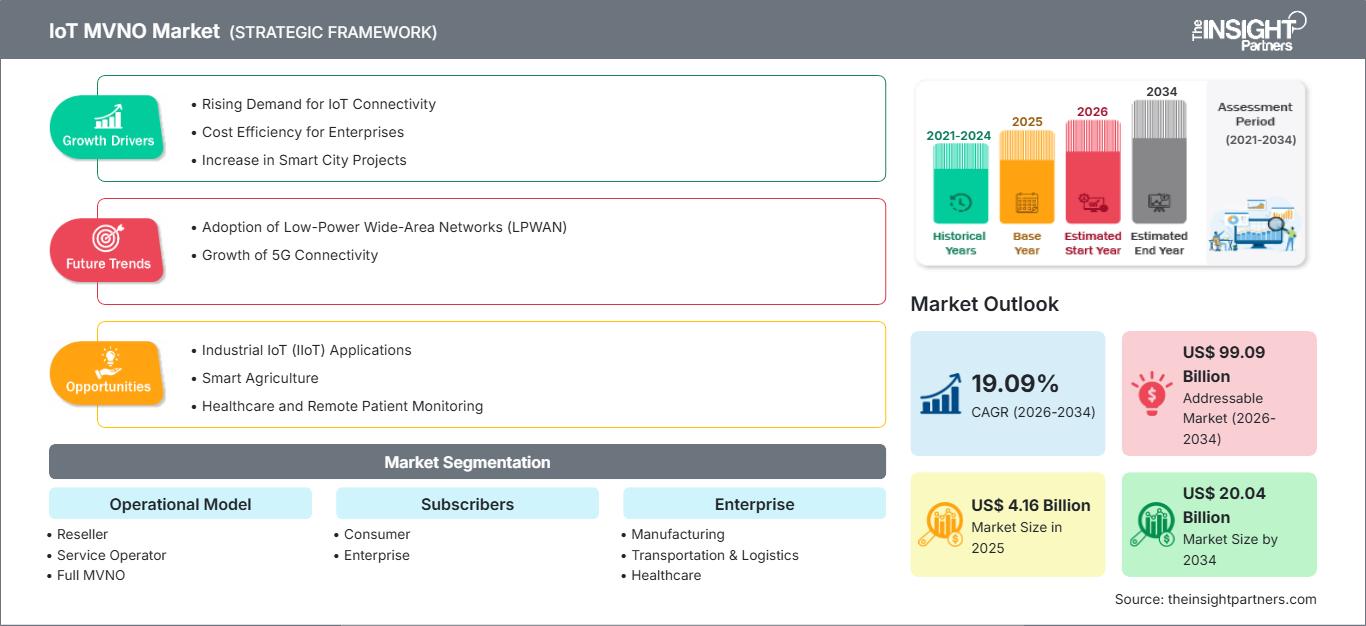
An IoT MVNO delivers specialized cellular connectivity, infrastructure, and management platforms without owning physical radio network infrastructure. By negotiating wholesale agreements with network operators, these virtual operators offer tailormade connectivity packages, multi-network roaming, simplified subscription management, and enhanced cybersecurity features. The increasing reliance on real-time data exchange across automotive, manufacturing, logistics, healthcare, and smart cities has elevated IoT MVNOs from niche connectivity resellers into critical enablers of enterprise digital transformation.
The IoT MVNO market was valued at US$ 4.16 Billion in 2025 and projected to reach US$ 20.04 Billion by 2034, expanding at a CAGR of 19.09% between 2026 and 2034 as enterprises seek flexible, multi-network cellular connectivity solutions. Connected-device proliferation across industrial and consumer applications is reshaping the market.
Key Drivers
Proliferation of Connected IoT Devices Across Industries
The continuous expansion of industrial automation, connected mobility, and smart city infrastructure serves as a primary catalyst for market growth. Millions of endpoints, ranging from smart utility meters to fleet telemetry sensors, require persistent, low-latency, and secure connectivity across international borders.
Rapid Transition to 5G and LPWAN Technologies
The global deployment of 5G infrastructure alongside Low-Power Wide-Area Network (LPWAN) standards such as NB-IoT and LTE-M enables high-density device connectivity and lower operational costs. IoT MVNOs capitalize on these technologies to support both high-bandwidth applications, such as autonomous vehicles and video surveillance, and ultra-low-power deployments.
Enterprise Demand for Multi-Carrier Global Roaming
Global enterprises operating distributed supply chains require seamless international connectivity without managing hundreds of individual carrier contracts. Specialized IoT MVNOs address this challenge through localized profiles and multi-IMSI technology, reducing roaming charges and eliminating single-point network dependency.
Download Sample Report@ https://www.theinsightpartners.com/sample/TIPRE00039495
Strategic Market Opportunities
- Mass Adoption of eSIM and iSIM Solutions: Embedded SIM (eSIM) and Integrated SIM (iSIM) technologies allow remote SIM provisioning and over-the-air profile management. This enables enterprises to deploy global devices with a single stock-keeping unit (SKU) and switch networks seamlessly to optimize performance and costs.
- Network Slicing and Private Cellular Networks: As 5G standalone architecture expands, IoT MVNOs can offer dedicated virtual network slices tailored to critical infrastructure, healthcare, or industrial operations that demand guaranteed throughput and strict security protocols.
- Managed Value-Added Services: Moving beyond basic data connectivity, MVNOs have vast growth potential in offering bundled end-to-end management services, including device orchestration, embedded security protocols, real-time telemetry analytics, and cloud integration platforms.
Market Segmentation Analysis
By Operational Model
- Full MVNO: Holds the largest market revenue share due to complete ownership over core network components, routing capabilities, and billing systems, offering maximum operational flexibility.
- Service Provider MVNO: Maintains intermediate control over billing and customer care while utilizing host network infrastructure.
- Reseller MVNO: Projects rapid growth due to minimal upfront capital requirements and fast service deployment.
By Application Vertical
- Automotive and Transportation: Dominates revenue share through connected car initiatives, telematics, predictive maintenance, and in-vehicle infotainment systems.
- Energy and Utilities: Fast-growing segment fueled by smart grid deployments, smart metering rollouts, and renewable energy monitoring.
- Healthcare and Logistics: Driven by remote patient monitoring systems, asset tracking, and cold-chain supply management.
By Geography
- North America: Accounts for significant market share due to early tech adoption, major cellular deployments, and presence of leading automotive enterprises.
- Europe: Strong presence driven by strict regulatory mandates around smart grid initiatives and connected vehicle standards.
- Asia-Pacific: Fastest-growing regional market, supported by rapid urbanization, massive smart city investments, and expanding manufacturing hubs.
Market News and Recent Developments
Industry participants are actively consolidating capabilities and expanding global connectivity reach through strategic partnerships and platform acquisitions:
- Strategic Infrastructure Acquisitions: Major industry players have consolidated assets by acquiring carrier connectivity management platforms and connected vehicle clouds to expand their operational reach across thousands of global enterprise accounts.
- GSMA Standardizations: The introduction and adoption of the GSMA SGP.32 architecture for IoT eSIM specification provides a streamlined framework for remote provisioning, significantly reducing deployment friction for enterprise customers.
- Partnerships for Hybrid Cloud Connectivity: Connectivity providers are partnering with cloud hyperscalers to integrate SIM management capabilities directly into cloud platforms, simplifying device-to-cloud data ingestion for industrial deployments.
Competitive Landscape and Top Players
The global IoT MVNO market displays moderate consolidation, with established telecommunications brands and agile specialized MVNOs competing through global coverage deals, multi-carrier management software, and competitive pricing structures.
Top Market Players
- Vodafone Group Plc (United Kingdom)
- KORE Wireless Group Inc. (United States)
- Wireless Logic Ltd. (United Kingdom)
- AT&T Inc. (United States)
- Aeris Communications Inc. (United States)
- 1NCE GmbH (Germany)
- Cubic Telecom Ltd. (Ireland)
- Telefónica S.A. (Spain)
- Sierra Wireless / Semtech Corporation (United States)
- Deutsche Telekom AG (Germany)
Get Full Copy of This Report @ https://www.theinsightpartners.com/buy/TIPRE00039495
Future Outlook
Looking ahead to 2034, the IoT MVNO market will evolve beyond traditional data connectivity management toward holistic device-to-cloud orchestration. The convergence of 5G network slicing, satellite-based non-terrestrial networks (NTN), and embedded artificial intelligence at the edge will require virtual operators to serve as trust and security orchestrators. Operators that invest in autonomous provisioning, zero-trust security architecture, and unified eSIM management will secure dominant positions in the global enterprise ecosystem.
About The Insight Partners
The Insight Partners provides comprehensive syndicated and tailored market research services in the healthcare, technology, and industrial domains. Renowned for delivering strategic intelligence and practical insights, the firm empowers businesses to remain competitive in ever-evolving global markets.
Contact Information
- Email: sales@theinsightpartners.com
- Website: theinsightpartners.com
- Phone: +1-646-491-9876
