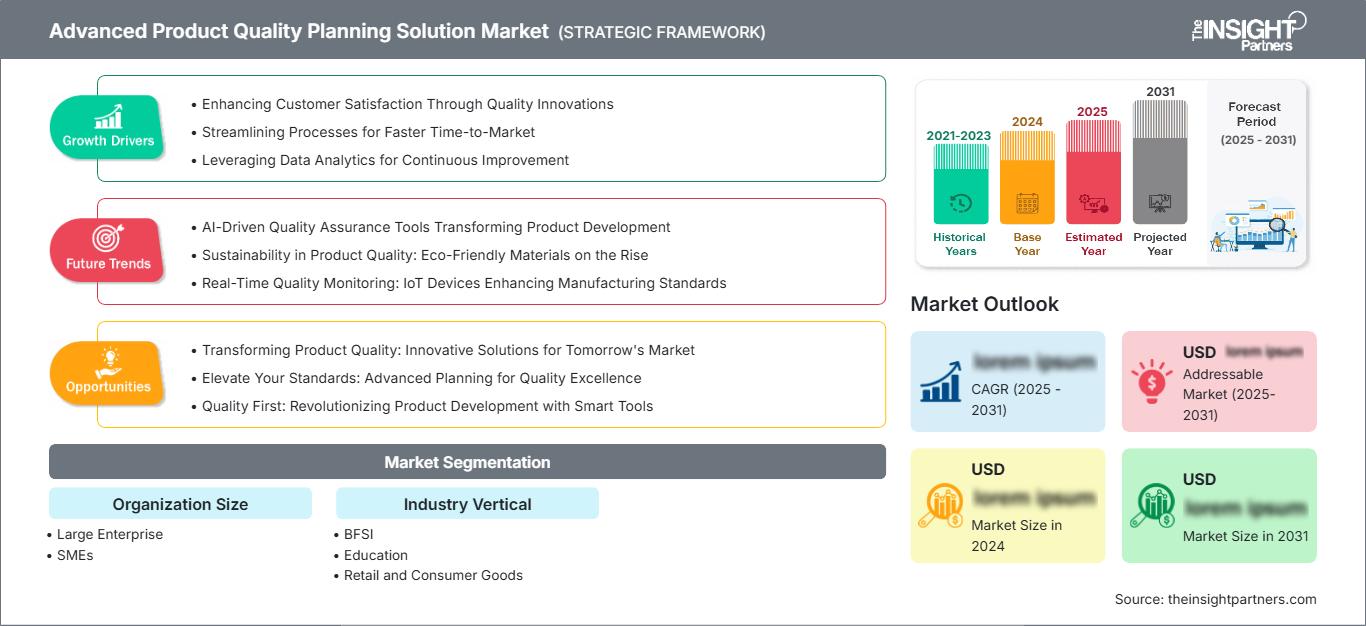
The global Advanced Product Quality Planning (APQP) solution market is undergoing significant transformation as global manufacturing industries transition toward automated, closed-loop quality management ecosystems. APQP provides a structured framework and software methodology designed to streamline product development from initial design concepts through full scale commercial production.
The advanced product quality planning solution market was valued at US$ 1.32 Billion in 2025 and is projected to reach US$ 2.78 Billion by 2034, expanding at a CAGR of 8.65% during 2026–2034.
Key Market Drivers
Stringent International Quality Standards and Regulatory Mandates
Strict compliance guidelines across highly regulated sectors continue to be a primary growth catalyst. Mandates such as IATF 16949 in automotive, AS9100 in aerospace, ISO 13485 in medical devices, and ISO 9001 across industrial manufacturing necessitate standardized quality planning and documented validation processes. Non-compliance can lead to severe financial penalties, product recalls, and operational halts, driving organizations to adopt specialized APQP software to enforce continuous compliance.
Need to Minimize Warranty Costs and Product Recalls
Product recalls and field failure liabilities represent substantial financial and reputational threats to original equipment manufacturers (OEMs). Implementing automated APQP platforms allows teams to identify design flaws and process vulnerabilities early in the pre-production stages. This proactive risk mitigation significantly reduces warranty claims, rework expenses, and scrap rates.
Digital Transformation and Industry 4.0 Integration
The shift toward connected manufacturing environments has heightened the need for centralized digital quality management. Industrial Internet of Things (IoT) sensors, automated inspection systems, and smart factory tools feed live operational data into APQP platforms, facilitating real-time monitoring and dynamic control plan updates.
Download Sample Report@ https://www.theinsightpartners.com/sample/TIPRE00020785
Emerging Market Opportunities
- Artificial Intelligence and Predictive Quality Analytics: Incorporating artificial intelligence and machine learning algorithms into APQP software offers immense market growth potential. AI tools can analyze historical failure modes to predict potential quality bottlenecks before physical prototypes are built, optimizing preventive action workflows.
- Electrification and Rapid Product Cycles in Automotive and Aerospace: The rapid evolution of electric vehicles (EVs), autonomous mobility, and commercial space ventures requires shortened product development timelines. Modern APQP software offers agile project management capabilities tailored for fast-paced engineering iterations.
- Cloud-Based SaaS Adoption among Small and Medium Enterprises (SMEs): Cloud deployment models lower capital expenditure barriers, making advanced APQP, FMEA, and PPAP automation accessible to Tier-2 and Tier-3 suppliers within global supply chains.
Market Segmentation
The global APQP solution market is segmented by component, deployment mode, enterprise size, and end-user industry:
- By Component:
- Software: Core APQP modules, FMEA tools, PPAP management, document control, and auditing tools.
- Services: Professional consulting, system integration, software implementation, and continuous training.
- By Deployment Mode:
- Cloud-Based / SaaS: Highly scalable solutions offering multi-tenant collaboration across multi-site global operations.
- On-Premises: Favored by aerospace, defense, and high-security sectors requiring strict localized data governance.
- By Enterprise Size:
- Large Enterprises: Dominate overall revenue share due to complex international supply networks.
- Small and Medium Enterprises (SMEs): Anticipated to register the fastest growth rate through 2034 due to cost-effective cloud offerings.
- By End-User Industry:
- Automotive & Transportation: Core consumer of APQP frameworks driven by EV platform expansion.
- Aerospace & Defense: Utilizing APQP for safety-critical component verification.
- Healthcare & Medical Devices: Applying APQP principles for medical device design controls.
- Industrial Manufacturing & Electronics: Expanding adoption to enhance operational efficiency and product reliability.
Market News and Recent Developments
Leading solution providers are actively investing in strategic partnerships, cloud transformations, and software acquisitions to offer unified engineering and quality platforms. Recent industry movements highlight a shift toward embedded PLM-QMS architectures where APQP functions communicate directly with Computer-Aided Design (CAD) and Bill of Materials (BOM) management tools.
Furthermore, regulatory updates emphasizing environmental sustainability, carbon footprint tracking, and material traceability are prompting vendors to update APQP modules with green compliance capabilities. Enterprise software developers are also introducing automated supplier portals that streamline the submission and approval of PPAP documentation, significantly reducing lead times for supplier onboarding.
Competitive Landscape and Top Key Players
The global market features a blend of established PLM software giants, specialized enterprise Quality Management Software (QMS) vendors, and industrial software conglomerates. Key players competing in the market include:
- Siemens AG (Siemens Digital Industries Software / Opcenter)
- Dassault Systèmes SE
- PTC Inc. (including Arena Solutions)
- Autodesk Inc.
- SAP SE
- Oracle Corporation
- Aras Corporation
- MasterControl Inc.
- ETQ LLC (Hexagon AB)
- Omnex Systems LLC
Market competitors focus on continuous feature enhancement, artificial intelligence integration, and flexible API connections with third-party ERP and MES platforms to gain competitive market share.
Get Full Copy of This Report @ https://www.theinsightpartners.com/buy/TIPRE00020785
Future Outlook
Looking forward to 2034, the Advanced Product Quality Planning solution market is poised for sustained expansion. As manufacturing ecosystems become increasingly digital and interconnected, APQP software will evolve from reactive quality documentation platforms into predictive engineering assistants. AI-driven FMEA, digital twin integration, automated compliance workflows, and cloud-enabled supplier collaboration will define the next generation of APQP solutions. Organizations that invest in modern, unified APQP platforms will gain a distinct competitive advantage through shorter time-to-market, enhanced product reliability, and reduced total cost of quality.
About The Insight Partners
The Insight Partners provides comprehensive syndicated and tailored market research services in the healthcare, technology, and industrial domains. Renowned for delivering strategic intelligence and practical insights, the firm empowers businesses to remain competitive in ever-evolving global markets.
Contact Information
- Email: sales@theinsightpartners.com
- Website: theinsightpartners.com
- Phone: +1-646-491-9876
