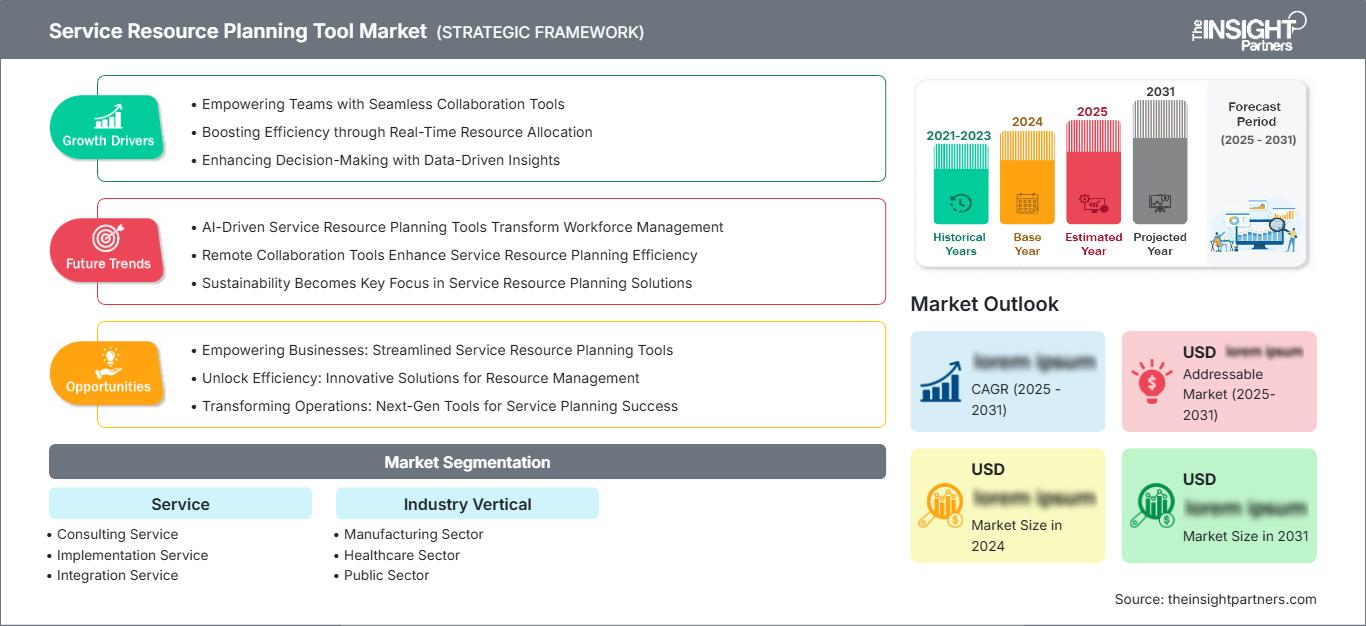
The global Service Resource Planning (SRP) tool market is experiencing rapid expansion as service-centric enterprises prioritize operational agility, resource optimization, and automated workflow management. Unlike traditional Enterprise Resource Planning (ERP) systems designed primarily for physical asset tracking and manufacturing supply chains, service resource planning software is built specifically for professional services, IT and telecom, healthcare, and consulting firms. These dedicated platforms unify human capital allocation, capacity planning, project tracking, and financial forecasting into a centralized digital ecosystem.
The Service resource planning tool market was valued at US$ 7.14 Billion in 2025 and is projected to reach US$ 13.24 Billion by 2034, expanding at a CAGR of 7.09% during 2026–2034.
Key Market Drivers
- Demand for Higher Operational Efficiency and Automation: Service organizations face continuous pressure to increase billable hours, streamline scheduling, and eliminate administrative overhead. Automated SRP software replaces prone-to-error manual spreadsheets with real-time resource tracking and automated billing workflows.
- Accelerated Shift to Cloud-Based Software (SaaS): Cloud deployment offers scalable, secure, and cost-effective access for businesses of all sizes. Cloud-native SRP solutions enable distributed teams to collaborate seamlessly across global regions with live data updates.
- Integration of Artificial Intelligence and Machine Learning: Next-generation SRP platforms leverage AI for predictive capacity planning, intelligent task assignment, and proactive risk detection. These smart capabilities allow managers to align talent allocation directly with business profitability.
- Expansion of Distributed and Remote Workforce Models: Managing remote and hybrid project teams requires centralized platforms that provide clear visibility into team availability, individual skill sets, and project commitments.
Download Sample Report@ https://www.theinsightpartners.com/sample/TIPRE00028896
Strategic Market Opportunities
- Tailored Solutions for Small and Medium Enterprises (SMEs): While large enterprises led early adoption, SMEs represent a major growth vector. Software vendors offering modular, cost-effective, and easy-to-implement SRP tools can gain substantial market share in expanding mid-market segments.
- Deep Ecosystem Integrations with Core Enterprise Tools: Building native connectors for Customer Relationship Management (CRM), accounting, and Human Capital Management (HCM) systems offers software providers a distinct competitive advantage.
- Transition to Outcome-Based and Value-Based Billing: As professional services move away from strict hourly rates toward value-driven pricing, SRP tools that accurately model margins, revenue forecasting, and delivery milestones will see surging demand.
Market Segmentation Analysis
The Service Resource Planning Tool Market is segmented by component, deployment model, enterprise size, and industry vertical:
- By Component:
- Software Solutions: Encompasses core modules for resource scheduling, project accounting, capacity forecasting, and time tracking.
- Services: Includes implementation, system integration, professional consulting, and ongoing technical support.
- By Deployment Mode:
- Cloud-Based (SaaS): Accounts for the largest revenue share owing to rapid deployment, low capital expenditure, and high remote accessibility.
- On-Premise: Utilized by select large organizations requiring strict data residency controls and specialized security configurations.
- By Enterprise Size:
- Large Enterprises: Holds dominant market revenue due to multi-entity operations, complex international tax structures, and high user counts.
- Small and Medium Enterprises (SMEs): Fastest-growing segment as agile service providers seek affordable tools to scale operations smoothly.
- By Industry Vertical:
- IT and Telecommunications: The largest end-user segment, relying on SRP tools for field management, network projects, and IT service delivery.
- Professional Services and Consulting: Rapidly adopting SRP tools to track billable utilization, client health, and project margins.
- Healthcare and Life Sciences: Utilized for specialized staff scheduling, resource dispatching, and regulatory compliance.
- BFSI, Media, and Utilities: Expanding usage to optimize cross-departmental project workflows and asset allocation.
Market News and Recent Developments
- Adoption of Autonomous Agentic AI: Leading SRP vendors are embedding agentic AI capabilities that autonomously resolve scheduling conflicts, adjust workload distributions, and update project forecasts without manual intervention.
- Strategic Investments and Mergers: High demand for professional services automation has spurred increased venture capital funding and strategic acquisitions aimed at unifying back-office financial tools with front-office project execution platforms.
- Heightened Focus on Governance and Compliance: Platform providers are enhancing data security frameworks, offering SOC 2 Type II certification, GDPR compliance, and granular role-based access controls to meet enterprise procurement requirements.
Market Analysis and Competitive Landscape
The global SRP tool market is highly dynamic, featuring a blend of global enterprise software leaders, professional services automation specialists, and niche cloud innovators. Competition centers on platform depth, AI capabilities, implementation speed, and seamless integration with existing software stacks.
Top Key Market Players
- SAP SE: Offers robust enterprise solutions integrating service planning and asset management capabilities.
- Oracle Corporation (NetSuite): Delivers enterprise cloud platforms connecting project management, resource tracking, and financial oversight.
- Microsoft Corporation: Provides integrated resource planning and field service management through Microsoft Dynamics 365.
- IFS: Offers specialized service management and resource planning platforms for asset-intensive and field-service industries.
- Kantata (formerly Mavenlink and Kimble): Provides deep professional services cloud solutions focused on resource management and financial visibility.
- Rocketlane: A key innovator delivering agentic AI-driven professional services automation and unified resource scheduling.
- Certinia (formerly FinancialForce): Offers specialized Salesforce-native resource planning and project accounting solutions.
- Zoho Corporation: Provides scalable, accessible resource planning software tailored for growing teams and mid-sized businesses.
- Accelo: Delivers mid-market automation tools connecting client operations, resource allocation, and billing.
Get Full Copy of This Report @ https://www.theinsightpartners.com/buy/TIPRE00028896
Future Outlook
Looking forward through 2034, the Service Resource Planning tool market will be driven by the imperative for real-time visibility and AI-powered operational intelligence. The ongoing evolution from static resource scheduling to predictive, autonomous workforce orchestration will allow companies to maximize profit margins, lower employee burnout, and consistently deliver superior service quality. Organizations that adopt modern, flexible SRP platforms will gain a durable competitive edge in an increasingly digital service economy.
About The Insight Partners
The Insight Partners provides comprehensive syndicated and tailored market research services in the healthcare, technology, and industrial domains. Renowned for delivering strategic intelligence and practical insights, the firm empowers businesses to remain competitive in ever-evolving global markets.
Contact Information
- Email: sales@theinsightpartners.com
- Website: theinsightpartners.com
- Phone: +1-646-491-9876
