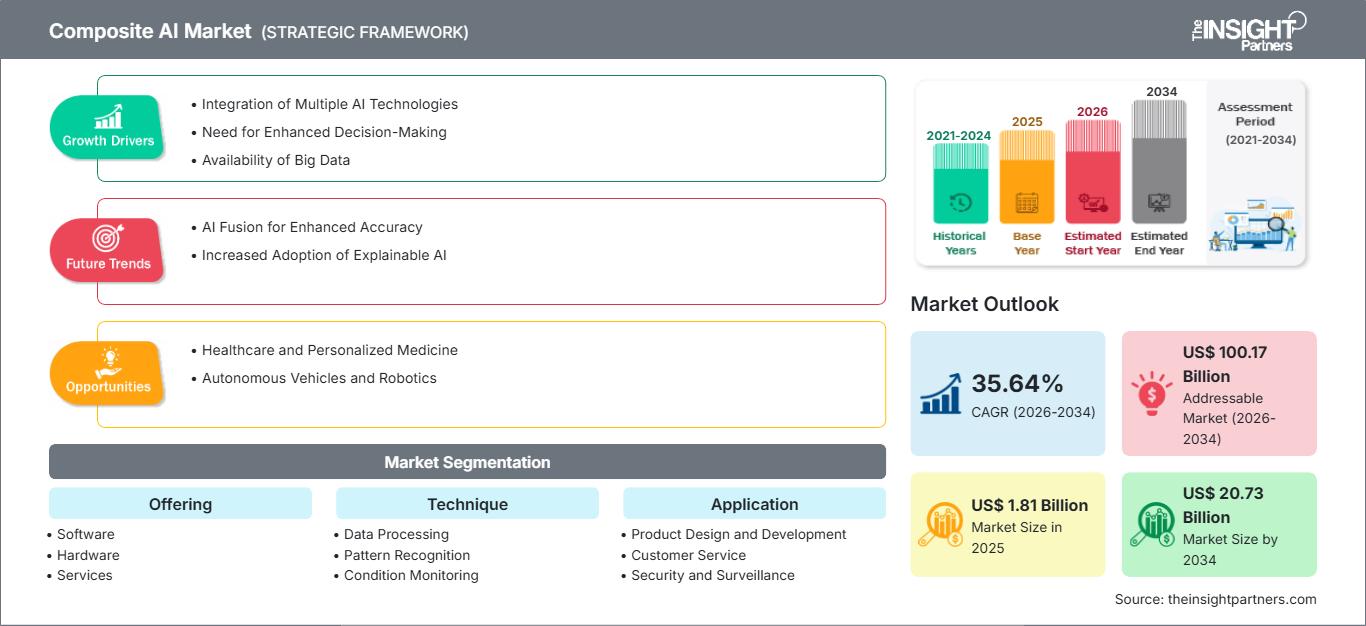
The global Composite AI market is experiencing unprecedented expansion as enterprise demand shifts from isolated machine learning models to multi-modal, interconnected intelligence frameworks. Composite AI refers to the strategic fusion of distinct artificial intelligence techniques, including machine learning (ML), natural language processing (NLP), computer vision, symbolic reasoning, and knowledge graphs. By combining data-driven algorithms with rule-based models, composite AI overcomes the limitations of single-model architectures, delivering higher accuracy, contextual understanding, and operational efficiency.
The Composite AI Market is projected to grow significantly, expanding from US$ 1.81 Billion in 2025 to US$ 20.73 Billion by 2034, reflecting a robust CAGR of 35.64% between 2026 and 2034.
Key Market Drivers
- Rising Complexity and Volume of Enterprise Data: Traditional, single-technique AI models struggle to process heterogeneous data sources such as text, images, video, and tabular telemetry simultaneously. Composite AI enables multi-modal processing, allowing organizations to synthesize disparate data streams into actionable operational intelligence.
- Demand for Explainable AI (XAI) and Regulatory Compliance: Pure deep learning networks are often critique-prone black boxes. Integrating rule-based systems and knowledge graphs with statistical machine learning enables enterprises to trace model outputs, satisfy regulatory compliance frameworks, and verify audit trails.
- Higher Efficiency and Reduced Compute Costs: Combining specialized lightweight algorithms with larger foundational models optimizes computational consumption. Composite AI orchestrates task-specific models dynamically, lowering cloud processing infrastructure overhead while improving overall execution speed.
- Scaling Enterprise Process Automation: Organizations across finance, healthcare, and supply chain management require end-to-end automation. Composite AI integrates Robotic Process Automation (RPA) with cognitive vision and language models to handle nuanced enterprise workflows without human intervention.
Download Sample Report@ https://www.theinsightpartners.com/sample/TIPRE00039794
Growth Opportunities
- Edge AI Integration: Deploying composite AI models on edge computing devices opens transformative opportunities in autonomous vehicles, remote patient monitoring, smart grids, and industrial Internet of Things (IoT) applications.
- Hyper-Personalization in E-Commerce and Banking: By combining behavioral machine learning with real-time NLP and graph analytics, institutions can deliver hyper-personalized financial advisory, dynamic pricing, and tailored product recommendation engines.
- Advanced Predictive Maintenance in Manufacturing: Combining sensor telemetry analysis, computer vision inspection, and rule-based diagnostic engines allows industrial manufacturers to anticipate equipment failures before outages occur, substantially minimizing downtime costs.
Market Segmentation
The composite AI market is structured into distinct segments based on technology, offering, deployment model, and end-user industry.
By Technology Type
- Machine Learning (ML): Holds the largest market share due to its core application in pattern recognition and predictive modeling.
- Natural Language Processing (NLP): Demonstrates rapid growth driven by conversational AI, document analysis, and multilingual intent processing.
- Computer Vision: Crucial for visual quality control, spatial recognition, and autonomous navigation.
- Symbolic AI & Knowledge Graphs: Essential for rule enforcement, reasoning, and semantic data structure mapping.
By Offering
- Software: Encompasses composite AI orchestration platforms, pre-built domain frameworks, and SDKs. Software commands the dominant revenue share.
- Services: Includes system integration, custom AI model development, managed services, and technical consulting.
By End-User Industry
- Banking, Financial Services, and Insurance (BFSI): Leads the market in adoption for automated fraud detection, algorithmic risk management, and personalized customer banking.
- Healthcare and Life Sciences: Utilizes composite AI for diagnostic imaging, drug discovery, clinical decision support systems, and patient care workflow optimization.
- Retail and E-Commerce: Applied in demand forecasting, dynamic supply chain routing, and personalized recommendation systems.
- Manufacturing: Drives adoption in industrial automation, automated quality assurance, and predictive equipment maintenance.
- Transportation and Logistics: Applied in fleet management, route optimization, and autonomous delivery logistics.
Market News and Recent Developments
Enterprise technology providers are actively expanding their composite AI capabilities through model orchestration platforms, strategic acquisitions, and multi-cloud ecosystems.
- Multi-Model Orchestration Platforms: Leading cloud providers have launched integrated foundation services, such as AWS Bedrock and IBM Watsonx, enabling enterprises to combine deep learning foundational models with domain-specific rule engines and enterprise data catalogs.
- Generative and Symbolic AI Hybridization: Major enterprise software providers like Salesforce and SAP have introduced solutions combining generative content tools (such as Einstein GPT) with structured CRM and ERP data stores (such as SAP Datasphere), improving enterprise decision-making fidelity.
- Strategic Ecosystem Collaborations: Tech leaders are forming deep technical alliances with system integrators to build sector-specific composite AI suites targeting financial compliance, clinical diagnostic workflows, and intelligent supply chain optimization.
Competitive Landscape and Top Players
The global composite AI market features a competitive landscape dominated by global technology conglomerates alongside specialized AI infrastructure providers. Market leaders focus heavily on product innovation, expanding developer ecosystem frameworks, and pursuing targeted acquisitions to enhance multi-modal capabilities.
Top Key Players
- IBM Corporation (USA)
- Microsoft Corporation (USA)
- Google LLC (Alphabet Inc.) (USA)
- Amazon Web Services, Inc. (AWS) (USA)
- NVIDIA Corporation (USA)
- Salesforce, Inc. (USA)
- SAP SE (Germany)
- Oracle Corporation (USA)
- SAS Institute Inc. (USA)
- DataRobot, Inc. (USA)
- BlackSwan Technologies (Israel)
- Pegasystems Inc. (USA)
Get Full Copy of This Report @ https://www.theinsightpartners.com/buy/TIPRE00039794
Future Outlook
Through 2034, the composite AI market is positioned to move from early enterprise adoption into standard architecture for complex artificial intelligence deployment. As multi-modal workloads expand, businesses will increasingly phase out isolated point-solution models in favor of hybrid, explainable composite frameworks. Advancements in quantum-assisted machine learning, edge deployment, and automated model orchestration will further boost efficiency and scalability. Organizations that implement robust composite AI architectures will gain a clear competitive edge in operational agility, regulatory compliance, and automated decision-making precision across global markets.
About The Insight Partners
The Insight Partners provides comprehensive syndicated and tailored market research services in the healthcare, technology, and industrial domains. Renowned for delivering strategic intelligence and practical insights, the firm empowers businesses to remain competitive in ever-evolving global markets.
Contact Information
- Email: sales@theinsightpartners.com
- Website: theinsightpartners.com
- Phone: +1-646-491-9876
