Radio frequency identification technology is becoming an increasingly important part of connected operations, helping organizations identify, track, authenticate, and manage physical objects without requiring direct line-of-sight scanning. From retail shelves and warehouses to industrial facilities, healthcare environments, transportation systems, and access-control applications, RFID-enabled solutions are helping businesses improve visibility and operational efficiency. Advances in semiconductor design, wireless connectivity, data analytics, and low-power electronics are also expanding the role of RFID beyond conventional identification applications. As organizations continue to digitize physical assets and automate information flows, demand for compact and reliable identification components is expected to remain strong through the coming years.
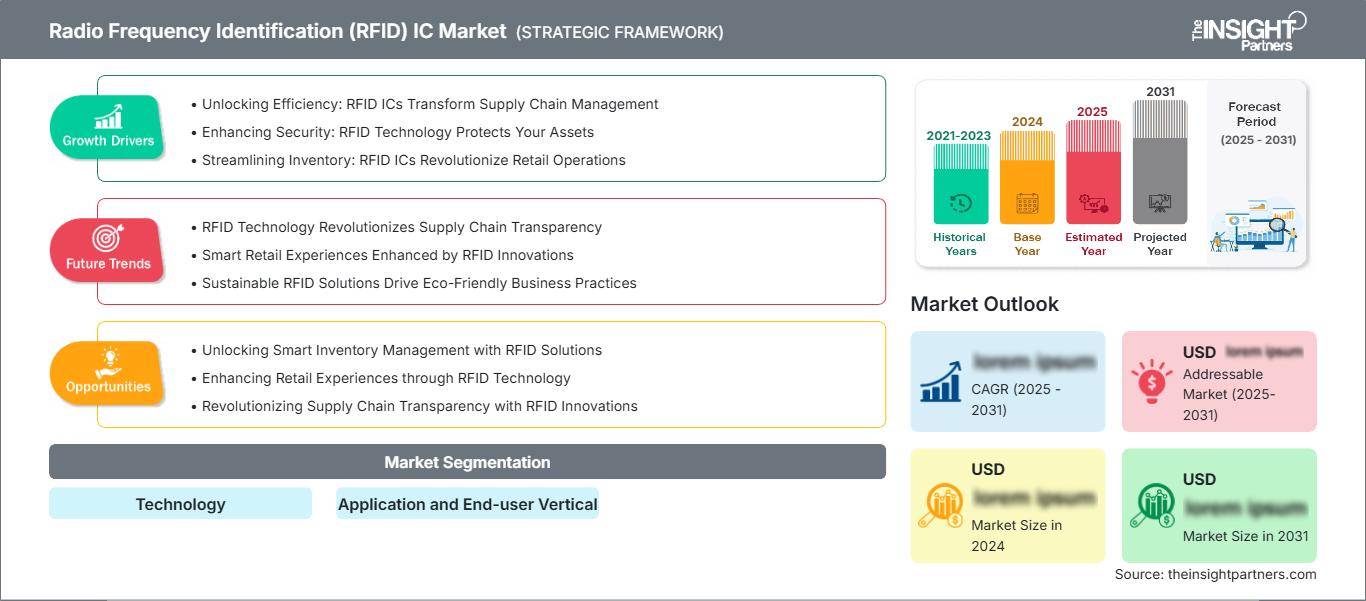
The Radio Frequency Identification (RFID) IC Market is gaining momentum as manufacturers and end users seek faster inventory management, improved supply chain visibility, enhanced asset tracking, and more automated workflows. According to The Insight Partners, the industry is analyzed across technology, application, end-user vertical, and major geographic regions, providing a comprehensive view of growth opportunities through 2031. The report also examines strategic insights, market drivers, emerging trends, competitive dynamics, and regional developments shaping the industry.
Get a Sample PDF: https://www.theinsightpartners.com/sample/TIPTE100000428
Growing Demand for Automated Identification
One of the strongest factors supporting the Radio Frequency Identification (RFID) IC Market is the increasing need to automate identification and tracking processes. Traditional barcode-based systems generally require line-of-sight scanning and can become inefficient when organizations handle large quantities of products or assets. RFID allows multiple tagged objects to be identified through radio communication, supporting faster data capture and improved operational visibility.
Retailers are increasingly using RFID to monitor inventory, improve stock accuracy, reduce product loss, and support omnichannel fulfillment. In logistics and warehousing, RFID ICs can help organizations track goods throughout storage and distribution processes. Manufacturing companies are also adopting RFID-enabled identification for work-in-progress monitoring, equipment tracking, production-line visibility, and supply chain coordination.
RFID ICs Strengthen Supply Chain Visibility
Supply chain modernization remains an important growth driver. Businesses are under increasing pressure to understand where products, components, containers, and equipment are located at different stages of their operational cycles. RFID IC-based solutions can provide automated identification capabilities that complement enterprise software, warehouse management systems, and Internet of Things platforms.
The technology can also contribute to better inventory accuracy by reducing manual data-entry requirements. As businesses move toward connected warehouses and smart factories, RFID ICs are increasingly positioned as an enabling component for real-time physical asset visibility.
Key Market Size, Share, Trends, Analysis, and Forecast Insights by 2031
- Market Size: The Radio Frequency Identification (RFID) IC Market is expected to expand steadily through 2031 as RFID adoption increases across retail, logistics, manufacturing, healthcare, transportation, and other industries.
- Market Share: Competitive share is influenced by semiconductor capabilities, product performance, technology specialization, manufacturing scale, customer relationships, and the ability to support diverse RFID applications.
- Market Trends: Important trends include higher RFID adoption in smart inventory systems, connected supply chains, automated retail, asset tracking, sustainable tagging solutions, and integration with IoT platforms.
- Market Analysis: Growth is being supported by increasing automation, the need for supply chain transparency, technological innovation, and demand for reliable identification systems across multiple end-user sectors.
- Market Forecast: Through 2031, opportunities are expected to develop around advanced RFID architectures, intelligent tracking, connected infrastructure, and applications requiring greater data visibility and operational efficiency.
Technology Trends Transforming the Industry
Technological development is influencing the evolution of RFID ICs. Manufacturers are working toward solutions that deliver improved sensitivity, reliability, memory capabilities, energy efficiency, and compatibility with increasingly sophisticated applications.
Another important trend is the development of RFID solutions for connected and sustainable environments. Organizations are exploring ways to combine identification capabilities with sensing, data collection, and IoT connectivity. RFID systems can therefore move beyond simple product identification toward applications involving condition monitoring, authentication, asset intelligence, and automated decision-making.
The growing emphasis on sustainability is also influencing product development. Businesses are looking for solutions that can improve resource utilization, reduce inventory waste, and support more transparent product lifecycles.
Global and Regional Analysis
Asia Pacific is expected to remain an important region for RFID adoption because of its extensive manufacturing base, expanding logistics infrastructure, growing retail sector, and increasing investment in automation. Countries such as China, Japan, India, and Australia are important contributors to regional technology development and adoption. The region’s large-scale electronics and semiconductor ecosystem also creates opportunities for RFID IC manufacturers.
North America represents another significant growth environment, supported by advanced retail operations, logistics modernization, industrial automation, healthcare applications, and strong investment in connected technologies. The United States is particularly important because businesses across supply chain-intensive industries continue to prioritize inventory visibility and automation.
Europe is also witnessing increasing adoption as retailers, manufacturers, logistics companies, and other organizations invest in digital transformation and operational efficiency. Meanwhile, South and Central America and the Middle East and Africa offer emerging opportunities as businesses modernize supply chain infrastructure and adopt connected identification technologies. The Insight Partners covers North America, Europe, Asia Pacific, South and Central America, and the Middle East and Africa in its regional assessment.
Updated Industry Developments and Competitive Landscape
Recent industry analysis highlights continued interest in UHF RFID IC technologies, particularly for large-scale identification, inventory, and asset-tracking applications. Independent industry research also points toward strong adoption potential for UHF solutions through 2031, reflecting growing demand for RFID-enabled automation and connected operations.
The competitive environment includes semiconductor manufacturers, RFID technology specialists, and companies developing solutions for specific applications and end-user industries. According to The Insight Partners, prominent companies identified in the competitive landscape include:
- Alien Technology Corporation
- ams AG
- EM Microelectronic
- Atmel Corporation
- Infineon Technologies AG
- Microchip Technology
- Toshiba Corporation
- STMicroelectronics
- NXP Semiconductors
Competition is increasingly centered on product performance, energy efficiency, scalability, application flexibility, technological innovation, and the ability to support customers across different RFID ecosystems.
Industry Opportunities
The Radio Frequency Identification (RFID) IC Market is creating opportunities beyond traditional retail and warehouse applications. Healthcare providers can use RFID-enabled systems for equipment and asset tracking, while transportation organizations can improve identification and monitoring processes. Industrial companies can integrate RFID with smart manufacturing platforms to improve production visibility and workflow management.
The combination of RFID with IoT, cloud platforms, analytics, and automation can further increase its commercial potential. As organizations seek more connected operations, RFID ICs can serve as a bridge between physical objects and digital information systems.
Challenges and Strategic Considerations
Despite its potential, adoption can be affected by implementation costs, interoperability requirements, privacy considerations, infrastructure compatibility, and differences in operating environments. Organizations must also select appropriate RFID technologies based on read range, frequency requirements, application conditions, tag design, and data-management needs.
For manufacturers, continued investment in semiconductor innovation and application-specific solutions will be important. For end users, successful deployment will depend on integration with existing enterprise systems and clear identification of measurable operational benefits.
Get the Premium Research Report @ https://www.theinsightpartners.com/buy/TIPTE100000428
Future Outlook
The outlook for the Radio Frequency Identification (RFID) IC Market remains promising as businesses increasingly connect physical assets with digital systems. The combination of supply chain automation, smart retail, industrial digitization, IoT integration, and demand for real-time visibility is expected to create new opportunities through 2031. Future developments are likely to focus on more efficient IC architectures, intelligent sensing capabilities, improved interoperability, and sustainable RFID solutions. As organizations continue shifting from manual tracking toward automated and data-driven operations, RFID IC technology is positioned to remain an important component of next-generation identification and asset intelligence ecosystems.
Related Reports –
Home Energy Management System Market Regional Share, Trend, and Growth Opportunity
Vision Transformers Market Regional Share, Trend, and Growth Opportunity
Differential-Pressure Mass Flow Controller Market Regional Share, Trend, and Growth Opportunity
About The Insight Partners
The Insight Partners is a leading market research and consulting firm delivering actionable insights through in-depth industry analysis and strategic intelligence. The firm supports clients across various industries in making informed business decisions by providing comprehensive market forecasts, competitive assessments, and growth opportunities.
Contact Us:
If you have any queries about this report or if you would like further information, please contact us:
Contact Person: Ankit Mathur
E-mail: sales@theinsightpartners.com
Phone: +1-646-491-9876
Also Available in :
Korean | German | Japanese | French | Chinese | Italian | Spanish
