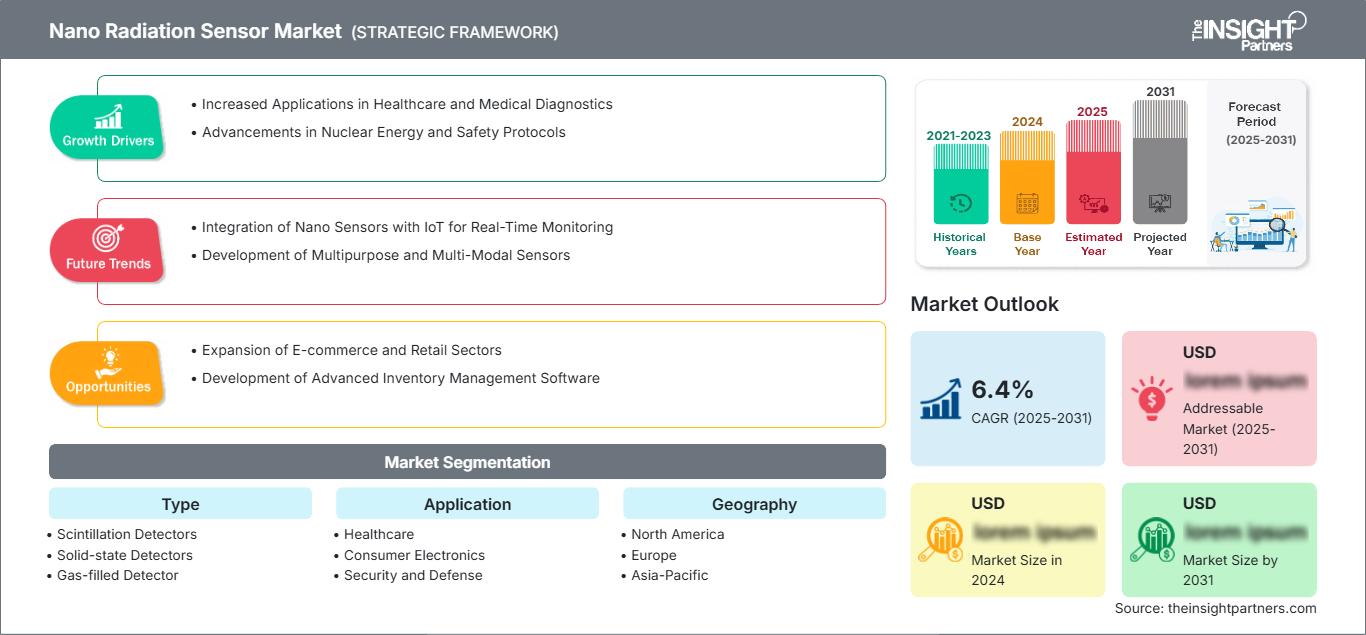
Radiation detection is becoming increasingly important across healthcare, nuclear energy, industrial safety, defense, environmental monitoring, and research. As organizations seek more accurate, compact, energy-efficient, and connected detection solutions, advances in nanotechnology are enabling sensors with improved sensitivity, smaller form factors, and greater deployment flexibility. These developments are particularly relevant in environments where conventional detection systems may be difficult to deploy or where real-time monitoring is essential.
The Nano Radiation Sensor Market is gaining attention as manufacturers and technology developers explore next-generation detection architectures for increasingly demanding applications. According to The Insight Partners, the industry is projected to register a CAGR of 6.4% during the forecast period to 2031. The study covers scintillation detectors, solid-state detectors, and gas-filled detectors across healthcare, consumer electronics, security and defense, oil and gas, power plants, and other applications.
Get a Sample PDF: https://www.theinsightpartners.com/sample/TIPRE00004142
Rising Demand for Compact and High-Sensitivity Detection
One of the strongest growth factors is the increasing requirement for precise radiation monitoring in healthcare and medical diagnostics. Radiation-based technologies are extensively used in X-ray imaging, computed tomography, radiotherapy, nuclear medicine, and other diagnostic and treatment procedures. Nano-enabled sensing technologies can support the development of smaller and highly responsive monitoring devices, helping organizations improve radiation safety and measurement capabilities.
Nuclear energy is another important growth driver. Expansion of nuclear power generation, stricter safety protocols, radioactive waste management requirements, and continuous monitoring needs are encouraging investment in advanced detection systems. The Insight Partners identifies healthcare applications and advances in nuclear energy and safety protocols as significant factors supporting industry expansion.
Miniaturization is also reshaping the competitive landscape. NIST has highlighted the potential of chip-scale radiation sensing technologies for applications spanning medicine, homeland security, and space exploration. Its work on photonic sensors demonstrates how nanomanufacturing and telecommunications technologies can be applied to create highly compact radiation dosimetry solutions.
Updated Industry Developments Strengthen Innovation
Recent scientific developments underline the broader movement toward portable, intelligent, and highly sensitive radiation measurement. In April 2026, NIST researchers reported a portable electron spin resonance instrument for retrospective dosimetry, with potential applications in radiation protection, emergency response, medical physics, and environmental monitoring. Such developments demonstrate the industry’s continuing focus on portability and practical deployment.
The integration of sensing, computing, and advanced materials is also creating new opportunities. Research into nanoscale and chip-based detectors is supporting more localized measurements, while emerging approaches involving advanced semiconductor materials, photonic structures, and quantum technologies could further improve detection performance. NIST has also highlighted compact quantum sensing approaches and their potential relevance to radiation-related monitoring and safety applications.
Nano Radiation Sensor Market Size, Share, Trends, Analysis, and Forecast by 2031
- Market Size: The global industry is expected to expand steadily through 2031, supported by growing adoption of compact radiation detection technologies across healthcare, energy, industrial, and security applications.
- Market Share: North America represents a significant regional opportunity because of its advanced healthcare infrastructure, nuclear-energy ecosystem, defense investments, and strong research capabilities.
- Market Trends: Key trends include sensor miniaturization, IoT integration, portable monitoring, advanced semiconductor detectors, low-power operation, and real-time data transmission.
- Market Analysis: Scintillation detectors, solid-state detectors, and gas-filled detectors remain important technology categories, with application demand varying across healthcare, power generation, industrial operations, defense, and energy.
- Market Forecast: The industry is expected to maintain a positive growth trajectory through 2031 as organizations prioritize radiation safety, remote monitoring, improved measurement accuracy, and connected sensing systems.
Global and Regional Analysis
North America is positioned as an important region due to its mature healthcare sector, nuclear infrastructure, defense capabilities, and continued investment in sensor research. The United States is particularly relevant for advanced radiation detection development, with research organizations and technology companies pursuing miniaturized and high-performance sensing solutions.
Europe is expected to benefit from stringent occupational safety requirements, nuclear decommissioning activities, medical technology adoption, and environmental monitoring initiatives. Demand for reliable detection equipment is likely to remain important across healthcare facilities, research institutions, industrial sites, and nuclear-related operations.
Asia Pacific presents substantial opportunities because of expanding healthcare infrastructure, nuclear power development, industrialization, and technological manufacturing capabilities. China, Japan, India, and other regional economies are investing in advanced electronics and sensing technologies, creating a favorable environment for next-generation radiation monitoring solutions.
South and Central America, along with the Middle East and Africa, offer emerging opportunities as healthcare modernization, industrial development, energy projects, and environmental monitoring requirements increase. The Insight Partners report evaluates these geographic markets alongside North America, Europe, and Asia Pacific.
Key Players
Major companies profiled in the competitive landscape include:
- Analog Devices, Inc.
- Baker Hughes
- First Sensor AG
- Canon Electron Tubes and Devices Co., Ltd.
- Mirion Technologies Inc.
- Nihon Kessho Kogaku Co., Ltd.
- PCE Instruments
- Hamamatsu Photonics K.K.
- Thermo Fisher Scientific Inc.
- Raytheon Company
These companies are competing through technology development, product innovation, detector performance improvements, strategic partnerships, and expansion into specialized sensing applications.
Technology Trends Creating New Opportunities
IoT connectivity is emerging as an important trend, allowing radiation sensors to collect and transmit data continuously for centralized monitoring. Connected devices can support remote supervision of hazardous locations, healthcare facilities, industrial plants, and energy infrastructure.
Portable and autonomous detection is another major opportunity. The IAEA notes that advances in mobile instruments are enabling radiation measurements in real-world environments such as disaster zones and mining areas. Lightweight detectors can also be integrated with navigation systems and mobile platforms for environmental radiation mapping.
The development of compact detectors for unmanned aerial vehicles is further expanding the potential use of advanced radiation sensing. IAEA-supported work includes lightweight systems capable of radiation detection and spectrometric measurements, reflecting the industry’s movement toward mobile and remotely operated monitoring.
Get the Premium Research Report @ https://www.theinsightpartners.com/buy/TIPRE00004142
Future Outlook
The future outlook for the Nano Radiation Sensor Market remains promising as demand shifts toward smaller, smarter, connected, and more energy-efficient detection solutions. Healthcare providers, nuclear operators, defense organizations, industrial companies, and environmental agencies are expected to continue investing in technologies that deliver accurate radiation measurements while enabling flexible deployment. Increasing integration with IoT platforms, advanced materials, photonics, AI-enabled analytics, and portable systems could further expand application opportunities through 2031.
As research moves toward chip-scale sensing and highly integrated detection architectures, manufacturers that can combine sensitivity, reliability, low power consumption, compact design, and real-time connectivity are likely to gain competitive advantages. Overall, continued technological innovation and growing emphasis on radiation safety are expected to support sustained industry development over the coming years.
Related Reports –
Home Energy Management System Market Regional Share, Trend, and Growth Opportunity
Vision Transformers Market Regional Share, Trend, and Growth Opportunity
Differential-Pressure Mass Flow Controller Market Regional Share, Trend, and Growth Opportunity
About The Insight Partners
The Insight Partners is a leading market research and consulting firm delivering actionable insights through in-depth industry analysis and strategic intelligence. The firm supports clients across various industries in making informed business decisions by providing comprehensive market forecasts, competitive assessments, and growth opportunities.
Contact Us:
If you have any queries about this report or if you would like further information, please contact us:
Contact Person: Ankit Mathur
E-mail: sales@theinsightpartners.com
Phone: +1-646-491-9876
Also Available in :
Korean | German | Japanese | French | Chinese | Italian | Spanish
