The global food supply chain is undergoing a significant transformation as businesses seek faster, safer, more transparent, and resilient ways to move perishable products from farms and processing facilities to retailers and consumers. The growing complexity of international food trade, increasing demand for fresh and frozen products, expansion of online grocery shopping, and pressure to reduce food waste are encouraging logistics providers to adopt connected technologies. Real-time monitoring, automated warehousing, intelligent transportation systems, predictive analytics, and digital traceability are becoming increasingly important across temperature-sensitive supply chains.
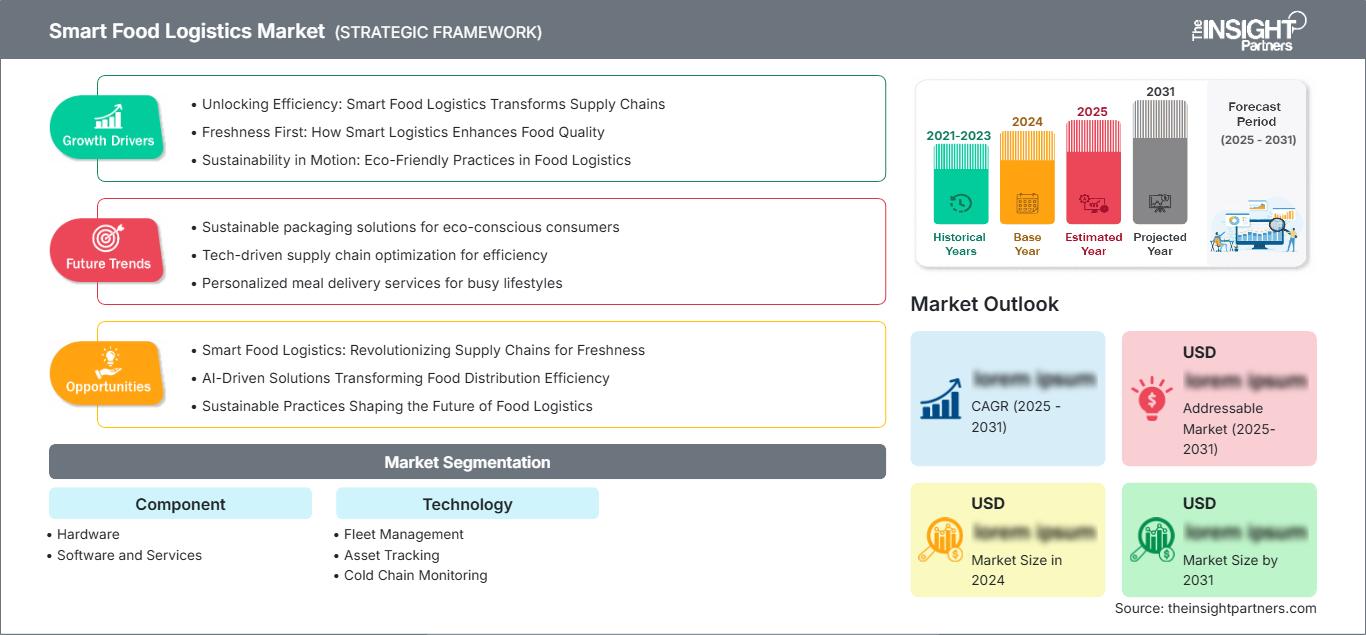
The Smart Food Logistics Market is gaining momentum as food manufacturers, retailers, distributors, and logistics providers integrate Internet of Things (IoT), artificial intelligence (AI), cloud platforms, sensors, asset tracking, and automated systems into logistics operations. These technologies enable organizations to monitor shipments, manage inventory, optimize routes, maintain cold-chain conditions, and improve end-to-end supply chain visibility. According to The Insight Partners, the sector is analyzed across hardware, software and services, with key technology areas including fleet management, asset tracking, and cold chain monitoring.
Download Sample PDF Link: https://www.theinsightpartners.com/sample/TIPRE00017563
Smart Food Logistics Market Trends and Industry Drivers
The growing adoption of connected cold-chain infrastructure is one of the strongest forces shaping the Smart Food Logistics Market. Temperature-sensitive products such as dairy, meat, seafood, fruits, vegetables, frozen foods, and prepared meals require consistent environmental conditions throughout transportation and storage. IoT-enabled sensors and connected monitoring platforms allow operators to detect temperature deviations and respond before products are compromised. Industry analysis also highlights cold chain monitoring as a significant technology area because real-time visibility can improve product quality, safety, and operational efficiency.
AI and predictive analytics are further changing logistics decision-making. Businesses are increasingly using intelligent software to forecast demand, optimize routes, predict equipment issues, improve inventory planning, and identify potential disruptions. Recent industry developments show that AI and automation are becoming major priorities for cold-chain and third-party logistics providers, particularly for supply chain visibility, inventory management, labor efficiency, and order fulfillment.
Another important trend is the increasing focus on food traceability. In the US, the FDA released updated guidance and information following industry tabletop exercises designed to improve preparedness for Food Traceability Rule requirements. The initiative emphasizes the ability of covered businesses to maintain and rapidly retrieve electronic records associated with food products moving through the supply chain.
Smart Food Logistics Market Size, Share, Trends, Analysis and Forecast to 2031
The outlook toward 2031 indicates continued expansion as digital technologies become more deeply integrated into food transportation, warehousing, inventory management, and delivery operations.
- Market Size: The Smart Food Logistics Market is expected to expand steadily through 2031 as businesses invest in connected infrastructure, automated logistics, cold-chain monitoring, and digital supply chain platforms.
- Market Share: Hardware, software, and services are expected to remain important components, while cold chain monitoring, fleet management, and asset tracking continue to support adoption across food-related logistics operations.
- Market Trends: IoT connectivity, AI-based forecasting, real-time temperature monitoring, smart warehousing, automated fulfillment, and end-to-end visibility are expected to remain key trends through 2031.
- Market Analysis: Growth is being supported by e-commerce grocery expansion, demand for fresh food, food safety requirements, supply chain complexity, sustainability initiatives, and the need to minimize spoilage and operational losses.
- Market Forecast: By 2031, logistics ecosystems are expected to become increasingly data-driven, with connected devices, intelligent software, automation, and predictive decision-making becoming more integral to food distribution.
The Smart Food Logistics Market is also benefiting from innovations in refrigerated transportation. In July 2026, Maersk announced the rollout of next-generation IoT connectivity devices across its refrigerated container fleet, designed to provide more consistent data flow and smarter cargo tracking. The company said the deployment is intended to strengthen real-time visibility throughout refrigerated cargo journeys.
Global and Regional Analysis
North America is positioned as an important region for the Smart Food Logistics Market because of its mature logistics infrastructure, high technology adoption, sophisticated retail networks, and growing emphasis on food traceability. The United States is particularly significant due to regulatory developments surrounding food traceability and the increasing use of digital systems across food distribution networks.
Europe is also expected to maintain strong adoption, supported by sustainability objectives, sophisticated cold-chain infrastructure, food safety requirements, and the increasing need to improve supply chain efficiency. Companies across the region are exploring automation and connected technologies to improve resource utilization and reduce food waste.
Asia Pacific represents a major growth opportunity because of expanding food processing industries, increasing urbanization, rising e-commerce penetration, and investments in modern logistics infrastructure. India, China, Japan, South Korea, and other developing economies are progressively adopting digital tracking and temperature-controlled logistics solutions.
Recent developments in India further demonstrate the direction of regional innovation. A dedicated refrigerated container rail service launched in Gujarat is designed to support frozen food exports by connecting an inland container depot with Mundra Port, highlighting the growing importance of temperature-controlled multimodal transportation.
Key Players in the Smart Food Logistics Market
Key companies identified across industry research and competitive analyses include:
- ORBCOMM, Inc.
- Berlinger & Co. AG
- LYNA LOGICS, Inc.
- YUSEN LOGISTICS CO., LTD.
- Hacobu Co., Ltd.
- Nippon Express Co., Ltd.
- Controlant
- Samsara Networks, Inc.
- Monnit Corporation
- Maersk
These companies are competing through connected tracking solutions, cold-chain monitoring, fleet management platforms, IoT infrastructure, data analytics, and logistics services.
Industry Analysis and Emerging Opportunities
The Smart Food Logistics Market is moving beyond basic shipment tracking toward integrated supply chain intelligence. Organizations increasingly want one connected environment that combines sensor data, transportation management, warehouse management, inventory information, and predictive analytics. This integration can help logistics teams make faster decisions while improving product visibility and customer service.
Sustainability is another important opportunity. Better route planning, optimized warehouse operations, efficient refrigeration, and improved inventory management can help companies reduce unnecessary transportation, energy consumption, and food waste. Cold-chain technology providers are increasingly focusing on practical solutions that combine connectivity, automation, sustainability, and operational reliability.
At the same time, businesses must address challenges such as high technology implementation costs, integration with legacy systems, cybersecurity risks, inconsistent connectivity, and the need for skilled personnel. Smaller food producers and logistics operators may face greater barriers when adopting sophisticated digital infrastructure.
Get the Premium Research Report @ https://www.theinsightpartners.com/buy/TIPRE00017563
Future Outlook
The future of the Smart Food Logistics Market through 2031 is expected to be shaped by greater connectivity, automation, artificial intelligence, predictive analytics, and digital traceability. Logistics providers will increasingly transition from reactive shipment management toward predictive and proactive supply chain operations. Connected cold-chain systems, intelligent warehouses, autonomous technologies, and real-time analytics are expected to play an increasingly important role in protecting food quality and improving distribution efficiency.
As food companies face rising expectations for freshness, transparency, safety, affordability, and sustainability, investment in smart logistics infrastructure is likely to remain a strategic priority. The convergence of IoT, AI, cloud computing, automation, and traceability is expected to create more resilient food supply chains and strengthen the long-term growth prospects of the Smart Food Logistics Market through 2031. The Insight Partners identifies the sector across hardware, software and services as well as fleet management, asset tracking, cold chain monitoring, and other technologies, providing a framework for understanding this evolving industry.
Related Reports –
Home Energy Management System Market Regional Share, Trend, and Growth Opportunity
Vision Transformers Market Regional Share, Trend, and Growth Opportunity
Differential-Pressure Mass Flow Controller Market Regional Share, Trend, and Growth Opportunity
About The Insight Partners
The Insight Partners is a leading market research and consulting firm delivering actionable insights through in-depth industry analysis and strategic intelligence. The firm supports clients across various industries in making informed business decisions by providing comprehensive market forecasts, competitive assessments, and growth opportunities.
Contact Us:
If you have any queries about this report or if you would like further information, please contact us:
Contact Person: Ankit Mathur
E-mail: sales@theinsightpartners.com
Phone: +1-646-491-9876
Also Available in :
Korean | German | Japanese | French | Chinese | Italian | Spanish
