The rapid evolution of connected healthcare, smart fitness devices, and intelligent consumer electronics is transforming how people collect and use real-time information about their bodies and surroundings. From smartwatches and fitness bands to smart glasses, connected clothing, and medical patches, sensing technologies are becoming increasingly compact, accurate, energy-efficient, and capable of continuous monitoring. These developments are encouraging manufacturers to integrate advanced sensing capabilities into everyday devices while creating new opportunities across healthcare, consumer electronics, sports, fitness, and industrial applications.
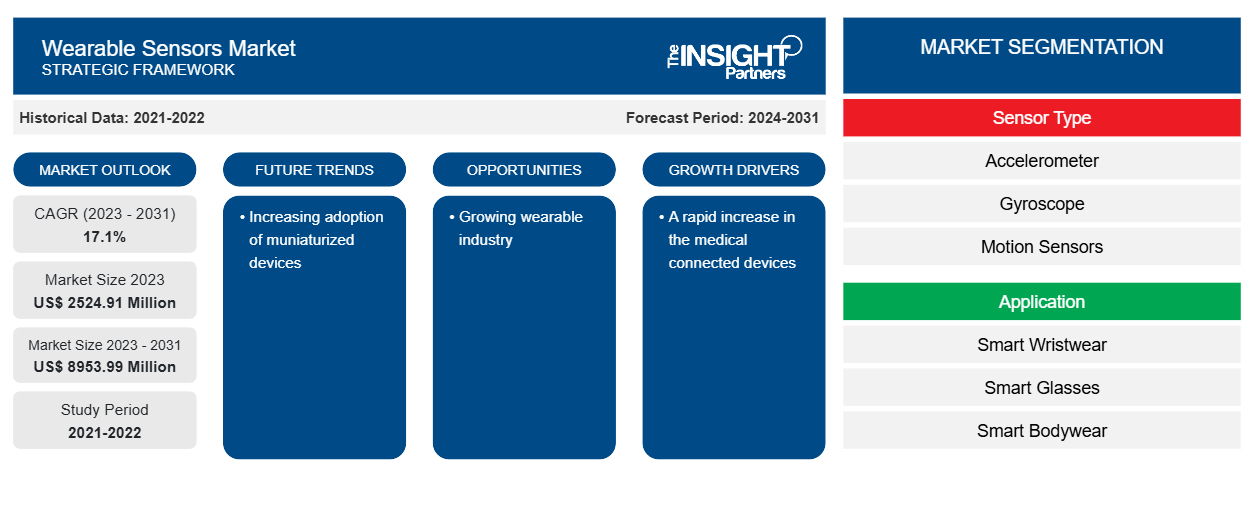
The Wearable Sensors Market is gaining significant momentum as demand increases for continuous health monitoring, personalized wellness insights, activity tracking, and connected devices. According to The Insight Partners, North America dominated the market in 2023, while increasing adoption of miniaturized devices is expected to remain an important trend through 2031. The company’s latest analysis examines sensor types including accelerometers, gyroscopes, motion sensors, image sensors, pressure and force sensors, touch sensors, and position sensors across smart wristwear, smart glasses, smart bodywear, smart footwear, and other applications.
Get a Sample PDF: https://www.theinsightpartners.com/sample/TIPRE00002908
Rising Demand for Continuous Health Monitoring
One of the strongest growth drivers is the increasing emphasis on preventive and personalized healthcare. Wearable devices can continuously collect physiological and activity-related information, allowing users and healthcare professionals to observe changes over time. This capability is particularly relevant to remote patient monitoring, fitness management, chronic-care support, rehabilitation, sleep monitoring, and general wellness.
The expansion of connected medical devices is also encouraging sensor manufacturers to develop solutions that combine higher sensitivity with smaller form factors. The Insight Partners identifies the rapid increase in medical connected devices and the growing wearable industry among the major factors supporting expansion.
Miniaturization is another important development. Advances in microfabrication and nanotechnology are enabling smaller sensors that can be integrated into lightweight consumer and medical devices without compromising functionality. The trend is also supporting the development of smart fabrics and other unobtrusive sensing formats.
Artificial Intelligence and Advanced Sensor Technologies Reshape the Industry
The convergence of wearable sensing and artificial intelligence is creating new opportunities for real-time data interpretation. Instead of simply recording measurements, next-generation devices increasingly analyze patterns and provide personalized insights.
Recent research is exploring AI-driven anomaly detection using wearable data to identify subtle deviations in physiological and behavioral patterns. Such technologies could support more proactive monitoring and home-based healthcare when appropriately validated.
Meanwhile, emerging research into wearable sweat-monitoring platforms is expanding the possibilities for non-invasive biochemical sensing. Sweat-based technologies are being investigated for continuous measurement of biomarkers, although clinical validation and the relationship between sweat measurements and established diagnostic standards remain important challenges.
Recent industry developments also highlight the expansion of sensing beyond conventional smartwatches. For example, researchers are developing smart garments and sensor-enabled devices designed to support early health screening and continuous monitoring. A recently reported smart-bra concept combines thermal sensing, electrical impedance measurements, and AI-based analysis as a potential complementary approach to breast-health screening, demonstrating the broader direction of wearable sensing innovation.
Wearable Sensors Market Size, Share, Trends, Analysis, and Forecast to 2031
Key qualitative findings from the industry outlook include:
- Market Size: Expansion is supported by increasing adoption of connected wearables across healthcare, fitness, consumer electronics, and industrial applications.
- Market Share: North America held a leading position in 2023, supported by advanced healthcare infrastructure, strong technology adoption, and established connected-device ecosystems.
- Market Trends: Miniaturization, low-power sensing, AI-assisted analytics, smart fabrics, continuous monitoring, and non-invasive sensing are among the most important trends shaping the industry.
- Market Analysis: Accelerometers, gyroscopes, motion sensors, pressure and force sensors, optical technologies, and other sensing technologies are being incorporated into increasingly diverse wearable platforms.
- Market Forecast: Growth through 2031 is expected to remain closely linked to the expansion of medical connected devices, consumer health monitoring, remote care, smart fitness products, and next-generation wearable form factors.
Global and Regional Analysis
North America represents a major center of adoption due to the presence of advanced healthcare systems, technology companies, research institutions, and consumers willing to adopt connected health solutions. The region’s established ecosystem for smartwatches, medical wearables, remote monitoring, and digital health applications creates favorable conditions for continued innovation.
Europe is also witnessing opportunities driven by healthcare digitization, wellness awareness, medical technology development, and growing interest in remote monitoring. However, regulatory requirements for medical technologies can influence product development and commercialization timelines.
Asia Pacific is emerging as an important growth region due to expanding consumer electronics manufacturing, rising healthcare technology adoption, increasing smartphone penetration, and growing demand for fitness and wellness products. The region’s manufacturing capabilities also support the development of smaller and more cost-efficient sensing components.
South and Central America and the Middle East and Africa are expected to present additional opportunities as digital healthcare infrastructure, consumer awareness, connected devices, and technology accessibility continue to improve.
Key Players
Leading companies identified in The Insight Partners’ analysis include:
- Texas Instruments Incorporated
- NXP Semiconductors
- Analog Devices, Inc.
- STMicroelectronics
- Infineon Technologies AG
- Sensirion AG
- Robert Bosch GmbH
- Panasonic Corporation
- TE Connectivity Corporation
- TDK Corporation
These companies are participating in the development of sensing technologies that address requirements for compact design, energy efficiency, connectivity, accuracy, and integration across multiple wearable platforms.
Get the Premium Research Report @ https://www.theinsightpartners.com/buy/TIPRE00002908
Future Outlook
The future of the industry is expected to move beyond basic activity tracking toward continuous, intelligent, and increasingly personalized sensing. Advances in MEMS, flexible electronics, biosensors, AI, low-power connectivity, and smart materials could enable wearable products to collect richer information while becoming more comfortable and less intrusive.
Healthcare is likely to remain one of the most influential application areas as providers explore remote monitoring and data-enabled care models. At the same time, consumer applications will continue to evolve through smart rings, watches, clothing, eyewear, footwear, and emerging skin-integrated technologies.
As sensor technology becomes smaller and more intelligent, the competitive landscape is likely to favor companies capable of combining sensing hardware with analytics, connectivity, software, and reliable user experiences. Continued innovation, clinical validation, data privacy, interoperability, and regulatory compliance will therefore remain central to the industry’s long-term development.
Related Reports –
Home Energy Management System Market Regional Share, Trend, and Growth Opportunity
Vision Transformers Market Regional Share, Trend, and Growth Opportunity
Differential-Pressure Mass Flow Controller Market Regional Share, Trend, and Growth Opportunity
About The Insight Partners
The Insight Partners is a leading market research and consulting firm delivering actionable insights through in-depth industry analysis and strategic intelligence. The firm supports clients across various industries in making informed business decisions by providing comprehensive market forecasts, competitive assessments, and growth opportunities.
Contact Us:
If you have any queries about this report or if you would like further information, please contact us:
Contact Person: Ankit Mathur
E-mail: sales@theinsightpartners.com
Phone: +1-646-491-9876
Also Available in :
Korean | German | Japanese | French | Chinese | Italian | Spanish
