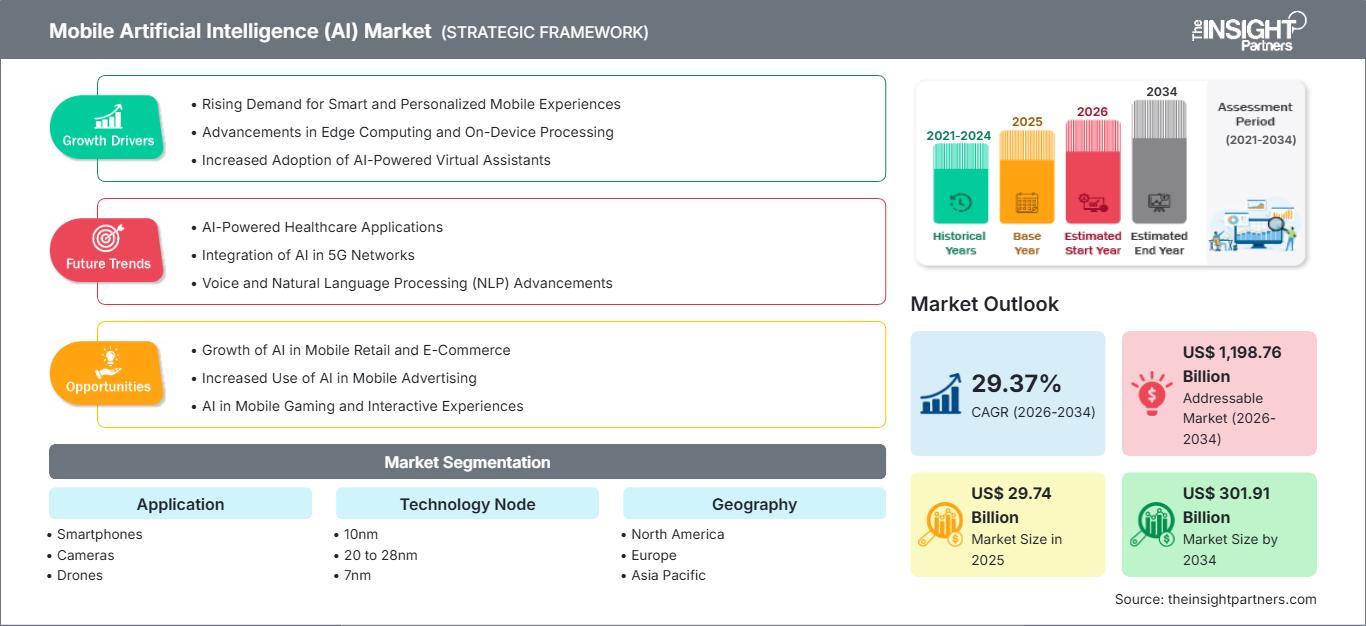
Artificial intelligence is rapidly becoming a core part of everyday mobile experiences, transforming smartphones, cameras, drones, vehicles, robotics, and immersive technologies. Faster processors, dedicated neural processing capabilities, edge computing, and increasingly capable AI models are enabling intelligent functions to operate closer to users. From real-time image enhancement and language translation to voice assistance, predictive recommendations, autonomous navigation, and personalized interfaces, AI is changing how consumers and businesses interact with connected devices.
The Mobile Artificial Intelligence (AI) Market is entering a new phase as manufacturers and technology providers shift from cloud-dependent intelligence toward more responsive, personalized, and increasingly on-device experiences. According to The Insight Partners, the sector is being shaped by rising demand for smart mobile experiences, advances in edge computing, on-device processing, AI-powered virtual assistants, and expanding applications across smartphones, cameras, drones, automotive, robotics, AR/VR, smart boards, and PCs.
Get a Sample PDF: https://www.theinsightpartners.com/sample/TIPEL00002426
Mobile AI Industry Trends Accelerating Adoption
One of the most important developments is the growing ability of mobile devices to process sophisticated AI workloads locally. On-device processing can reduce latency, improve responsiveness, support privacy-sensitive applications, and allow selected AI functions to continue operating when connectivity is limited. Qualcomm, for example, highlights on-device generative AI, local large language model execution, personalization, and AI-powered agentic experiences as major capabilities of its latest mobile platforms.
The smartphone segment remains a major catalyst for adoption. AI-powered photography, real-time translation, call assistance, content creation, personalized recommendations, and intelligent search are increasingly becoming differentiating features rather than experimental additions. Recent industry developments also show manufacturers extending AI capabilities across broader device portfolios. Samsung, for instance, has indicated plans to bring AI capabilities across its smartphone lineup, demonstrating how mobile intelligence is moving beyond premium devices toward mass-market adoption.
Generative AI is further expanding the scope of mobile intelligence. Instead of simply recognizing images, speech, or patterns, newer systems can generate text, images, summaries, recommendations, and contextual responses. This creates opportunities for mobile AI applications in productivity, education, entertainment, retail, healthcare, customer engagement, and digital services.
Market Size, Share, Trends, Analysis, and Forecast by 2031
- Market Size: The industry is positioned for substantial expansion through 2031 as AI capabilities become integrated into an increasing range of mobile and edge devices.
- Market Share: Smartphones represent a significant application area, while cameras, drones, automotive systems, robotics, AR/VR, smart boards, and PCs are creating additional avenues for technology adoption.
- Market Trends: Key trends include on-device AI, generative AI, AI-powered assistants, edge intelligence, multimodal processing, personalized experiences, and increasingly efficient AI accelerators.
- Market Analysis: Growth is supported by advances in semiconductor architectures, neural processing units, AI software frameworks, 5G connectivity, and demand for low-latency intelligent applications.
- Market Forecast: Through 2031, increasing integration of AI across consumer electronics and intelligent machines is expected to create new commercial opportunities for chipmakers, device manufacturers, software developers, platform providers, and solution vendors.
Global and Regional Analysis
Globally, the Mobile Artificial Intelligence (AI) Market is being driven by the convergence of semiconductor innovation, mobile connectivity, cloud-edge computing, and intelligent software. North America remains an important innovation center because of its strong technology ecosystem, advanced semiconductor capabilities, AI research infrastructure, and presence of major platform and chip companies. The United States is particularly influential in areas such as AI software, mobile processors, cloud services, and intelligent device ecosystems.
Europe is advancing through investments in AI, connected devices, industrial automation, privacy-focused technology, and automotive intelligence. The region presents opportunities for mobile AI applications across manufacturing, mobility, healthcare, robotics, and consumer technology.
Asia Pacific is expected to remain a highly significant regional environment because of its large electronics manufacturing base, extensive smartphone ecosystem, semiconductor development, and rapid adoption of connected technologies. China, Japan, South Korea, and India are important contributors to the regional technology landscape, with applications spanning smartphones, cameras, robotics, automotive systems, and consumer electronics. The Insight Partners report also provides country-level coverage across major global regions, including North America, Europe, Asia Pacific, and South and Central America.
Key Growth Drivers
The rising demand for personalized digital experiences is a fundamental growth driver. Consumers increasingly expect smartphones and connected devices to understand context, automate routine actions, improve content, and provide more natural interactions.
Advancements in edge computing are equally important. Processing AI workloads closer to the device can improve response times while reducing dependence on remote computing resources. This is particularly valuable for applications involving real-time computer vision, voice processing, augmented reality, autonomous machines, and intelligent transportation.
The growing adoption of virtual assistants and natural language technologies is another important factor. More capable language models are enabling devices to interpret conversational requests, summarize information, translate languages, and perform increasingly complex tasks.
At the same time, developers are exploring mobile AI applications in healthcare, retail, advertising, gaming, and e-commerce. AI-enabled mobile applications can personalize recommendations, support remote monitoring, improve customer engagement, and deliver interactive experiences.
Key Players
The competitive landscape includes major semiconductor, cloud, software, and technology companies, including:
- Advanced Micro Devices, Inc.
- Apple Inc.
- Amazon Web Services, Inc.
- IBM Corporation
- Google LLC
- Huawei Technologies Co., Ltd.
- Intel Corporation
- MediaTek Inc.
- NVIDIA Corporation
- Qualcomm Inc.
These companies are competing through processor innovation, AI acceleration, software ecosystems, cloud-edge integration, device partnerships, and intelligent application development.
Latest Industry Developments
Recent technology developments reinforce the shift toward practical on-device intelligence. Qualcomm’s latest mobile AI ecosystem emphasizes local generative AI, AI agents, multimodal models, personalization, and privacy-oriented processing. Its Snapdragon platforms are designed to support AI workloads directly on smartphones, helping manufacturers deliver more responsive intelligent features.
The broader smartphone industry is also moving toward AI-centric product differentiation. Recent device launches and technology roadmaps increasingly emphasize intelligent photography, real-time assistance, translation, productivity, and personalized user experiences. This evolution indicates that AI capabilities are becoming deeply integrated into the overall mobile computing architecture rather than remaining standalone software features.
Get the Premium Research Report @ https://www.theinsightpartners.com/buy/TIPEL00002426
Future Outlook
The future of the Mobile Artificial Intelligence (AI) Market will be shaped by the continued convergence of efficient AI chips, advanced models, edge computing, 5G connectivity, and intelligent applications. Through 2031, mobile AI is expected to expand beyond smartphones into vehicles, drones, robots, cameras, AR/VR systems, and other intelligent devices. Greater emphasis on privacy, energy efficiency, multimodal interaction, and autonomous AI agents will further influence product development. As AI becomes more capable and accessible, companies that combine powerful hardware with useful, secure, and human-centered experiences are likely to gain a stronger position in the evolving mobile technology landscape. The Insight Partners identifies on-device processing, personalized experiences, virtual assistants, healthcare applications, and natural language advancements among the key forces influencing the industry’s future direction.
Related Reports –
Home Energy Management System Market Regional Share, Trend, and Growth Opportunity
Vision Transformers Market Regional Share, Trend, and Growth Opportunity
Differential-Pressure Mass Flow Controller Market Regional Share, Trend, and Growth Opportunity
About The Insight Partners
The Insight Partners is a leading market research and consulting firm delivering actionable insights through in-depth industry analysis and strategic intelligence. The firm supports clients across various industries in making informed business decisions by providing comprehensive market forecasts, competitive assessments, and growth opportunities.
Contact Us:
If you have any queries about this report or if you would like further information, please contact us:
Contact Person: Ankit Mathur
E-mail: sales@theinsightpartners.com
Phone: +1-646-491-9876
Also Available in :
Korean | German | Japanese | French | Chinese | Italian | Spanish
