The rapid evolution of industrial automation, connected manufacturing, and energy-efficient operations is changing how companies manage electric motors across factories and critical infrastructure. Modern motor control technologies are moving beyond basic starting and stopping functions to deliver real-time monitoring, diagnostics, protection, communication, and performance optimization. Increasing deployment of connected equipment across manufacturing, water and wastewater, oil and gas, chemicals, pharmaceuticals, food and beverage, and power generation is creating new opportunities for advanced motor management solutions. The growing emphasis on reducing unplanned downtime and improving equipment reliability is also encouraging industrial operators to adopt digitally enabled control architectures.
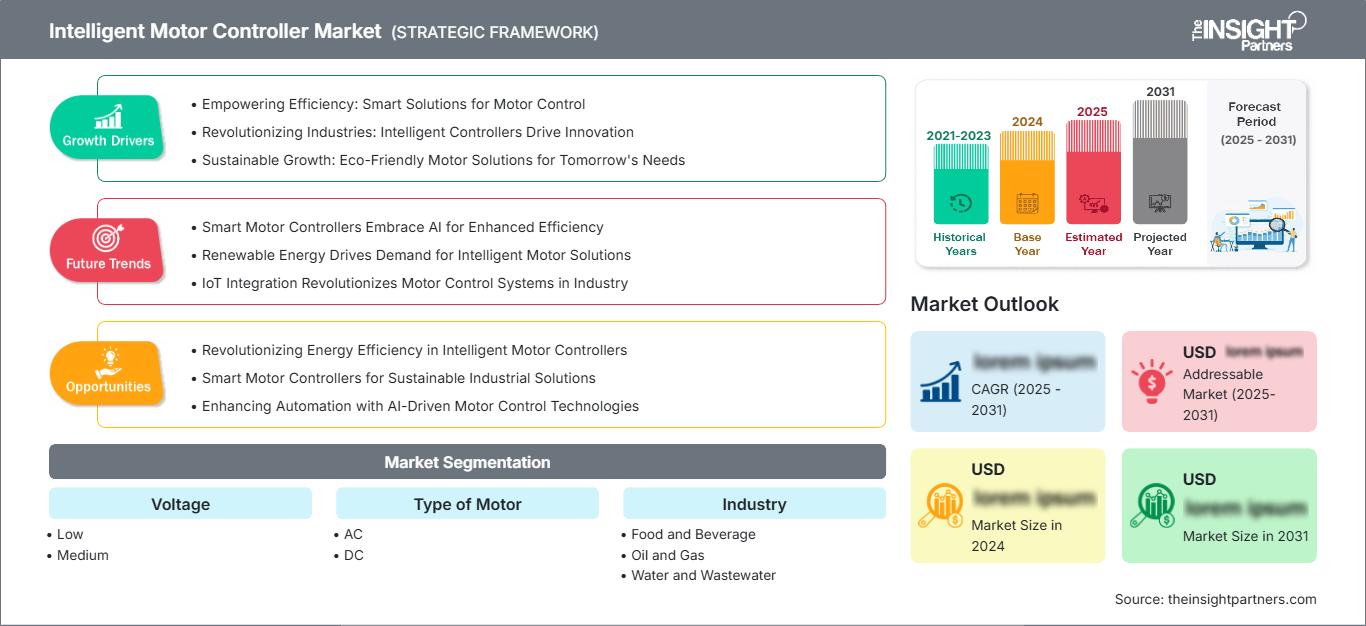
The Intelligent Motor Controller Market is gaining momentum as manufacturers seek smarter and more connected ways to operate motors. Intelligent controllers combine control, protection, diagnostics, and communication capabilities, allowing operators to gain greater visibility into motor performance. According to The Insight Partners, the industry is being analyzed across low- and medium-voltage solutions, AC and DC motor types, and applications spanning multiple process industries.
Get a Sample PDF: https://www.theinsightpartners.com/sample/TIPRE00026485
Rising Industrial Automation Creates New Growth Opportunities
Industrial automation remains one of the strongest forces supporting adoption. Factories increasingly depend on automated pumps, compressors, fans, conveyors, production equipment, and material-handling systems. Intelligent motor controllers help integrate these assets with broader automation platforms while providing operational data that can support faster decision-making.
Another important driver is the growing focus on energy efficiency. Motors represent a substantial portion of electricity consumption in many industrial facilities, making efficient operation an important consideration for plant managers. Intelligent controllers can help optimize speed, torque, starting, stopping, and operating conditions, supporting efforts to reduce unnecessary energy consumption.
The transition toward predictive maintenance is also reshaping demand. Instead of waiting for motor failures, operators increasingly want early warnings about abnormal operating conditions. Recent industry developments highlight the growing importance of real-time motor data, predictive diagnostics, remote monitoring, energy optimization, and digital alerts. Schneider Electric, for example, recently highlighted these capabilities as part of its intelligent motor-management approach.
Intelligent Motor Controller Market Size, Share, Trends, Analysis and Forecast to 2031
- Market Size: The industry is positioned for continued expansion through 2031 as intelligent control becomes increasingly integrated into industrial automation systems.
- Market Share: Competitive positioning is being shaped by established automation and electrical-equipment companies offering connected motor-management portfolios.
- Market Trends: Predictive maintenance, remote monitoring, digital diagnostics, energy optimization, cloud connectivity, and Industrial Internet of Things integration are among the major trends influencing adoption.
- Market Analysis: Demand is particularly strong where motors are critical to continuous operations, including manufacturing, water treatment, energy, chemicals, oil and gas, and process industries.
- Forecast: Growth through 2031 is expected to be supported by factory digitalization, modernization of aging industrial infrastructure, increased automation investments, and demand for efficient motor operation.
Global Analysis
Globally, the industry is transitioning toward digitally connected motor-control architectures. Manufacturers are increasingly combining controllers with communication interfaces, sensors, automation software, and monitoring platforms. This shift allows industrial organizations to move from reactive maintenance toward condition-based and predictive strategies.
The growing adoption of Industry 4.0 technologies is another major opportunity. Intelligent controllers can act as an important connection point between motors and industrial control networks, helping organizations collect operational information and use it for process optimization. The broader industry is also seeing increasing interest in AI-enabled optimization, digital twins, cloud-based monitoring, automated fault detection, and connected industrial systems.
Regional Outlook
North America continues to represent an important technology and investment center because of its mature industrial automation ecosystem and strong emphasis on modernization. Manufacturers across the United States and Canada are investing in connected equipment, digital factory infrastructure, predictive maintenance, and energy-management technologies.
Europe is benefiting from industrial digitalization, energy-efficiency initiatives, advanced manufacturing, and the modernization of production facilities. Demand is particularly relevant in process industries where reliable motor operation is essential.
Asia Pacific is expected to remain a highly attractive growth region, supported by manufacturing expansion, factory automation, infrastructure development, and increasing investment in connected industrial technologies. China, Japan, South Korea, and India are important markets within the regional landscape.
Latin America and the Middle East & Africa are also creating opportunities through investments in power, water and wastewater, oil and gas, mining, manufacturing, and infrastructure modernization.
Key Players
- ABB
- Schneider Electric
- Siemens
- Rockwell Automation
- Eaton
- Mitsubishi Electric
- Honeywell International
- General Electric
- WEG
- Emerson Electric
Competition is increasingly focused on combining motor control with connectivity, diagnostics, cybersecurity, energy management, and industrial automation platforms. Companies are also developing modular solutions that can support both new installations and modernization of existing motor-control infrastructure.
Recent product developments demonstrate this transition. Schneider Electric’s TeSys Tera approach, for example, emphasizes real-time equipment-health information, predictive maintenance, advanced diagnostics, remote monitoring, and energy optimization within intelligent motor-control-center environments.
Industry Trends Reshaping Demand
One of the most significant trends is the shift toward connected motor management. Industrial users increasingly expect controllers to communicate with PLCs, HMIs, supervisory systems, and industrial networks.
Predictive maintenance is another key trend. By monitoring operating parameters and identifying abnormal conditions, intelligent systems can help maintenance teams intervene before failures result in costly production interruptions.
Energy monitoring is also becoming more important. Intelligent motor-management systems can provide information about voltage, power, energy consumption, and equipment performance, helping organizations identify opportunities for operational improvement. Schneider Electric’s current product portfolio demonstrates the industry’s movement toward enhanced measurement and digital monitoring capabilities.
At the same time, manufacturers are modernizing legacy motor-control systems. Replacement and retrofit opportunities are expected to remain significant as industrial facilities seek to introduce digital functionality without completely rebuilding existing infrastructure.
Get the Premium Research Report @ https://www.theinsightpartners.com/buy/TIPRE00026485
Future Outlook
The outlook through 2031 remains positive as industrial organizations continue moving toward connected, automated, and data-driven operations. Intelligent motor controllers are expected to become increasingly integrated with Industrial Internet of Things platforms, predictive-maintenance systems, energy-management software, and advanced industrial automation environments.
Future solutions are likely to place greater emphasis on real-time analytics, cybersecurity, remote asset management, adaptive control, AI-assisted diagnostics, and seamless integration with digital factory platforms. As manufacturers prioritize productivity, equipment reliability, energy efficiency, and operational visibility, intelligent motor-control technologies are positioned to become an increasingly important component of modern industrial infrastructure.
The Insight Partners provides detailed analysis of the Intelligent Motor Controller Market, including segmentation by voltage, motor type, industry, geography, strategic insights, market drivers, trends, and regional developments.
Related Reports –
Home Energy Management System Market Regional Share, Trend, and Growth Opportunity
Vision Transformers Market Regional Share, Trend, and Growth Opportunity
Differential-Pressure Mass Flow Controller Market Regional Share, Trend, and Growth Opportunity
About The Insight Partners
The Insight Partners is a leading market research and consulting firm delivering actionable insights through in-depth industry analysis and strategic intelligence. The firm supports clients across various industries in making informed business decisions by providing comprehensive market forecasts, competitive assessments, and growth opportunities.
Contact Us:
If you have any queries about this report or if you would like further information, please contact us:
Contact Person: Ankit Mathur
E-mail: sales@theinsightpartners.com
Phone: +1-646-491-9876
Also Available in :
Korean | German | Japanese | French | Chinese | Italian | Spanish
