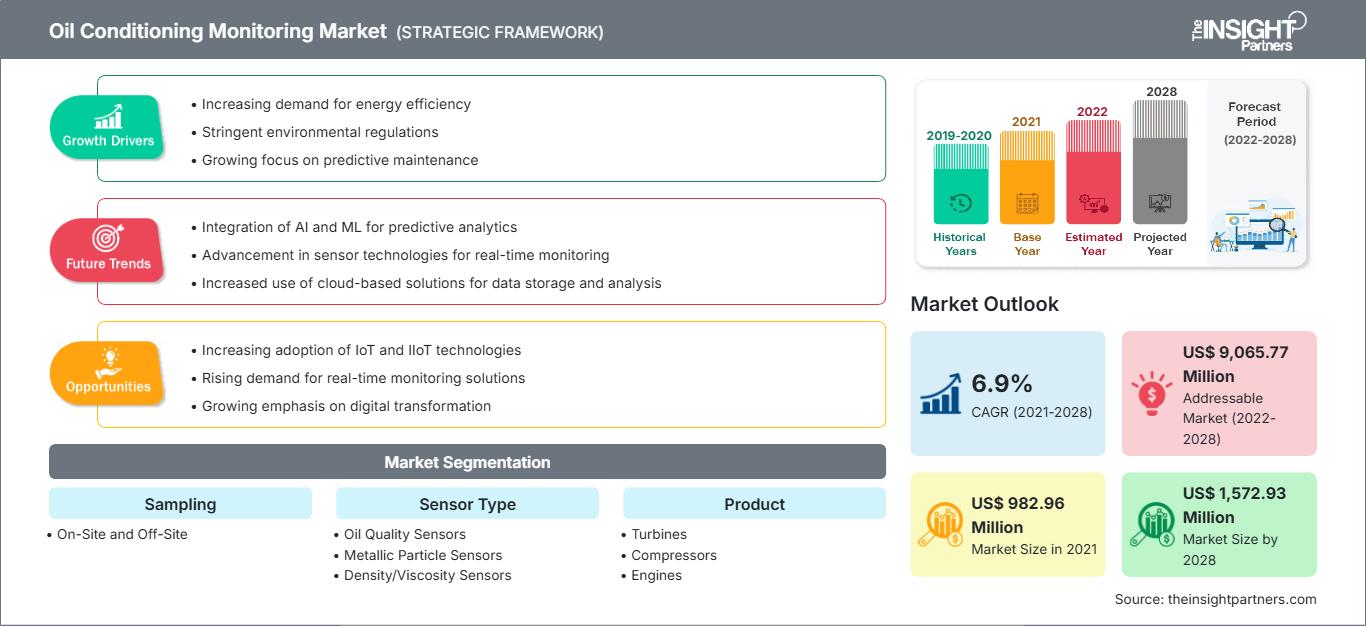
The growing emphasis on equipment reliability, operational efficiency, and preventive maintenance is transforming how industries manage critical machinery. Organizations across oil and gas, power generation, manufacturing, mining, transportation, marine, and heavy industrial operations are increasingly turning to advanced monitoring technologies to identify equipment deterioration before it results in costly failures. Oil condition monitoring enables operators to assess lubricant health, detect contamination, identify wear particles, and understand machinery performance, helping maintenance teams make more informed decisions and improve asset availability.
The Global Oil Condition Monitoring Market is gaining traction as companies move from conventional, schedule-based maintenance toward predictive and condition-based maintenance strategies. Modern solutions combine sensors, oil analysis, connected devices, software platforms, and data analytics to provide actionable information about equipment health. Increasing adoption of Industry 4.0, Industrial Internet of Things (IIoT), automation, and cloud-based analytics is creating new opportunities for technology providers while encouraging industrial users to adopt continuous and data-driven maintenance practices. Recent industry research also highlights predictive maintenance and IIoT integration as major factors supporting demand for these solutions.
Download Sample PDF Link – https://www.theinsightpartners.com/sample/TIPRE00008254
The latest industry developments indicate that oil monitoring is becoming increasingly connected and real time. Advanced systems can monitor parameters associated with lubricant degradation, moisture, contamination, and equipment wear, allowing maintenance teams to respond before minor abnormalities develop into major mechanical problems. In marine applications, for example, continuous monitoring technologies are being deployed to detect water contamination and other lubrication-related issues at an early stage.
Key Market Insights and Forecast to 2031
- Market Size: The global market is expected to experience sustained expansion through 2031 as industries increase spending on predictive maintenance, equipment health monitoring, and asset optimization.
- Market Share: Demand is expected to remain strong across oil and gas, power generation, manufacturing, transportation, mining, marine, and other asset-intensive industries.
- Market Trends: Key trends include real-time oil analysis, wireless sensing, cloud-connected platforms, AI-assisted diagnostics, IIoT integration, and portable monitoring technologies.
- Market Analysis: Growth is being supported by the need to reduce unplanned downtime, extend machinery life, improve lubricant utilization, and strengthen maintenance decision-making.
- Forecast: The outlook through 2031 remains positive as industrial organizations increasingly prioritize reliability-centered maintenance and digital transformation.
Key Growth Drivers
A major factor influencing the Oil Condition Monitoring Market is the rising cost and operational impact of unplanned equipment downtime. Failures involving engines, turbines, compressors, gearboxes, hydraulic systems, and other lubricated machinery can interrupt production and increase repair expenses. Monitoring lubricant conditions provides an additional layer of information that helps maintenance teams recognize abnormal wear and contamination before equipment performance deteriorates significantly.
The rapid adoption of predictive maintenance is further strengthening demand. Instead of relying exclusively on fixed maintenance schedules, industrial operators can use equipment and lubricant data to determine when intervention is required. This approach can support better maintenance planning, reduce unnecessary component replacement, and improve overall asset utilization.
Digital transformation is another important growth catalyst. The integration of IoT sensors, machine learning, cloud platforms, and analytics is enabling condition monitoring systems to move beyond periodic laboratory testing toward more frequent or continuous assessments. The wider machine condition monitoring industry is similarly being influenced by wireless communication, cloud computing, artificial intelligence, and big-data analytics.
Global and Regional Analysis
North America is expected to remain an important region for adoption because of its mature industrial infrastructure, extensive energy and manufacturing activities, and increasing use of predictive maintenance technologies. The US, in particular, presents opportunities across oil and gas, power generation, transportation, manufacturing, and heavy equipment applications. Organizations are increasingly seeking solutions capable of delivering real-time equipment insights while supporting maintenance efficiency and operational safety.
Europe continues to present strong opportunities due to industrial automation, energy-efficiency initiatives, established manufacturing capabilities, and growing interest in asset lifecycle management. The region’s focus on sustainable industrial operations is also encouraging companies to optimize lubricant consumption and reduce equipment-related waste.
Asia-Pacific is expected to demonstrate significant growth as industrialization, manufacturing expansion, infrastructure development, and investments in energy and transportation assets continue. China, India, Japan, South Korea, and Southeast Asian economies are creating opportunities for connected monitoring technologies as industrial operators modernize maintenance processes.
The Middle East and Africa are also important markets, particularly because of substantial oil and gas, power, marine, and industrial operations. Meanwhile, South and Central America offer opportunities through mining, energy, transportation, and industrial development.
Emerging Trends Shaping the Industry
One of the most significant trends is the movement toward continuous oil health monitoring. Instead of relying solely on periodic sampling, operators are increasingly interested in technologies that can provide frequent or real-time information. Recent developments in marine applications demonstrate how continuous monitoring can identify water contamination and potential engine risks earlier.
Another emerging trend is the integration of artificial intelligence and machine learning. These technologies can help identify patterns within large volumes of equipment data, improve anomaly detection, and support predictive maintenance decisions. Wireless sensors and cloud-based platforms are also making monitoring easier to deploy across geographically distributed assets.
Key Players
- Bureau Veritas
- Castrol Limited
- Chevron Corporation
- Eaton Corporation
- Emerson Electric Co.
- General Electric
- Honeywell International Inc.
- Intertek Group plc
- Parker Hannifin Corporation
- Rockwell Automation
- SGS SA
- Shell plc
- Tan Delta Systems
- TotalEnergies
- Poseidon Systems, LLC
These companies are competing through product development, sensor innovation, analytical capabilities, digital platforms, partnerships, and expansion of monitoring services. Competitive activity is increasingly centered on delivering integrated solutions that combine oil analysis with broader machine-health intelligence.
Industry Analysis and Business Opportunities
The industry is moving toward integrated asset-health platforms capable of combining oil condition information with vibration, temperature, pressure, and other machine parameters. This convergence can provide maintenance teams with a more comprehensive understanding of equipment performance.
Opportunities are also emerging for compact sensors, remote monitoring platforms, AI-powered analytics, and cloud-based maintenance applications. Service providers can benefit from the growing requirement for laboratory analysis, on-site testing, equipment diagnostics, and customized maintenance programs.
Get the Premium Research Report @ https://www.theinsightpartners.com/buy/TIPRE00008254
Future Outlook
The future of the Oil Condition Monitoring Market is closely connected with the broader shift toward intelligent and predictive industrial operations. Through 2031, organizations are expected to place greater emphasis on real-time equipment visibility, digital maintenance workflows, and technologies that improve reliability while controlling operating costs. Continued advances in sensors, AI, IIoT, cloud computing, and analytics are likely to make oil monitoring more accessible across both large industrial facilities and distributed equipment fleets. As industries increasingly recognize lubrication data as an important source of machine-health intelligence, oil condition monitoring is positioned to become an increasingly valuable component of modern predictive maintenance strategies.
Related Reports –
Home Energy Management System Market Regional Share, Trend, and Growth Opportunity
Vision Transformers Market Regional Share, Trend, and Growth Opportunity
Differential-Pressure Mass Flow Controller Market Regional Share, Trend, and Growth Opportunity
About The Insight Partners
The Insight Partners is a leading market research and consulting firm delivering actionable insights through in-depth industry analysis and strategic intelligence. The firm supports clients across various industries in making informed business decisions by providing comprehensive market forecasts, competitive assessments, and growth opportunities.
Contact Us:
If you have any queries about this report or if you would like further information, please contact us:
Contact Person: Ankit Mathur
E-mail: sales@theinsightpartners.com
Phone: +1-646-491-9876
Also Available in :
Korean | German | Japanese | French | Chinese | Italian | Spanish
