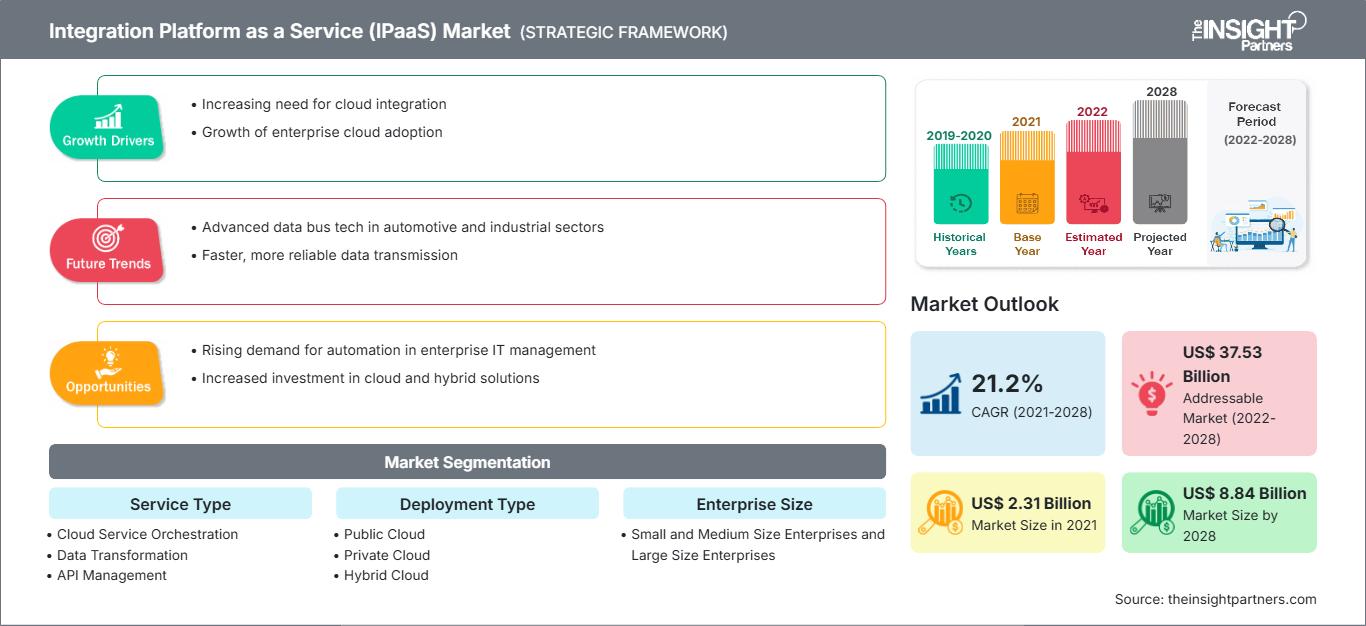
IPaaS solutions have evolved beyond basic middleware and legacy enterprise application integration (EAI) tools. Today, they serve as the central backbone for enterprise connectivity, orchestrating data flows, automating complex business processes, and managing Application Programming Interfaces (APIs) across public cloud, private cloud, and on-premises systems. As businesses adopt multi-cloud strategies and Software-as-a-Service (SaaS) applications, cloud-native integration platforms provide the agility, security, and scalability required to maintain operational synchronization.
The integration platform as a service market was valued at US$ 8.5 Billion in 2025 and is expected to reach US$ 66.67 Billion by 2034, registering a CAGR of 12.63% during 2026–2034.
Key Drivers Fueling Market Growth
- Accelerated SaaS and Cloud Adoption: The exponential increase in specialized SaaS platforms across business functions necessitates automated, real-time connectivity to ensure seamless data exchange.
- Demand for Process Automation and Workflow Efficiency: Organizations are actively replacing manual data entry and batch processing with automated workflows to eliminate human error and optimize throughput.
- Expansion of API-Led Connectivity: API-centric architectures allow enterprises to securely expose data services, connect legacy systems with cloud applications, and construct flexible digital business models.
- Growing Hybrid and Multi-Cloud Architectures: As businesses avoid vendor lock-in by utilizing multiple cloud infrastructure providers, IPaaS offers the unified control plane needed to govern cross-cloud data environments.
Download Sample Report@ https://www.theinsightpartners.com/sample/TIPTE100000446
High-Potential Opportunities
The rising integration of Artificial Intelligence (AI) and Machine Learning (ML) into IPaaS architectures presents significant growth avenues. AI-assisted mapping, automated data transformation, and self-healing integration pipelines are reducing the technical barrier for non-specialist users, leading to the rise of citizen integrators within business units.
Additionally, industry-specific IPaaS offerings cater to strict regulatory frameworks and operational requirements in sectors such as healthcare, financial services, and government. Pre-built connectors, compliance templates, and low-code/no-code interface models allow enterprises to achieve rapid deployment and shorter time-to-value.
Market Segmentation Analysis
According to the comprehensive report by The Insight Partners, the IPaaS market is categorized across four primary dimensions:
By Service Type
- Data Integration: Accounts for the largest market share (22% to 26% in 2025) and is expected to grow at a CAGR of 12% to 14%, driven by enterprise needs for consolidated data repositories and analytics readiness.
- Real-time Monitoring and Integration: Holds 10% to 14% market share in 2025 and represents the highest growth segment with a projected CAGR of 15% to 17%, propelled by demand for real-time visibility and instant alert systems.
- API Management, Cloud Service Orchestration, Data Transformation, Application Integration, and B2B/Cloud Integration: Essential services supporting end-to-end digital connectivity.
By Deployment Type
- Public Cloud: Highly favored for scalability, lower capital expenditure, and rapid deployment capabilities.
- Private Cloud: Preferred by enterprises with high data sovereignty requirements.
- Hybrid Cloud: Experiencing rapid traction as legacy systems interact with modern cloud platforms.
By Enterprise Size
- Large Enterprises: Dominate overall market spend due to complex digital infrastructure and multi-departmental integration requirements.
- Small and Medium-Sized Enterprises (SMEs): Fastest-growing segment as scalable, subscription-based IPaaS tools eliminate heavy upfront infrastructure investments.
By Industry Vertical
- Key sectors adopting IPaaS include Banking, Financial Services, and Insurance (BFSI), Healthcare, Telecommunications, Manufacturing, Consumer Goods & Retail, Government & Public Sector, and Energy.
Regional Landscape Insights
- North America: Commands a dominant position with a 35% to 39% market share in 2025, expanding at a CAGR of 12% to 14%. The United States represents approximately 75% to 80% of the regional demand, supported by mature cloud infrastructure and extensive enterprise technology investments.
- Europe: Represents a 25% to 29% market share in 2025, growing at 11% to 13% CAGR. Key markets like Germany, the UK, and France prioritize industrial automation, enterprise application modernization, and strict regulatory compliance.
- Asia Pacific (APAC): The fastest-growing region, holding a 24% to 28% market share in 2025 and projecting a CAGR of 14% to 16%. Expanding cloud infrastructure in China, Japan, India, and South Korea drives strong adoption.
- Middle East & Africa (MEA): Expected to grow at a CAGR of 11% to 13%, driven by smart infrastructure investments and digital transformation initiatives in the UAE and Saudi Arabia.
Market News and Recent Developments
Recent industry movements highlight a pivot toward hyper-automation, intelligence, and strategic ecosystem consolidation:
- Generative AI Integration: Leading vendors are integrating generative AI co-pilots into integration suites, enabling developers to build, test, and troubleshoot integration flows using natural language commands.
- Enhanced Security and Compliance Standards: With expanding cyber threats, vendors are strengthening zero-trust access controls, end-to-end data encryption, and automated governance capabilities within integration pipelines.
- Strategic Ecosystem Alliances: Technology providers are partnering with global system integrators and specialized SaaS vendors to deliver industry-tailored integration accelerators.
Get Full Copy of This Report @ https://www.theinsightpartners.com/buy/TIPTE100000446
Competitive Landscape and Top Players
The global IPaaS market is characterized by intense competition among established cloud technology giants and agile, specialized integration vendors. Companies focus on platform flexibility, low-code interface design, and pre-built connector libraries to maintain market dominance.
Key Players Profiled:
- Informatica
- MuleSoft, LLC (Salesforce)
- SAP SE
- Oracle Corporation
- IBM Corporation
- Microsoft Corporation
- SnapLogic
- Software AG
- SEEBURGER AG
- elastic.io
Established technology giants leverage their massive enterprise client bases and broader cloud ecosystem offerings, while specialized providers differentiate themselves through rapid deployment models, flexible pricing structures, and niche industry capabilities.
Future Outlook
The Integration Platform as a Service (IPaaS) market is positioned for sustained long-term expansion through 2034. As enterprise architecture grows increasingly distributed across multi-cloud environments, edge locations, and SaaS ecosystems, IPaaS will remain an indispensable strategic asset. Vendors that innovate in AI-driven automation, low-code user accessibility, robust API governance, and hybrid deployment scenarios will lead the market into its next era of growth.
About The Insight Partners
The Insight Partners provides comprehensive syndicated and tailored market research services in the healthcare, technology, and industrial domains. Renowned for delivering strategic intelligence and practical insights, the firm empowers businesses to remain competitive in ever-evolving global markets.
Contact Information
- Email: sales@theinsightpartners.com
- Website: theinsightpartners.com
- Phone: +1-646-491-9876
