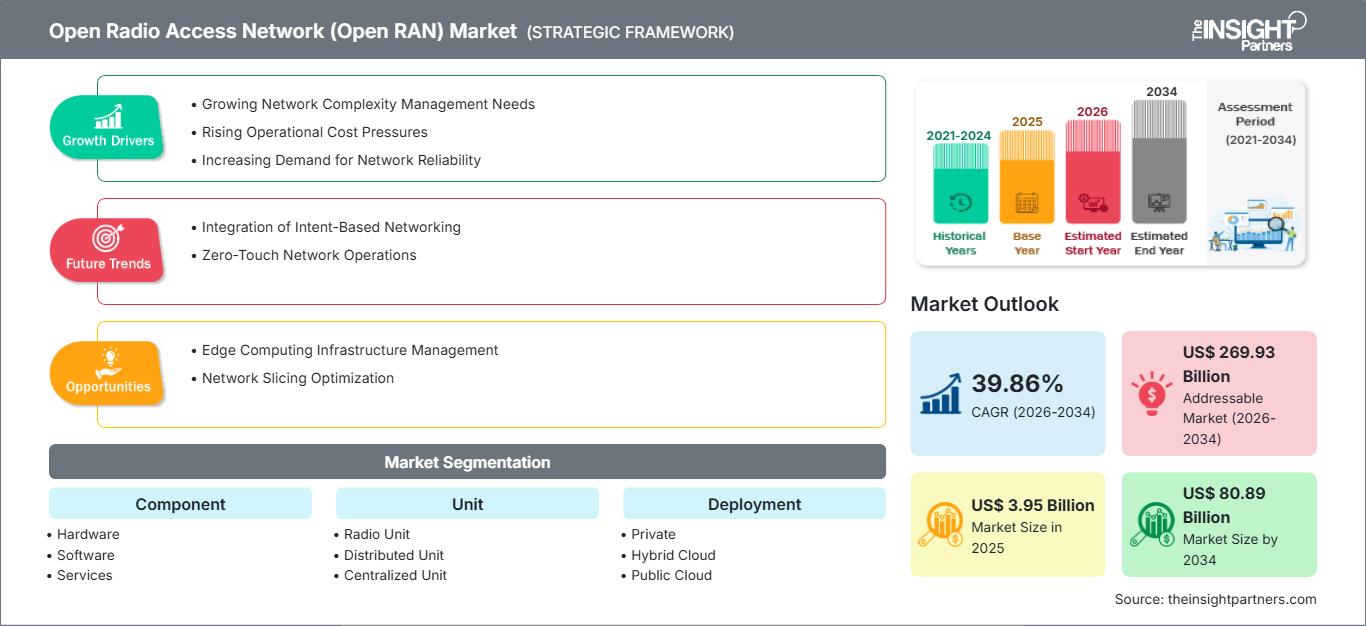
The global Open Radio Access Network (Open RAN) market is experiencing exponential growth as mobile network operators (MNOs) shift from traditional, proprietary telecommunication architectures toward open, disaggregated, and fully interoperable software-driven networks. Historically, traditional Radio Access Networks relied on tightly integrated hardware and software solutions from single vendors, creating significant vendor lock-in, inflated capital expenditures (CapEx), and operational rigidities. Open RAN architecture breaks this reliance by standardizing interfaces between key components, including the Radio Unit (RU), Distributed Unit (DU), and Centralized Unit (CU).
The Open Radio Access Network Market has emerged as one of the most closely watched segments within global telecommunications infrastructure, valued at US$ 3.95 Billion in 2025 and projected to reach US$ 80.89 Billion by 2034, expanding at a CAGR of 39.86% between 2026 and 2034.
Key Market Drivers
- Demand for Cost Optimization and Reduced Vendor Lock-in: Traditional telecommunication networks leave operators dependent on single-vendor solutions for upgrades and maintenance. Open RAN allows service providers to decouple hardware from software, encouraging price competition among equipment suppliers and significantly reducing CapEx and OpEx.
- Rapid Deployment of 5G and Next-Generation Mobile Networks: As global mobile data traffic escalates exponentially due to high-definition video streaming, online gaming, and industrial automation, operators require scalable, flexible infrastructure. Open RAN provides the agility required to deploy ultra-reliable low-latency communications (URLLC) and enhanced mobile broadband (eMBB).
- Government Support and Regulatory Initiatives for Supply Chain Diversity: National governments and regulatory authorities across North America, Europe, and Asia-Pacific actively encourage supplier diversity and network security. Financial incentives, grants, and spectrum policies favoring open architecture are accelerating nationwide Open RAN adoption.
- Advancements in Cloud-Native Technologies and Virtualization: The rise of containerized software, cloud-native network functions (CNFs), and edge computing allows network workloads to run seamlessly on standard commercial off-the-shelf (COTS) hardware, simplifying network expansion.
Download Sample Report@ https://www.theinsightpartners.com/sample/TIPRE00039567
Emerging Market Opportunities
- Private 5G Networks for Enterprise Automation: Industrial environments, healthcare facilities, logistics hubs, and smart cities require dedicated private wireless networks. Open RAN provides custom, cost-effective network configurations tailored to specific enterprise security and latency demands.
- Integration of Artificial Intelligence and Machine Learning: Open RAN architecture introduces the RAN Intelligent Controller (RIC), enabling dynamic traffic steering, real-time slice management, automated fault detection, and energy conservation. AI integration offers technology vendors massive opportunities to build specialized xApps and rApps.
- Greenfield Operators and Rural Broadband Expansion: New telecom entrants and regional service providers leverage Open RAN to build cloud-native networks without legacy infrastructure constraints. Furthermore, open architecture reduces the cost of rural cell tower deployments, extending high-speed connectivity to underserved regions.
Market Segmentation Analysis
The Open RAN market is segmented by offering, network deployment, frequency band, deployment phase, and geography.
By Offering
- Hardware: Comprises Open Radio Units (O-RU), Open Distributed Units (O-DU), Open Centralized Units (O-CU), and COTS servers. Hardware holds a substantial revenue share due to the ongoing physical rollout of cell sites and base station equipment.
- Software: Includes cloud-native virtualized software, network orchestrators, and AI-powered RIC applications (xApps and rApps). Software represents the fastest-growing segment as operators shift toward software-defined network control.
- Services: Encompasses system integration, network planning, consulting, operation management, and technical support. System integration services are critical to ensure smooth interoperability in multi-vendor environments.
By Network Deployment
- Public Networks: Represents the largest adoption segment as Tier-1 telecommunication operators modernize macro-cell and small-cell public networks.
- Private Networks: Demonstrates rapid growth across manufacturing, mining, ports, and healthcare verticals.
By Frequency Band
- Sub-6 GHz: Dominates current deployments due to its optimal balance of wide area coverage and wall-penetration capabilities for 4G and mid-band 5G networks.
- mmWave (Millimeter Wave): Projected to exhibit high growth rates, supporting hyper-dense urban deployments and high-capacity industrial applications.
By Deployment Phase
- Greenfield Deployments: Led by new market entrants who deploy 100% open, cloud-native architectures from day one.
- Brownfield Deployments: Represents traditional operators gradually integrating Open RAN components into existing legacy infrastructure.
Market News and Recent Developments
- Massive Multi-Vendor Commercial Contracts: Leading telecom giants across North America and Europe have awarded multi-billion-dollar Open RAN modernization contracts to accelerate the replacement of legacy proprietary equipment across tens of thousands of cell sites.
- Ecosystem Interoperability Testing Initiatives: Industry consortia and test laboratories are conducting extensive plugfests worldwide to validate O-RAN Alliance specifications, ensuring multi-vendor hardware and software interoperability.
- Focus on Energy Efficiency Standards: Vendors are launching energy-conscious O-RUs and dynamic sleep-mode software algorithms that drastically reduce operational power consumption at cell sites.
Get Full Copy of This Report @ https://www.theinsightpartners.com/buy/TIPRE00039567
Competitive Landscape and Top Market Players
The Open RAN market features a dynamic mix of established telecommunication vendors, cloud hyperscalers, and specialized system integrators. Major legacy vendors have adapted their product portfolios to support open interfaces alongside dedicated Open RAN pioneers.
Top Market Players Include:
- Ericsson
- Nokia Corporation
- Samsung Electronics Co., Ltd.
- NEC Corporation
- Fujitsu Limited
- Mavenir
- Parallel Wireless
- Rakuten Symphony
- Intel Corporation
- Hewlett Packard Enterprise (HPE)
- Radisys Corporation
- Viavi Solutions Inc.
Key competitive strategies include strategic partnerships between hardware makers and software providers, joint interoperability labs, and acquisitions of specialized network automation startups.
Future Outlook
Looking toward 2034, Open RAN will transition from an emerging architectural alternative to the mainstream standard for global wireless communication. As O-RAN specifications mature and system integration complexities lessen, brownfield operators will increasingly replace legacy proprietary infrastructure with open, cloud-native solutions.
The convergence of Open RAN with artificial intelligence, 6G research initiatives, edge computing, and cloud virtualization will transform mobile networks into intelligent, autonomous software platforms. Operators that adopt flexible Open RAN frameworks will benefit from lower long-term operating costs, rapid innovation cycles, and scalable service delivery across consumer and industrial markets.
About The Insight Partners
The Insight Partners provides comprehensive syndicated and tailored market research services in the healthcare, technology, and industrial domains. Renowned for delivering strategic intelligence and practical insights, the firm empowers businesses to remain competitive in ever-evolving global markets.
Contact Information
- Email: sales@theinsightpartners.com
- Website: theinsightpartners.com
- Phone: +1-646-491-9876
