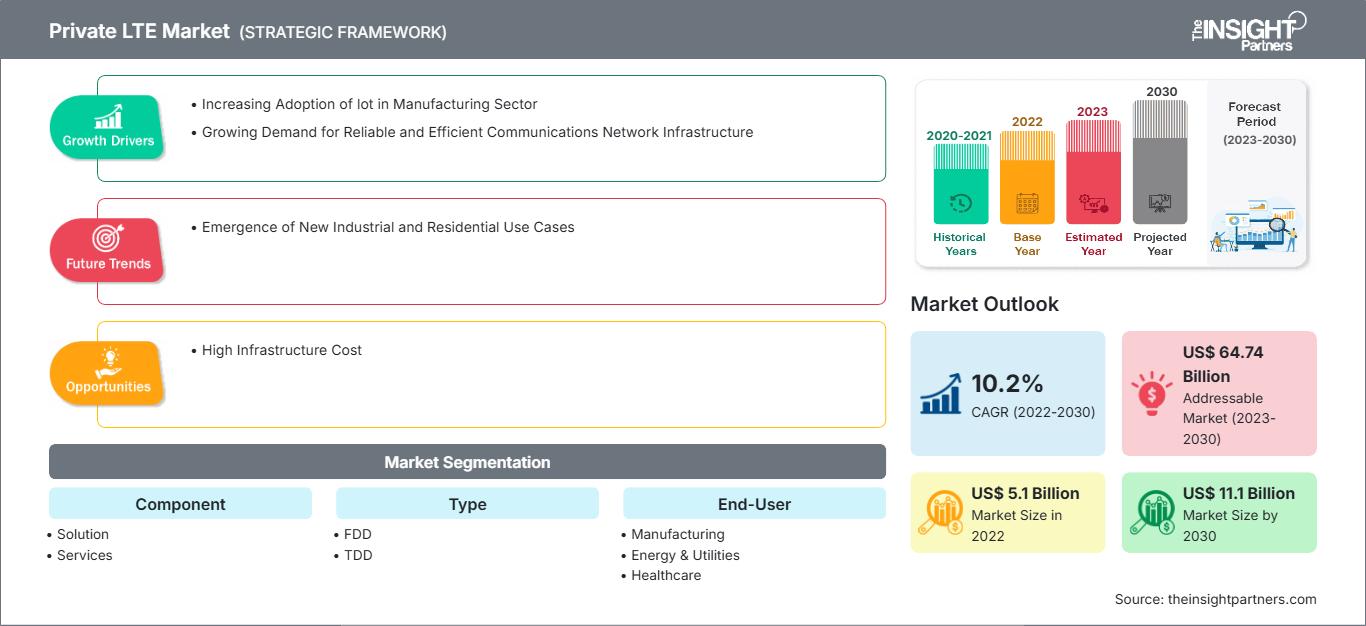
Private Long-Term Evolution (LTE) networks are localized, dedicated wireless systems that offer private cellular connectivity tailored specifically for enterprise requirements. Unlike public cellular services, private LTE delivers dedicated bandwidth, high data privacy, predictable latency, and granular network management. As industrial enterprises accelerate digital transformation, private LTE provides the reliable communication foundation necessary for modern smart facilities.
The Private LTE Market reached a valuation of US$ 6.3 Billion in 2025 and is projected to advance to US$ 18.55 Billion by 2034, expanding at a CAGR of 12.05% between 2026 and 2034.
Key Market Drivers
- Demand for Mission-Critical Reliability and Security: Public cellular networks suffer from congestion and shared bandwidth risk. Private LTE provides dedicated spectrum coverage and localized security protocols, ensuring uninterrupted operation for critical infrastructure such as energy grids, processing plants, and defense facilities.
- Rapid Proliferation of Industrial IoT (IIoT): The adoption of connected sensors, automated guided vehicles (AGVs), and smart machinery requires network infrastructure capable of supporting high endpoint density. Private LTE offers the necessary stability, low latency, and deterministic performance needed for real-time telemetry.
- Spectrum Liberalization and Regulatory Support: Governments worldwide are increasingly opening shared and unlicensed spectrum bands for private enterprise use. Regulatory frameworks such as the Citizens Broadband Radio Service (CBRS) in the United States lower financial barriers, enabling organizations to deploy private wireless environments without acquiring costly spectrum licenses.
Download Sample Report@ https://www.theinsightpartners.com/sample/TIPRE00003471
Growth Opportunities
- Transition Toward Hybrid Private 5G Systems: Private LTE acts as a mature, reliable foundation for enterprise wireless infrastructure. Software-definable architecture allows organizations to deploy private LTE today while maintaining a direct upgrade path to private 5G as multi-mode device ecosystems mature.
- Expansion in Healthcare and Smart Campuses: Beyond heavy manufacturing, private LTE is expanding into university campuses, hospital networks, and transport hubs. These environments utilize dedicated networks to isolate critical medical monitoring, campus security, and operational communications from public internet traffic.
- Growth of Network-as-a-Service (NaaS) Delivery Models: Managed service models are making private cellular networks accessible to small and medium enterprises. Managed NaaS offerings eliminate high upfront capital investments and simplify ongoing network operation.
Market Segmentation
The global private LTE market is segmented across multiple operational categories:
By Component
- Solution: Includes core network components such as Radio Access Networks (RAN), Evolved Packet Core (EPC), and backhaul equipment. This segment represents the largest portion of initial infrastructure spending.
- Services: Divided into Professional Services (system design, installation, integration) and Managed Services (ongoing monitoring and network optimization).
By Type
- FDD (Frequency Division Duplexing): Widely utilized in legacy setups and long-range outdoor communications.
- TDD (Time Division Duplexing): Highly favored for modern industrial applications due to its capability to dynamically allocate bandwidth for asymmetrical data traffic, such as video surveillance feeds.
By End-User
- Manufacturing: The largest end-user segment, relying on private wireless for robotics, assembly line automation, and inventory control.
- Energy & Utilities: Deployed across power distribution networks, refineries, and pipelines for remote asset monitoring.
- Transportation & Logistics: Utilized in seaports, rail terminals, and airports for container tracking and fleet automation.
- Mining: Applied in open-pit and underground mines for autonomous haulage, automated drilling, and worker safety communication.
- Healthcare & Others: Used for isolated medical device networks, public safety platforms, and smart municipality projects.
By Geography
- North America: Currently holds the largest market share, backed by early CBRS spectrum availability and high technology investment across United States manufacturing hubs.
- Europe: Driven by Industry 4.0 initiatives in Germany, France, and the UK, supported by stringent enterprise data sovereignty standards.
- Asia-Pacific: Projected to record the fastest CAGR through 2034, driven by smart factory expansions in China, Japan, India, and Southeast Asia.
- South & Central America and Middle East & Africa: Experiencing steady growth driven by modernization in mining, oil fields, and major port facilities.
Market Analysis and Competitive Landscape
The competitive landscape of the private LTE market is defined by convergence among telecom equipment manufacturers, system integrators, cloud providers, and traditional mobile network operators. Enterprise procurement trends reveal a preference for complete control over data and network parameters, causing a shift away from standard commercial operator subscriptions.
Vendors are distinguishing themselves by offering integrated solutions that combine edge computing, enterprise IT management, and automated security monitoring. Plug-and-play private network packages that simplify deployment for non-telecom IT teams are gaining strong market traction.
Market News and Recent Developments
- Spectrum Policy Expansion: Additional national telecom authorities across Europe and Asia are introducing localized spectrum allocations dedicated specifically to enterprise private networks.
- Edge Computing Convergence: Leading vendors are embedding Multi-access Edge Computing (MEC) into private LTE cores, enabling real-time computer vision and artificial intelligence workloads directly on site.
- System Integrator Alliances: Strategic partnerships between enterprise IT integrators and network hardware vendors are expanding, providing turnkey private network deployments for complex industrial facilities.
Get Full Copy of This Report @ https://www.theinsightpartners.com/buy/TIPRE00003471
Top Key Players
Prominent vendors and service providers in the private LTE market include:
- Cisco Systems, Inc.
- Telefonaktiebolaget LM Ericsson
- Huawei Investment & Holding Co., Ltd.
- Samsung Group
- Verizon Communications, Inc.
- CommScope Holding Co., Inc.
- Future Technologies, Inc.
- Star Solutions
- Sierra Wireless, Inc.
- Kyndryl Holdings, Inc.
Future Outlook
Through 2034, private LTE will remain a vital standard for enterprise digital transformation and operational connectivity. As automated systems, artificial intelligence at the edge, and robotics become standard across heavy industries, the need for dedicated, high-security cellular infrastructure will continue to expand. Organizations that establish robust private LTE architectures today will maintain a strong foundation for scalable, high-performance wireless connectivity well into the future.
About The Insight Partners
The Insight Partners provides comprehensive syndicated and tailored market research services in the healthcare, technology, and industrial domains. Renowned for delivering strategic intelligence and practical insights, the firm empowers businesses to remain competitive in ever-evolving global markets.
Contact Information
- Email: sales@theinsightpartners.com
- Website: theinsightpartners.com
- Phone: +1-646-491-9876
