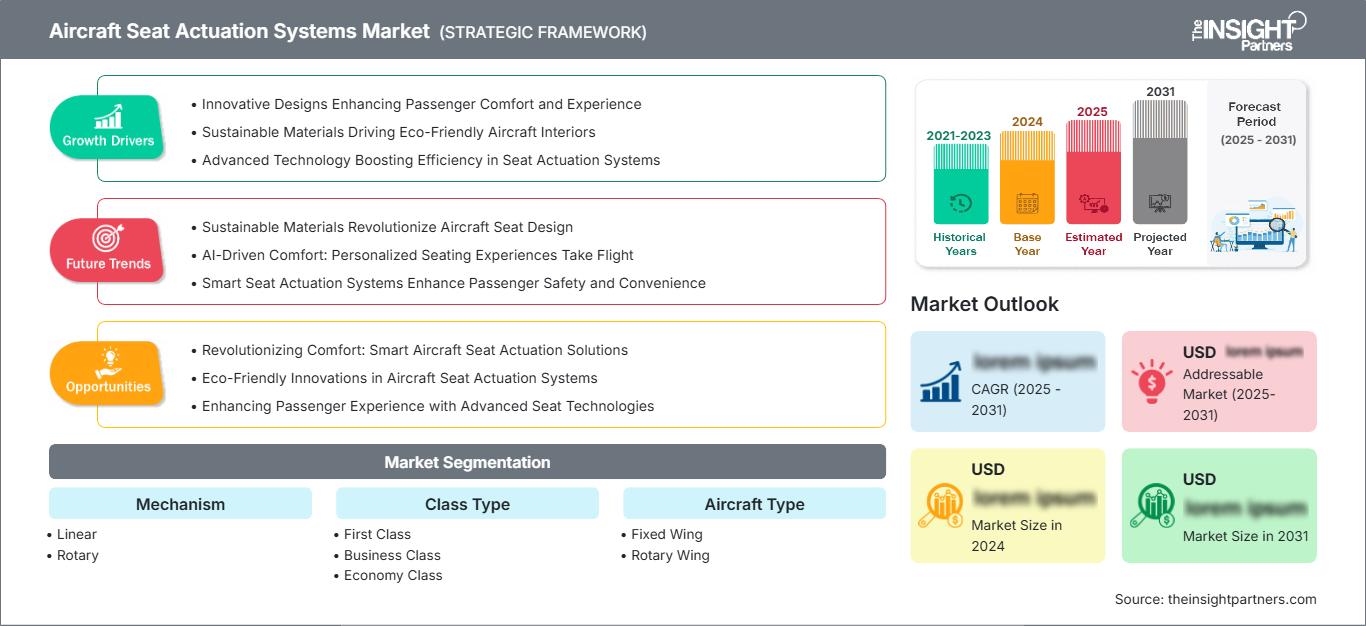
The aviation industry is witnessing a significant transformation driven by rising passenger traffic, fleet expansion, and continuous technological upgrades in commercial and business aircraft. Modern airlines are increasingly focusing on enhancing passenger comfort, expanding premium economy and business class cabins, and reducing overall aircraft weight to optimize fuel efficiency. A critical component in delivering superior passenger ergonomics is the aircraft seat actuation system. These electro-mechanical and hydraulic mechanisms enable smooth, automated adjustments for recline, legrests, height, and lumbar support, ensuring a tailored seating experience for passengers across medium-haul and long-haul flights.
Get a PDF Sample- https://www.theinsightpartners.com/sample/TIPRE00005688
North America Aircraft Seat Actuation Systems Market
North America holds a dominant position in the global aircraft seat actuation systems market, driven by the presence of major commercial aircraft fleets and commercial airliner manufacturing hubs across the region. High consumer demand for premium transcontinental travel and luxury business jets continually boosts retrofitting activities and OEM seating upgrades across major U.S. and Canadian carriers. Furthermore, substantial investments in R&D by regional aerospace component suppliers accelerate the deployment of next-generation, lightweight electro-mechanical seat actuators. Strict aviation regulatory standards and safety mandates enforced by regional authorities also push airlines to adopt reliable, state-of-the-art actuation components.
Market Forecast & Growth Trajectory
The global Aircraft Seat Actuation Systems Market size is projected to reach US$ 898.39 million by 2034 from US$ 607.77 million in 2025. The market is anticipated to register a CAGR of 5.01% during the forecast period 2026-2034.
This steady growth is heavily supported by the retrofit market as well as new aircraft deliveries across major global carriers. Modern commercial airliners are prioritizing interior retrofits to upgrade aging seating structures with lightweight, low-power actuation technologies. As regional and international travel rebounds to pre-pandemic trajectories, aircraft original equipment manufacturers (OEMs) like Boeing and Airbus are ramping up production rates, directly driving the demand for integrated seating actuation assemblies.
Market Drivers and Key Trends
1. Rise in Premium Economy and Luxury Cabin Layouts
Airlines are restructuring cabin configurations to maximize revenue per seat kilometer. The expansion of premium economy and first-class cabins requires complex, multi-axis automated seating configurations. Actuation systems integrated into modern premium seats offer pre-programmed memory positions, massage functions, and seamless motorized transitions between upright and flatbed positions.
2. Focus on Weight Reduction and Energy Efficiency
Weight management remains a top parameter in aerospace engineering. Traditional heavy hydraulic actuation mechanisms are rapidly being replaced by lightweight electro-mechanical actuators (EMAs) and compact brushless DC motors. These modern systems not only reduce fuel burn but also minimize wiring complexity and maintenance downtime.
3. Integration of Smart Seating Technologies
The convergence of IoT and smart sensors in aircraft cabins is revolutionizing maintenance routines. Modern seat actuation systems incorporate diagnostic sensors that monitor motor temperature, wear, and cycle counts, allowing maintenance crews to perform predictive servicing before component failure occurs during flights.
Key Market Players
The global market is moderately consolidated, with established aerospace equipment vendors and specialized component suppliers leading product development and supply contracts with major seating manufacturers and OEMs. Key players operating in the market include:
Astronics Corporation
Bühler Motor GmbH
Collins Aerospace
Crane Aerospace and Electronics
Elektro-Metall Export GmbH
ITT Inc.
Kyntronics
Meggitt PLC
Rollon S.p.A.
Safran
Market Segmentation Insights
By Mechanism
- Linear
- Rotary
By Class Type
- First Class
- Business Class
- Economy Class
By Aircraft Type
- Fixed Wing
- Rotary Wing
Future Outlook
The future of the aircraft seat actuation systems market looks highly promising, underpinned by continuous innovations in urban air mobility (UAM), electric vertical takeoff and landing (eVTOL) aircraft, and ultra-long-haul commercial aviation. Over the coming decade, market developments will focus heavily on modular, ultra-lightweight actuation architectures that consume minimal power while supporting advanced cabin customization. As sustainability mandates prompt airlines to optimize overall aircraft weight, suppliers who prioritize high power-to-weight ratio actuators, additive manufacturing techniques, and fully integrated smart diagnostic systems will be best positioned to capture long-term growth opportunities across both linefit and retrofit sectors.
Related Reports-
About Us
The Insight Partners is a one-stop industry research provider of actionable intelligence. We help our clients in getting solutions to their research requirements through our syndicated and consulting research services. We specialize in industries such as Semiconductor and Electronics, Aerospace and Defense, Automotive and Transportation, Biotechnology, Healthcare IT, Manufacturing and Construction, Medical Devices, Technology, Media, and Telecommunications, as well as chemicals and Materials.
Contact Us
If you have any queries about this report or if you would like further information, don’t hesitate to get in touch with us:
Contact Person: Ankit Mathur
E-mail: ankit.mathur@theinsightpartners.com
