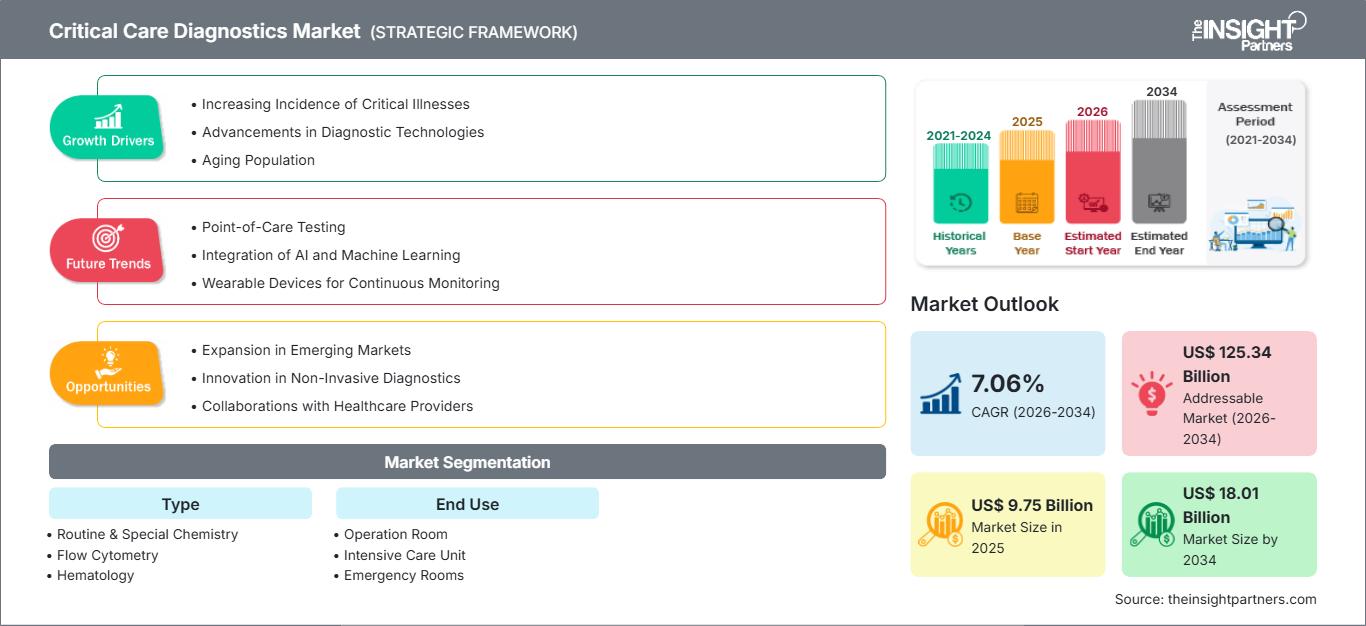
The Critical Care Diagnostics Market is valued at US$ 9.75 Billion in 2025 and is projected to reach US$ 18.01 Billion by 2034, registering a CAGR of 7.06% during 2026–2034.
Critical care diagnostics encompasses testing and diagnostic technologies used to evaluate patients requiring intensive monitoring and treatment. These solutions support the assessment of physiological conditions and help healthcare professionals make informed decisions in critical care settings. Increasing demand for rapid testing and improved patient monitoring is contributing to market expansion.
Get Sample PDF – https://www.theinsightpartners.com/sample/TIPRE00040786
Growing Demand for Rapid Diagnostic Testing
Speed is particularly important in critical care because patients can experience rapid changes in their health status. Conventional testing processes that require extended turnaround times may not always meet the needs of intensive care environments. Rapid diagnostic solutions can provide clinically relevant information within shorter timeframes, helping healthcare professionals respond more efficiently.
The growing adoption of point-of-care testing is supporting this trend. Diagnostic technologies that can be used close to the patient can reduce delays associated with transporting samples to centralized laboratories. This can be particularly valuable in emergency departments and intensive care units where immediate information is often required.
Rising Burden of Critical and Chronic Diseases
The increasing prevalence of conditions that may require intensive medical care is contributing to demand for critical care diagnostics. Cardiovascular disorders, respiratory diseases, infections, and other serious conditions can require continuous assessment and rapid diagnostic evaluation.
As healthcare providers manage increasingly complex patient populations, the need for accurate diagnostic information is growing. Diagnostic tests can support the assessment of physiological parameters and help clinicians monitor treatment response. This creates sustained demand for diagnostic technologies designed for critical care environments.
Increasing Adoption of Point-of-Care Diagnostics
Point-of-care testing is becoming increasingly important in critical care because it allows diagnostic assessments to be performed near the patient. This approach can provide healthcare professionals with faster access to test results and support more efficient clinical workflows.
Point-of-care solutions can be particularly valuable when immediate decisions are required. Portable and compact diagnostic devices can enable testing within intensive care units, emergency departments, and other clinical environments. Their growing adoption is expected to remain an important contributor to market development.
Technological Advancements Improve Diagnostic Efficiency
Advances in diagnostic technology are improving the capabilities of critical care testing solutions. Manufacturers are developing systems designed to provide accurate results while reducing testing time and simplifying operation.
Automation, digital connectivity, and improvements in analytical technologies can help healthcare professionals manage diagnostic information more efficiently. Integration with hospital information systems and electronic medical records can also improve data accessibility and support coordinated patient management.
These technological developments are encouraging healthcare facilities to modernize their diagnostic infrastructure and adopt solutions that can support faster clinical workflows.
Importance of Diagnostics in Intensive Care
Intensive care units require continuous monitoring because critically ill patients can experience significant changes in physiological status. Diagnostic information can complement other monitoring technologies and provide clinicians with important insights into a patient’s condition.
Rapid diagnostic testing can support treatment decisions, monitoring, and assessment of disease progression. The growing focus on patient safety and evidence-based critical care is therefore increasing the importance of reliable diagnostic technologies.
Expansion of Healthcare Infrastructure
Healthcare infrastructure development is creating opportunities for the critical care diagnostics market. Hospitals are expanding intensive care capacity and investing in advanced diagnostic and monitoring technologies to improve the management of critically ill patients.
Upgrading existing facilities is another important opportunity. Healthcare organizations may replace older diagnostic equipment with modern systems that provide faster testing, improved analytical capabilities, and better integration with digital hospital infrastructure.
As hospitals continue to modernize their critical care departments, demand for advanced diagnostic solutions is expected to increase.
Competitive Landscape and Top Players
The critical care diagnostics market includes leading healthcare, medical technology, and diagnostic companies offering a range of diagnostic and monitoring solutions. Key players include:
- Abbott Laboratories
- Siemens Healthineers AG
- Philips Healthcare
- Roche Diagnostics International Ltd.
- GE HealthCare Technologies Inc.
- Medtronic plc
- bioMérieux SA
- Beckman Coulter Inc.
- Thermo Fisher Scientific Inc.
- Edwards Lifesciences Corporation
These companies compete through diagnostic technology development, product innovation, clinical applications, digital integration, and expansion of their healthcare technology portfolios.
Growing Role of Digital Connectivity
Digital connectivity is becoming increasingly relevant to critical care diagnostics. Diagnostic systems capable of communicating with hospital information systems can help healthcare professionals access results more efficiently and incorporate diagnostic information into broader patient records.
The integration of diagnostic technologies with digital healthcare infrastructure can also improve data management and workflow coordination. As hospitals continue to adopt connected technologies, demand for interoperable diagnostic systems is expected to increase.
Focus on Personalized and Data-Driven Critical Care
The growing emphasis on personalized healthcare is also influencing critical care diagnostics. Clinicians increasingly require detailed patient information to support individualized treatment and monitoring strategies.
Get Full Copy of This Report @ https://www.theinsightpartners.com/buy/TIPRE00040786
Advanced diagnostic systems can provide data that contributes to clinical assessment and treatment decisions. Combining diagnostic information with other patient data can help healthcare professionals develop a more comprehensive understanding of critically ill patients. Continued advancements in analytical technologies are expected to strengthen this role.
Future Outlook
The future of the critical care diagnostics market is expected to be driven by increasing demand for rapid testing, expansion of intensive care infrastructure, technological advancements, and the growing adoption of point-of-care diagnostics. Healthcare providers are expected to continue prioritizing diagnostic solutions that can deliver timely and reliable information in critical care environments.
Further development of portable systems, automation, digital connectivity, and interoperable technologies can create additional opportunities for market participants. The integration of diagnostic data into broader digital healthcare workflows is also expected to improve the accessibility and usefulness of test results. With the market projected to reach US$ 18.01 billion by 2034, continued innovation and investment in critical care diagnostic infrastructure are expected to support sustained market development.
Related Reports @
Critical Care Equipment Market Size and Competitive Analysis by 2027
Critical Care Patient Monitoring Products Market Growth, Share & Trends by 2034
About Us –
The Insight Partners provides comprehensive syndicated and tailored market research services in the healthcare, technology, and industrial domains. Renowned for delivering strategic intelligence and practical insights, the firm empowers businesses to remain competitive in ever-evolving global markets.
Contact Us:
Contact Person: Ankit Mathur
E-mail: ankit.mathur@theinsightpartners.com
Phone: +1-646-491-9876
