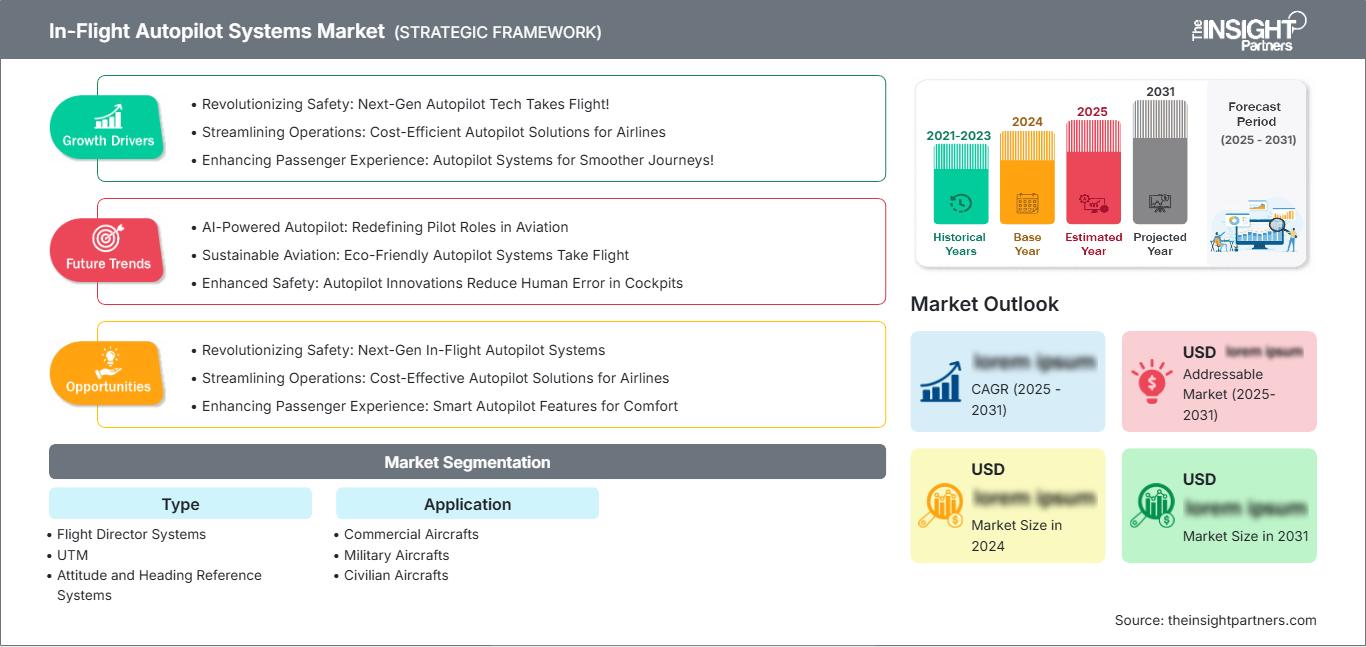
The global aviation sector is undergoing a rapid transition toward automation, driven by the need for enhanced flight safety, optimized fuel consumption, and reduced pilot workload. In-flight autopilot systems have evolved from simple heading-hold mechanisms into complex, highly integrated avionics suites capable of managing navigate-and-control operations across commercial, military, and general aviation sectors. As modern aircraft become increasingly reliant on digital flight control systems, artificial intelligence (AI), and advanced sensor fusion, the market for in-flight autopilot solutions is experiencing robust growth worldwide.
Get a PDF Sample- https://www.theinsightpartners.com/sample/TIPRE00012234
North America In-Flight Autopilot Systems Market
North America dominates the global in-flight autopilot systems market due to the high concentration of leading aircraft manufacturers, defense prime contractors, and major commercial airlines. The region benefits from substantial defense spending by the United States government aimed at modernizing military transport and surveillance aircraft fleets. Furthermore, stringent safety regulations established by the Federal Aviation Administration (FAA) drive continuous upgrades of flight control avionics across general and commercial aviation. Rapid adoption of autonomous drone technology and next-generation Urban Air Mobility (UAM) initiatives further accelerates the growth of advanced autopilot solutions throughout the region.
Market Forecast
According to the latest research report by The Insight Partners, the In-Flight Autopilot Systems Market size is expected to reach US$ 7.34 Billion by 2034 from US$ 3.68 Billion in 2025. Driven by ongoing fleet modernization programs, rising passenger traffic, and the rapid expansion of unmanned aerial vehicles (UAVs), the market is anticipated to register a CAGR of 7.97% during the forecast period 2026–2034.
The steady expansion reflects increasing investments by commercial airlines and defense forces in next-generation flight deck technologies. Autopilot systems not only assist in long-haul route navigation but also contribute significantly to precision approaches, automatic landing, and real-time flight path optimization, thereby minimizing human error—a primary cause of aviation incidents.
Key Industry Drivers and Technological Trends
Increasing Commercial Fleet Deliveries: Rising demand for air travel globally has compelled commercial OEMs to accelerate aircraft production. Modern narrow-body and wide-body jets are built with integrated digital autopilot suites that streamline cockpit operations and enhance overall flight efficiency.
Growth in Unmanned Aerial Systems (UAS): Autopilot hardware and software form the operational core of commercial and military UAVs. As defense forces expand surveillance operations and commercial sectors explore autonomous logistics, drone-tailored autopilot systems are experiencing unprecedented demand.
Fuel Efficiency and Sustainability Goals: Airlines face immense pressure to lower carbon emissions. Advanced flight management systems paired with intelligent autopilot software enable smooth climb profiles, optimal cruising altitudes, and reduced fuel burn during long-haul flights.
Integration of AI and Machine Learning: Emerging autopilot technologies are incorporating adaptive flight control algorithms capable of reacting to sudden severe weather changes or mechanical anomalies faster than traditional rule-based controllers, significantly raising safety margins.
Key Players in the Market
The market for in-flight autopilot systems is highly competitive, characterized by continuous research and development, strategic acquisitions, and partnership agreements among global technology leaders. Prominent companies operating in this space include:
Airware
Lockheed Martin
Rockwell Collins (Collins Aerospace)
Honeywell International
Genesys Aerosystems Group
Century Flight Systems
BAE Systems
Garmin
Cloud Cap Technology Inc.
L-3 Communications (L3Harris Technologies)
These industry leaders focus on delivering modular, lightweight, and fault-tolerant flight management solutions suitable for fixed-wing aircraft, rotary-wing platforms, and uncrewed aerial vehicles.
Get Full Copy of This Report- https://www.theinsightpartners.com/buy/TIPRE00012234
Future Outlook
Looking ahead, the in-flight autopilot systems market is set to experience transformative shifts toward fully autonomous flight operations and artificial intelligence-assisted co-piloting. As autonomous electric vertical takeoff and landing (eVTOL) aircraft enter commercial services, demand for light, ultra-reliable, and fail-operational autopilot technology will escalate sharply. Additionally, continuous breakthroughs in cybersecurity architectures will ensure autopilot systems remain resilient against emerging cyber threats. Over the forecast period of 2026 to 2034, collaboration between aviation regulators, technology developers, and aircraft OEMs will be vital to unlocking next-level airspace automation and establishing single-pilot or fully uncrewed flight frameworks for the future of global aviation.
Related Reports-
In Flight Entertainment Market
Enhanced Flight Vision System Market
About Us
The Insight Partners is a one-stop industry research provider of actionable intelligence. We help our clients in getting solutions to their research requirements through our syndicated and consulting research services. We specialize in industries such as Semiconductor and Electronics, Aerospace and Defense, Automotive and Transportation, Biotechnology, Healthcare IT, Manufacturing and Construction, Medical Devices, Technology, Media, and Telecommunications, as well as chemicals and Materials.
Contact Us
If you have any queries about this report or if you would like further information, don’t hesitate to get in touch with us:
Contact Person: Ankit Mathur
E-mail: ankit.mathur@theinsightpartners.com
