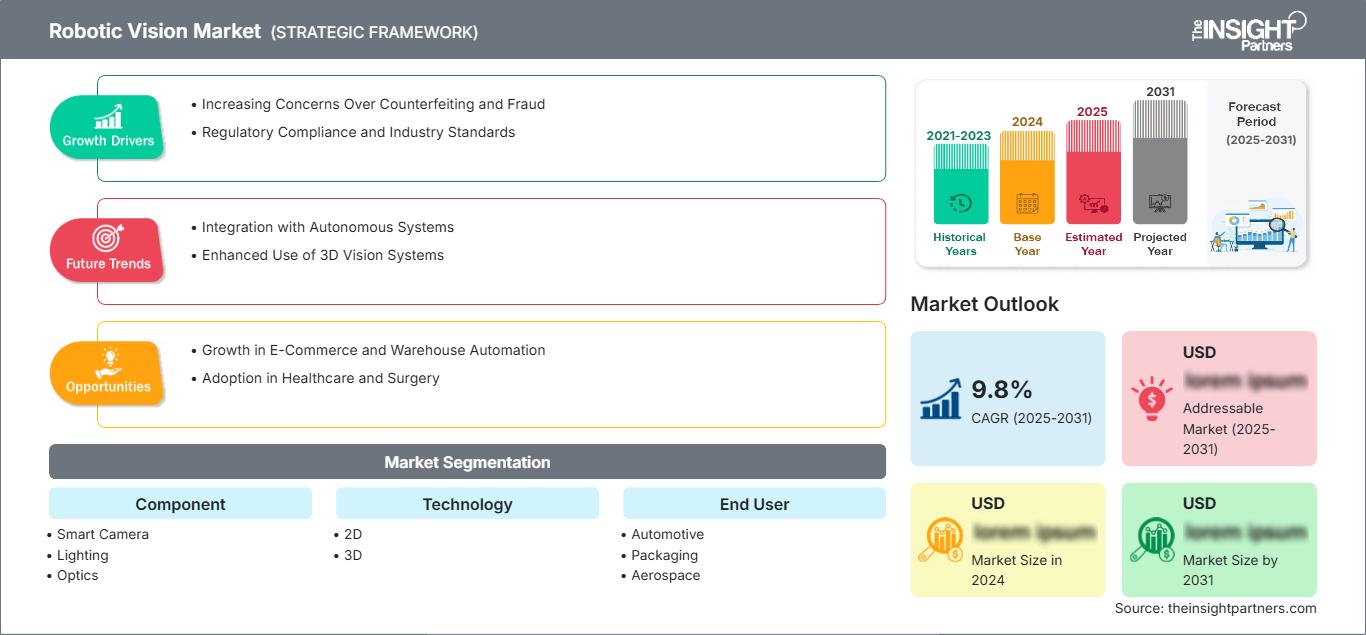
The rapid evolution of industrial automation is changing how manufacturers approach production, inspection, material handling, and quality assurance. Robots are increasingly expected to perform tasks that require visual perception, decision-making, precision, and adaptability rather than simply repeating predefined movements. Advances in cameras, sensors, artificial intelligence, machine learning, image processing, and three-dimensional perception are helping manufacturers create more intelligent and flexible automation environments. These capabilities are particularly valuable in automotive, electronics, logistics, food and beverage, pharmaceuticals, and other industries where accuracy and consistency are essential.
The Robotic Vision Market is gaining momentum as companies combine robotic systems with advanced vision technologies to improve productivity, reduce defects, enhance worker safety, and support increasingly automated production environments. Recent industry analysis indicates strong growth through 2031, supported by the transition toward AI-enabled inspection, smart manufacturing, collaborative robotics, and increasingly sophisticated 3D vision systems.
Get a Sample PDF: https://www.theinsightpartners.com/sample/TIPRE00012053
Robotic Vision Market Growth Drivers
One of the strongest factors supporting the Robotic Vision Market is the growing emphasis on automated quality inspection. Manufacturers are under constant pressure to maintain consistent product quality while controlling operating costs. Vision-enabled robots can identify defects, verify dimensions, recognize components, and inspect products at high speed, helping production facilities reduce dependence on manual inspection.
The expansion of Industry 4.0 is another important growth catalyst. Modern factories increasingly connect robots, cameras, sensors, software, and industrial networks to create data-driven production environments. Vision systems provide robots with information about their surroundings, allowing them to respond to changes in product position, orientation, shape, and condition.
The adoption of artificial intelligence is further transforming robotic vision. AI-powered systems can process complex visual information and improve object recognition, classification, defect detection, and decision-making. This is encouraging manufacturers to move beyond conventional rule-based inspection toward more adaptable systems capable of handling production variability.
Key Trends Shaping the Robotic Vision Market
Several technology trends are expected to influence the Robotic Vision Market through 2031:
- AI-enabled vision: Machine learning and deep-learning algorithms are improving object recognition, anomaly detection, and automated inspection.
- 3D vision adoption: Depth perception is becoming increasingly important for bin picking, assembly, navigation, measurement, and complex material handling.
- Edge processing: Processing visual information closer to the robot is supporting faster responses and reducing dependence on centralized computing.
- Collaborative robotics: Vision systems are helping collaborative robots operate more safely and intelligently around people.
- Vision-guided material handling: Automated picking, sorting, packaging, and palletizing are creating new opportunities for vision-integrated robotics.
- Compact and intelligent sensors: More capable cameras and sensors are allowing vision technology to be deployed in applications where space and installation complexity are limited.
Recent technology developments reinforce this direction. Industry commentary highlights the growing role of AI platforms and advanced 3D systems in improving defect detection and addressing limitations associated with conventional vision hardware.
Robotic Vision Market Size, Share, Trends, Analysis and Forecast to 2031
- Market Size: The global Robotic Vision Market is positioned for sustained expansion toward 2031 as manufacturers increase investments in intelligent automation and automated inspection.
- Market Share: Hardware remains an important part of the competitive landscape, while software and AI capabilities are gaining strategic importance as customers seek complete vision solutions.
- Market Trends: AI-based inspection, 3D perception, edge computing, collaborative robotics, and vision-guided automation are among the leading trends shaping industry adoption.
- Market Analysis: Automotive, electronics, logistics, food and beverage, pharmaceuticals, and industrial manufacturing remain significant application areas because of their need for precision, repeatability, traceability, and high-speed operations.
- Forecast to 2031: Industry forecasts point toward continued expansion through 2031, supported by Industry 4.0 adoption, labor-related challenges, demand for zero-defect manufacturing, and advances in AI-powered robotic perception.
Global Analysis
Globally, the Robotic Vision Market is benefiting from the convergence of robotics, artificial intelligence, machine vision, and industrial automation. Developed manufacturing economies are investing in smart factories and automated inspection, while emerging economies are increasingly adopting robotics to improve production efficiency and address workforce challenges.
Asia Pacific represents a major growth environment because of its extensive electronics, automotive, semiconductor, and manufacturing ecosystem. Increasing factory automation and investment in advanced production technologies are creating opportunities for robotic vision providers.
North America remains a technologically advanced region for robotic vision adoption. The United States is supported by strong investments in automation, logistics, automotive manufacturing, electronics, and AI. Recent industry research also highlights a highly competitive US machine vision landscape, with leading suppliers serving major sectors such as logistics and automotive alongside a broad group of specialized vendors.
Europe continues to benefit from its established automotive and industrial manufacturing base. Demand for high-precision automation, workplace safety, and smart factory technologies is supporting the deployment of robotic vision across production environments.
Regional Outlook
The regional outlook indicates that adoption will remain diversified. Asia Pacific is expected to remain an important growth engine because of manufacturing expansion and increasing automation investments. North America is positioned strongly due to technological innovation, AI development, advanced logistics, and established robotics adoption. Europe is expected to maintain steady demand as manufacturers modernize production facilities and pursue greater efficiency.
Emerging markets across Latin America and the Middle East & Africa are also creating opportunities as industrial automation becomes more accessible and manufacturers gradually introduce intelligent robotics into production and logistics operations.
Competitive Landscape and Key Players
The competitive environment includes robotics companies, machine vision specialists, camera manufacturers, sensor providers, and software developers. Key participants identified across industry research include:
- ABB Ltd.
- Cognex Corporation
- FANUC Corporation
- Keyence Corporation
- Basler AG
- Denso Corporation
- Omron Corporation
- MVTec Software GmbH
- Matrox Electronic Systems Ltd.
- Comau S.p.A.
Companies are increasingly focusing on integrated hardware and software solutions, AI-powered inspection, 3D vision, easier system integration, and application-specific technologies.
Industry Developments and Latest News
Recent developments across the broader machine vision and robotics landscape demonstrate a clear shift toward intelligent perception. New AI platforms are being developed to accelerate defect detection, while 3D vision technologies are becoming more important for robots operating in variable and unstructured environments.
At the same time, research into the US machine vision sector indicates that the competitive environment combines a small number of major suppliers with numerous specialized vendors. This creates opportunities for companies that can provide differentiated solutions for specific industrial applications.
Get the Premium Research Report @ https://www.theinsightpartners.com/buy/TIPRE00012053
Future Outlook
The future of the Robotic Vision Market will be closely linked to the development of intelligent, flexible, and autonomous manufacturing. As AI algorithms become more capable and vision hardware becomes easier to deploy, robots will increasingly move from repetitive automation toward perception-driven decision-making. The integration of 3D sensing, edge computing, AI software, collaborative robotics, and real-time analytics is expected to create new applications across manufacturing, logistics, healthcare, and other industries.
Through 2031, businesses are likely to prioritize robotic vision solutions that deliver measurable improvements in quality, productivity, safety, and operational flexibility. Vendors that combine reliable imaging hardware with sophisticated AI and user-friendly software will be well positioned to capture emerging opportunities as industries accelerate their transition toward smart and autonomous operations.
Related Reports –
Home Energy Management System Market Regional Share, Trend, and Growth Opportunity
Vision Transformers Market Regional Share, Trend, and Growth Opportunity
Differential-Pressure Mass Flow Controller Market Regional Share, Trend, and Growth Opportunity
About The Insight Partners
The Insight Partners is a leading market research and consulting firm delivering actionable insights through in-depth industry analysis and strategic intelligence. The firm supports clients across various industries in making informed business decisions by providing comprehensive market forecasts, competitive assessments, and growth opportunities.
Contact Us:
If you have any queries about this report or if you would like further information, please contact us:
Contact Person: Ankit Mathur
E-mail: sales@theinsightpartners.com
Phone: +1-646-491-9876
Also Available in :
Korean | German | Japanese | French | Chinese | Italian | Spanish
