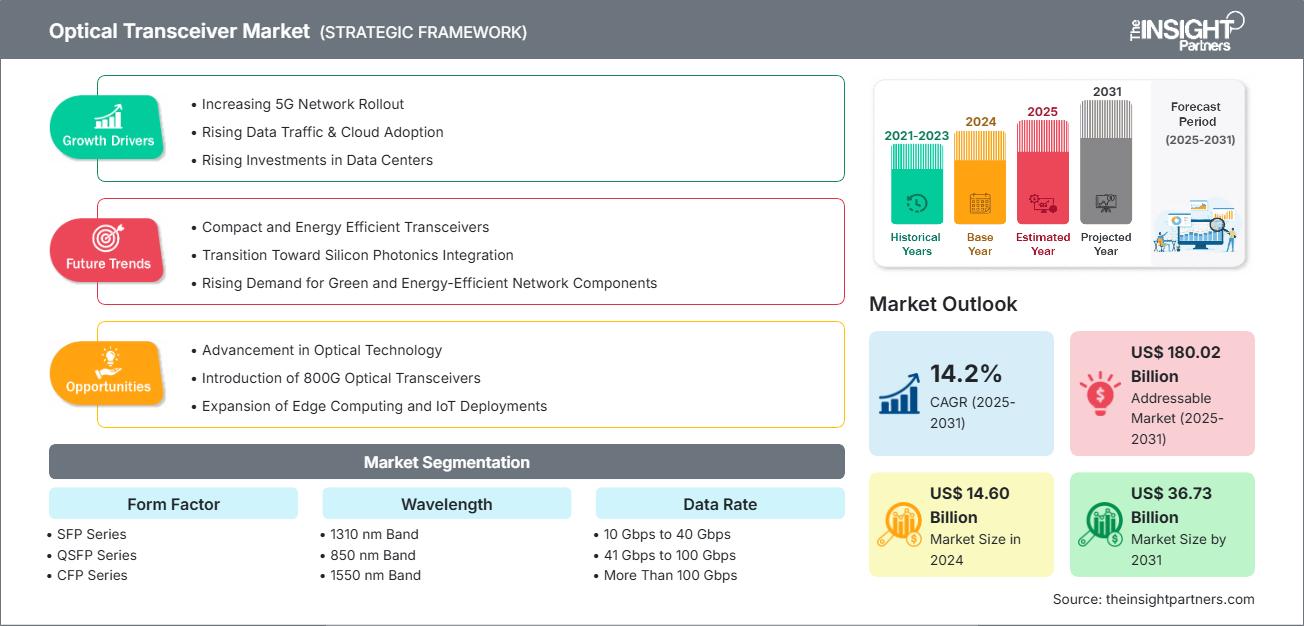
The rapid expansion of artificial intelligence, cloud computing, hyperscale data centers, and high-performance networking is reshaping the way digital infrastructure is designed and deployed. Optical communication technologies are becoming increasingly important as conventional electrical interconnects face growing challenges related to bandwidth, latency, power consumption, and scalability. Optical transceivers serve as critical components by converting electrical signals into optical signals and optical signals back into electrical signals, enabling high-speed data transmission across servers, switches, data centers, telecommunications networks, and enterprise infrastructure. Their ability to support faster connectivity over longer distances makes them essential for modern digital ecosystems. Recent industry developments indicate that demand is moving rapidly toward higher-speed solutions, with 800G becoming increasingly established and 1.6T technologies progressing toward broader commercial deployment.
The Optical Transceiver Market Share is entering a significant transformation phase as AI workloads require increasingly powerful and efficient data-center networks. Recent developments from leading optical technology companies demonstrate that the industry is shifting from conventional high-speed modules toward next-generation architectures designed for AI clusters and increasingly dense networking environments. Marvell announced an expanded 1.6T optical DSP portfolio in 2026, while Applied Optoelectronics reported its first volume order for 1.6T data-center transceivers from a major hyperscale customer.
Get a Sample PDF: https://www.theinsightpartners.com/sample/TIPTE100001069
Latest Industry Developments and Key Growth Drivers
Artificial intelligence is emerging as one of the strongest forces influencing the Optical Transceiver Market. AI training and inference require large numbers of GPUs and accelerators to communicate with one another at extremely high speeds. As AI clusters become larger, network bottlenecks can reduce compute utilization, creating greater demand for high-bandwidth optical connectivity.
The transition toward 800G and 1.6T connectivity is therefore becoming a central industry trend. Industry analysis indicates that shipments of higher-speed optical transceivers are accelerating as hyperscalers expand AI infrastructure. LightCounting reported that hyperscaler investment in AI infrastructure substantially increased demand for 800G optical technologies, while expectations for both 800G and 1.6T shipments were raised for the current technology cycle.
Another important development is the growing emphasis on silicon photonics, advanced digital signal processors, co-packaged optics, and near-packaged optics. These technologies aim to improve bandwidth density while addressing power and thermal challenges associated with increasingly sophisticated data centers.
Recent developments also highlight growing production investments. Applied Optoelectronics is expanding manufacturing capacity in the US and expects its combined production capability for high-speed transceivers to increase significantly. Lumentum has also reported strong demand for next-generation optical technologies and is expanding production capacity in North Carolina.
Market Size, Share, Trends, Analysis, and Forecast by 2031
- Market Size: The industry is expected to expand substantially through 2031, supported by rising deployment of high-speed optical connectivity across data centers, telecommunications, cloud platforms, and enterprise networks.
- Market Share: Data-center applications are expected to account for an increasingly important share of demand as hyperscalers, cloud providers, and AI infrastructure operators expand high-performance networking capacity.
- Market Trends: The transition from 400G toward 800G and 1.6T connectivity, increasing adoption of silicon photonics, greater use of PAM4 technology, and development of co-packaged and near-packaged optical solutions are shaping the competitive landscape.
- Market Analysis: Growth is being supported by AI infrastructure expansion, cloud computing, rising network traffic, data-center modernization, and the need for higher bandwidth with improved energy efficiency.
- Market Forecast: Through 2031, demand is expected to move toward higher-speed, lower-power, compact, and more intelligent optical connectivity solutions, while suppliers continue investing in manufacturing capacity and advanced component technologies.
Global Analysis
Globally, the Optical Transceiver Market is being influenced by the rapid development of hyperscale data centers and telecommunications infrastructure. North America remains a highly important innovation and deployment center because of its concentration of hyperscalers, cloud service providers, AI companies, networking technology developers, and data-center operators.
Asia-Pacific is also positioned as a major growth region due to large-scale electronics manufacturing capabilities, expanding digital infrastructure, telecommunications development, and increasing investment in AI and cloud computing. Countries across the region are strengthening data-center capacity while suppliers continue expanding optical component and module manufacturing.
Europe is focusing on data-center modernization, high-speed communications, energy efficiency, and advanced photonics technologies. The region’s emphasis on digital infrastructure and efficient networking is expected to support continued adoption of optical technologies.
Meanwhile, emerging economies across Latin America, the Middle East, and Africa are gradually increasing investment in cloud services, broadband connectivity, telecommunications infrastructure, and data centers. These developments create additional opportunities for optical connectivity suppliers.
Regional Trends and Competitive Landscape
North America is expected to remain particularly influential in the Optical Transceiver Market, driven by AI-focused data-center investments and the presence of major technology companies. Recent announcements from Applied Optoelectronics, Lumentum, and other technology suppliers demonstrate the strategic importance of expanding high-speed optical production capabilities in the region.
The competitive environment is increasingly centered on product speed, power efficiency, thermal performance, manufacturing scale, reliability, and interoperability. Vendors are also working to reduce supply-chain constraints affecting lasers, optical components, DSPs, and other critical materials.
Key Players
- Coherent Corp.
- Lumentum Holdings Inc.
- Applied Optoelectronics, Inc.
- Marvell Technology, Inc.
- Broadcom Inc.
- Cisco Systems, Inc.
- NVIDIA Corporation
- Innolight Technology
- Eoptolink Technology Inc.
- Fabrinet
Applications and Emerging Opportunities
The Optical Transceiver Market serves a broad range of applications, including data centers, telecommunications, enterprise networking, cloud computing, high-performance computing, broadband infrastructure, and data-center interconnects.
One of the most promising opportunities is the development of AI-native networking infrastructure. As AI clusters become increasingly distributed, optical links must support greater throughput while maintaining low latency and manageable power consumption. Industry discussions at OFC 2026 highlighted the progression toward 1.6T connectivity and the emergence of technologies designed to scale optical networks across multiple dimensions.
The industry is also moving toward more sophisticated optical architectures. Co-packaged optics and near-packaged optics are being explored as potential approaches for reducing electrical link distances and improving system-level efficiency. Although the timing of broad CPO adoption remains an industry discussion, investment and development activity indicate that optical integration will remain an important long-term technology direction.
Challenges Affecting Industry Expansion
Despite strong opportunities, the Optical Transceiver Market faces challenges including supply-chain constraints, component availability, thermal management, manufacturing complexity, testing requirements, interoperability, and the need for continuous technology upgrades.
The rapid transition between generations also creates pressure on manufacturers to deliver reliable products at scale while maintaining competitive costs. Component shortages involving optical chips and other critical materials can affect production schedules and lead times. At the same time, operators must balance the performance benefits of next-generation transceivers with power, cooling, and total cost-of-ownership considerations.
Get the Premium Research Report @ https://www.theinsightpartners.com/buy/TIPTE100001069
Future Outlook
The future of the Optical Transceiver Market will be closely connected to the evolution of AI, cloud computing, high-performance computing, and hyperscale data centers. The industry is moving beyond incremental bandwidth improvements toward a broader transformation in how optical connectivity is designed, manufactured, deployed, and integrated into networking systems.
The progression from 800G toward 1.6T and eventually higher-speed architectures is expected to create opportunities for suppliers across optical engines, DSPs, lasers, silicon photonics, packaging, testing, and module manufacturing. Recent company announcements and industry developments suggest that the transition toward higher-speed optical connectivity is already gaining commercial momentum.
As data-intensive applications continue to grow, optical transceivers are expected to remain a foundational technology for scalable digital infrastructure. Companies capable of combining high bandwidth, energy efficiency, reliability, manufacturing scale, and advanced photonic integration are likely to be well positioned through 2031.
Related Reports –
Home Energy Management System Market Regional Share, Trend, and Growth Opportunity
Vision Transformers Market Regional Share, Trend, and Growth Opportunity
Differential-Pressure Mass Flow Controller Market Regional Share, Trend, and Growth Opportunity
About The Insight Partners
The Insight Partners is a leading market research and consulting firm delivering actionable insights through in-depth industry analysis and strategic intelligence. The firm supports clients across various industries in making informed business decisions by providing comprehensive market forecasts, competitive assessments, and growth opportunities.
Contact Us:
If you have any queries about this report or if you would like further information, please contact us:
Contact Person: Ankit Mathur
E-mail: sales@theinsightpartners.com
Phone: +1-646-491-9876
Also Available in :
Korean | German | Japanese | French | Chinese | Italian | Spanish
