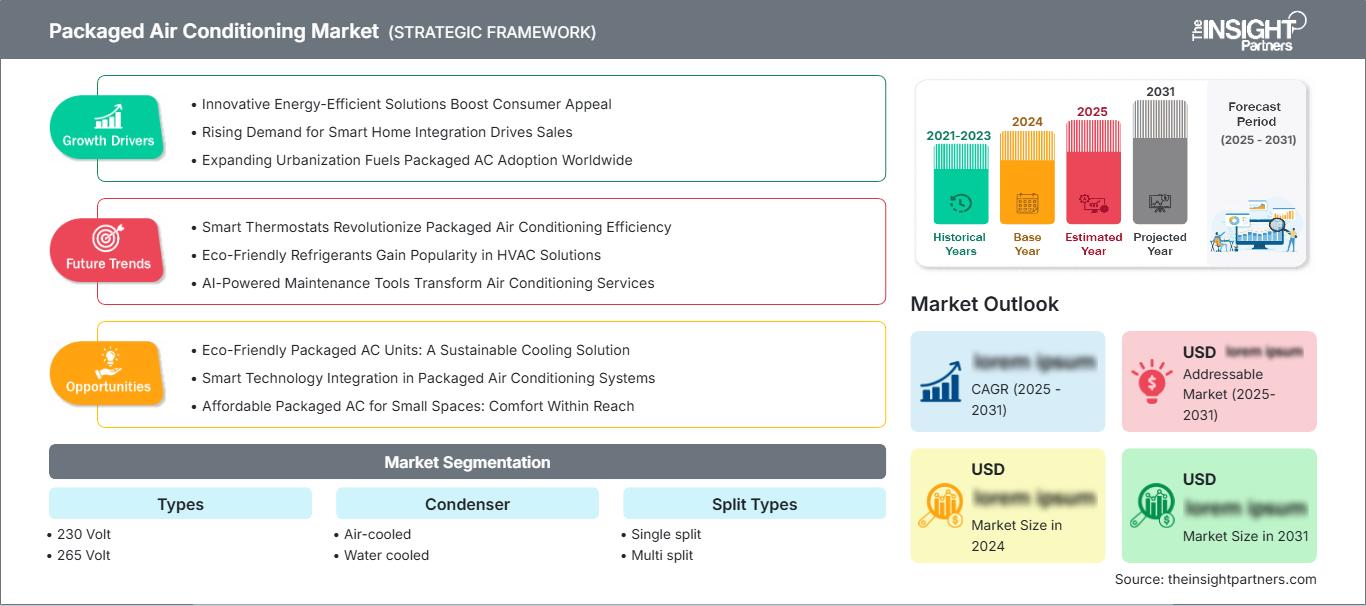
Rising temperatures, rapid urbanization, commercial construction, and the growing emphasis on energy-efficient building infrastructure are reshaping the global cooling industry. Packaged air conditioning systems are increasingly being selected for their compact architecture, simplified installation, centralized cooling capability, and suitability for commercial, industrial, and selected residential environments. Rooftop and self-contained configurations can help optimize usable indoor space while providing consistent temperature management. At the same time, manufacturers are responding to evolving customer expectations with advanced controls, improved compressors, better heat-exchange performance, and lower-environmental-impact refrigerant technologies. The growing focus on indoor air quality and building energy management is also encouraging property owners to replace aging equipment with more efficient systems. These developments are creating new opportunities for equipment manufacturers, technology suppliers, distributors, contractors, and service providers worldwide.
The Packaged Air Conditioning Market is entering a technology-driven phase in which energy efficiency, intelligent controls, refrigerant transition, and flexible installation are becoming major purchasing considerations. According to The Insight Partners, the sector is analyzed across key configurations and technical categories, including 230-volt and 265-volt systems, air-cooled and water-cooled condensers, single-split and multisplit configurations, and constant-volume and variable-air-volume distribution systems. Demand is being supported by modernization of commercial buildings, expansion of retail and hospitality infrastructure, and the need for reliable cooling in increasingly temperature-sensitive environments.
Get a Sample PDF: https://www.theinsightpartners.com/sample/TIPRE00026565
Key Growth Drivers
Energy efficiency remains one of the strongest forces influencing purchasing decisions. Building owners are increasingly evaluating HVAC equipment based not only on initial acquisition costs but also on lifetime energy consumption, maintenance requirements, operating reliability, and compliance with evolving environmental standards. Connected controls, variable-speed technologies, improved compressors, and advanced monitoring capabilities are helping users optimize system performance.
Refrigerant transition is another important development. In the US, the Environmental Protection Agency has implemented technology-transition requirements that encourage the use of lower-GWP refrigerants in affected air-conditioning applications. For example, new packaged terminal air conditioners manufactured from January 2025 are subject to lower-GWP refrigerant requirements, while R-32 is among the refrigerant options that fall below the applicable GWP limit for the residential and light-commercial air-conditioning subsector.
Recent industry developments also demonstrate continued innovation. Commercial HVAC manufacturers have been introducing systems designed around energy efficiency, low-GWP refrigerants, improved controls, and easier installation. Industry reporting in 2026 also indicates that commercial HVAC activity has remained comparatively resilient, with manufacturers reporting commercial-sector growth while residential demand faces a more mixed economic environment.
Market Size, Share, Trends, Analysis, and Forecast by 2031
- Market Size: The global industry is expected to maintain an upward expansion trajectory through 2031, supported by replacement demand, commercial construction, modernization projects, and increasing requirements for efficient cooling.
- Market Share: Share is expected to increasingly favor technologically advanced systems that combine efficient operation, flexible configuration, intelligent controls, and lower-GWP refrigerant compatibility.
- Market Trends: Major trends include smart HVAC controls, connected monitoring, energy optimization, advanced compressors, low-GWP refrigerants, improved indoor air management, and predictive maintenance.
- Market Analysis: Commercial and institutional applications remain important demand centers because packaged systems can offer simplified installation and effective space management. Rooftop and self-contained solutions are particularly relevant where centralized cooling and limited indoor equipment space are priorities.
- Forecast to 2031: Growth is expected to remain supported by urban development, refurbishment of older buildings, increasing cooling requirements, sustainability initiatives, and continuing technological improvements.
Global and Regional Analysis
Asia-Pacific is expected to remain a significant growth region because of urbanization, industrial expansion, commercial infrastructure development, and rising cooling requirements. China, India, Japan, South Korea, and other developing economies continue to provide opportunities for HVAC manufacturers as businesses and property developers invest in modern climate-control infrastructure. The region’s diverse climatic conditions and expanding construction activity make efficient packaged systems increasingly relevant.
North America represents another important opportunity, particularly across commercial buildings, retail facilities, warehouses, hospitality properties, and institutional infrastructure. In the US, regulatory changes surrounding refrigerants and efficiency are encouraging manufacturers and building owners to reconsider equipment specifications and replacement strategies. The transition toward lower-GWP refrigerants is likely to influence product development and purchasing decisions throughout the forecast period.
Europe continues to emphasize energy performance, sustainability, and environmentally responsible cooling technologies. Demand is increasingly linked to building modernization, stringent efficiency expectations, and the transition toward refrigerants with lower environmental impact. Latin America and the Middle East & Africa also present opportunities as commercial development, urbanization, hospitality projects, and climatic conditions increase the need for dependable cooling infrastructure.
Technology Trends Reshaping the Industry
Smart connectivity is becoming increasingly important. Modern systems can incorporate sensors, remote monitoring, automated scheduling, diagnostics, and building-management-system integration. These capabilities allow operators to monitor equipment performance and identify potential maintenance requirements before failures cause costly downtime.
Artificial intelligence and data-driven maintenance are also gaining attention. Predictive analytics can help identify abnormal operating conditions, optimize energy consumption, and support service scheduling. Meanwhile, low-GWP refrigerants and more efficient components are becoming central to product development as governments and businesses pursue lower environmental impact. Industry commentary in 2026 highlights electrification, refrigerant changes, efficiency standards, and digitalization as major forces shaping HVAC development.
Key Players
Major companies participating in the competitive landscape include:
- Carrier Global Corporation
- Daikin Industries, Ltd.
- Johnson Controls International plc
- Trane Technologies plc
- Lennox International Inc.
- Rheem Manufacturing Company
- Mitsubishi Electric Corporation
- LG Electronics
- Panasonic Corporation
- Fujitsu General Limited
Competition is increasingly centered on energy performance, product reliability, refrigerant readiness, digital functionality, installation flexibility, and after-sales service. Manufacturers are investing in product development and strategic initiatives to differentiate their offerings as building owners demand more efficient and intelligent cooling solutions.
Future Outlook
The outlook for the Packaged Air Conditioning Market through 2031 remains positive as cooling requirements expand and customers place greater emphasis on efficiency, reliability, sustainability, and intelligent operation. The convergence of smart building technologies, low-GWP refrigerants, advanced controls, and energy-saving components is expected to create a new generation of packaged cooling systems. Commercial construction and renovation will remain important demand generators, while replacement of aging equipment will provide another sustained opportunity.
As regulatory requirements continue to evolve, manufacturers that can deliver compliant, energy-efficient, connected, and cost-effective solutions are likely to strengthen their competitive positions. At the same time, expanding adoption of predictive maintenance and digital monitoring can create recurring opportunities for service providers. Overall, technological innovation and the global transition toward more sustainable buildings are expected to remain central to industry development through 2031.
Get the Premium Research Report @ https://www.theinsightpartners.com/buy/TIPRE00026565
Related Reports –
Home Energy Management System Market Regional Share, Trend, and Growth Opportunity
Vision Transformers Market Regional Share, Trend, and Growth Opportunity
Differential-Pressure Mass Flow Controller Market Regional Share, Trend, and Growth Opportunity
About The Insight Partners
The Insight Partners is a leading market research and consulting firm delivering actionable insights through in-depth industry analysis and strategic intelligence. The firm supports clients across various industries in making informed business decisions by providing comprehensive market forecasts, competitive assessments, and growth opportunities.
Contact Us:
If you have any queries about this report or if you would like further information, please contact us:
Contact Person: Ankit Mathur
E-mail: sales@theinsightpartners.com
Phone: +1-646-491-9876
Also Available in :
Korean | German | Japanese | French | Chinese | Italian | Spanish
