The next generation of visual technology is moving beyond conventional flat screens as organizations increasingly seek immersive, interactive, and highly realistic ways to present complex information. Advances in projection systems, optical engineering, processors, sensors, and real-time rendering are helping transform three-dimensional visualization from a specialized concept into a practical tool for several industries. Applications spanning medical imaging, aerospace and defense, automotive design, education, industrial simulation, and entertainment are creating new opportunities for companies developing advanced display architectures.
The Volumetric Display Market is gaining attention as enterprises and technology developers explore glass-free three-dimensional visualization that can be viewed from different angles. Unlike conventional two-dimensional screens, volumetric systems generate images with depth within a physical or perceived volume, allowing users to examine objects and spatial information more naturally. The Insight Partners estimates that the industry will register a strong CAGR through 2031, highlighting increasing investment in advanced visualization technologies and the expanding range of commercial applications.
Get a Sample PDF: https://www.theinsightpartners.com/sample/TIPRE00003285
Industry Growth Driven by Demand for Immersive Visualization
One of the strongest factors supporting growth is the increasing need to understand complex three-dimensional information quickly. In healthcare, volumetric visualization can support the interpretation of anatomical structures and improve the presentation of medical images. In aerospace and defense, the technology can help users interact with terrain, mission information, simulations, and other spatial data.
Automotive manufacturers are also exploring advanced visualization for design, human-machine interfaces, simulation, and next-generation vehicle experiences. Meanwhile, media and entertainment companies are investigating three-dimensional displays for exhibitions, events, gaming, advertising, and immersive experiences.
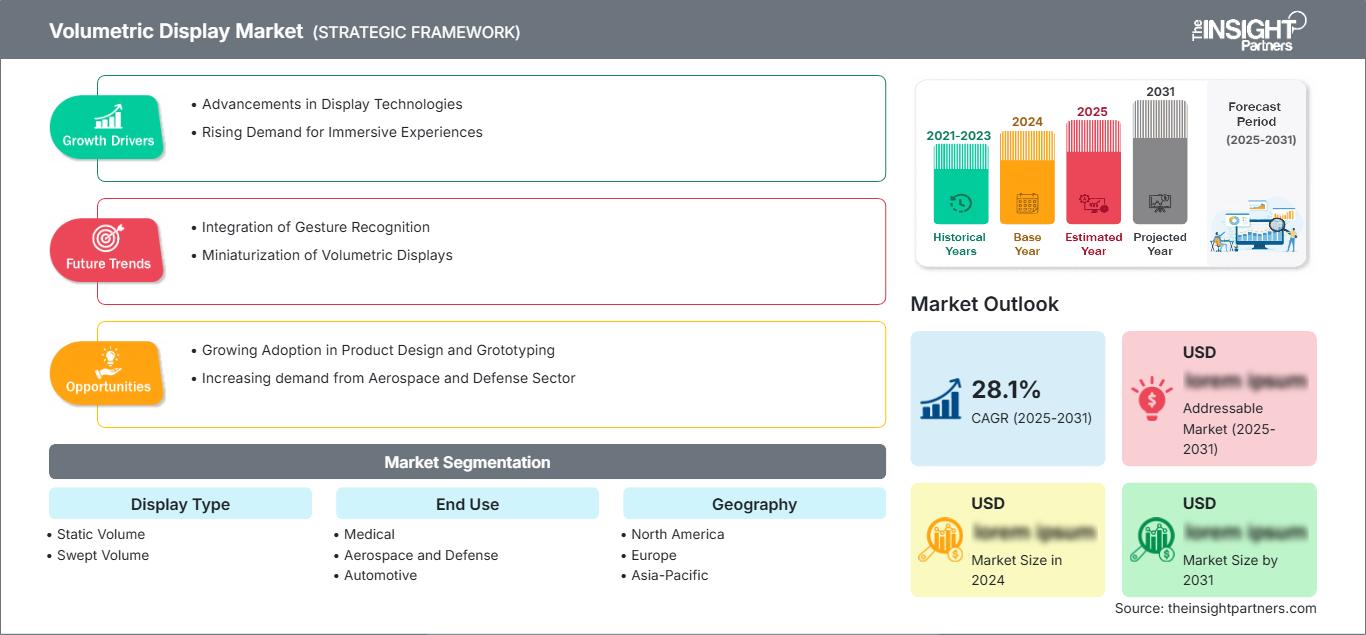
The technology is evolving through innovations in swept-volume, static-volume, and multi-planar approaches, while improvements in projectors, motors, position sensors, mirrors, processors, and rendering software are helping manufacturers address performance and usability challenges. The Insight Partners segments the industry by display type, component, end user, and geography, with aerospace and defense, automotive, healthcare, education, and other sectors forming important application areas.
Key Market Size, Share, Trends, Analysis, and Forecast Insights by 2031
- Market Size: The industry is expected to expand substantially through 2031 as advanced visualization moves from experimental applications toward broader commercial and institutional use.
- Market Share: Regional and application-level shares are expected to evolve as healthcare, defense, automotive, entertainment, and education organizations increase adoption.
- Market Trends: Major trends include glass-free 3D visualization, higher-resolution volumetric imagery, real-time rendering, AI-assisted content generation, improved optical components, and integration with immersive digital environments.
- Market Analysis: Growth is being supported by demand for interactive visualization, technological advances in projection and processing, expanding enterprise applications, and increasing interest in spatial computing.
- Market Forecast: The outlook through 2031 remains positive, with strong expansion expected across established markets as well as emerging economies. The Insight Partners forecasts a 28.1% CAGR for the period from 2025 to 2031.
Global Industry Analysis
Globally, adoption is being shaped by the convergence of display engineering, computer graphics, artificial intelligence, sensors, and high-performance computing. Organizations are increasingly interested in technologies that can simplify complex data and provide more intuitive interaction.
Healthcare represents an important opportunity because three-dimensional visualization can make anatomical structures easier to interpret. Aerospace and defense organizations are another major area of interest, particularly for simulation, command-and-control environments, training, and spatial data visualization.
Automotive applications are also expanding as manufacturers investigate advanced displays for design, simulation, navigation, and future vehicle interfaces. Entertainment and education are contributing additional opportunities by using immersive visualization to create more engaging experiences.
Regional Outlook
North America: North America remains an important technology hub because of its established aerospace and defense ecosystem, healthcare technology capabilities, research institutions, and concentration of display and computing companies. Demand for sophisticated simulation and visualization systems continues to support regional opportunities.
Asia-Pacific: Asia-Pacific is positioned for strong expansion, supported by electronics manufacturing capabilities, technological investment, and adoption across countries such as China, Japan, South Korea, and India. Research indicates that the region is expected to be among the fastest-growing areas during the forecast period.
Europe: European demand is supported by automotive engineering, healthcare innovation, industrial design, research, and entertainment applications. Germany, the UK, and France remain important technology and industrial centers.
Middle East & Africa: Adoption is developing across defense, entertainment, advertising, and visualization applications. Investment in advanced technology and large-scale entertainment projects could create additional opportunities.
Latin America: The region represents an emerging opportunity, with universities, technology organizations, and entertainment companies gradually exploring advanced three-dimensional visualization.
Latest Industry Developments and Trends
Recent industry analysis shows that volumetric visualization is increasingly being connected with real-time graphics, spatial computing, and AI-enabled content workflows. Falling component costs and improvements in processing capabilities are helping developers explore more commercially viable systems.
At the same time, the competitive landscape is becoming more technology-driven. Companies are working to improve brightness, resolution, viewing angles, system size, image quality, processing speed, and ease of content creation. Industry research also identifies increasing attention toward rendering software and GPU capabilities, indicating that software innovation is becoming an important source of differentiation.
The broader technology ecosystem is also benefiting from developments in medical imaging, defense visualization, automotive interfaces, and immersive entertainment. However, challenges remain, including high development costs, complex content creation, limitations in resolution, system integration requirements, and the need for specialized expertise.
Key Players
Major companies and technology providers associated with the industry include:
- Voxon Photonics
- Looking Glass Factory
- Holoxica
- Lumi Industries
- Sony
- REALFICTION
- SeeReal Technologies S.A.
- Alioscopy
- Burton Inc.
- Artosci
Competitive strategies include product development, optical innovation, software integration, partnerships, research initiatives, and expansion into specialized applications.
Get the Premium Research Report @ https://www.theinsightpartners.com/buy/TIPRE00003285
Future Outlook
The future of the volumetric display industry will depend on how effectively manufacturers overcome technical and commercial barriers while making three-dimensional visualization easier to deploy. Greater integration with artificial intelligence, advanced graphics processing, spatial computing, digital twins, medical visualization, and immersive content is expected to open new use cases through 2031.
As organizations increasingly prioritize intuitive interaction with complex data, volumetric systems could become a valuable complement to conventional displays and extended-reality technologies. Continued innovation in optical components, projection architectures, processors, sensors, and content-generation platforms is likely to strengthen the industry’s long-term potential. The Insight Partners’ latest analysis reinforces the expectation of significant expansion through 2031, supported by technology development and growing adoption across multiple end-use industries.
Related Reports –
Home Energy Management System Market Regional Share, Trend, and Growth Opportunity
Vision Transformers Market Regional Share, Trend, and Growth Opportunity
Differential-Pressure Mass Flow Controller Market Regional Share, Trend, and Growth Opportunity
About The Insight Partners
The Insight Partners is a leading market research and consulting firm delivering actionable insights through in-depth industry analysis and strategic intelligence. The firm supports clients across various industries in making informed business decisions by providing comprehensive market forecasts, competitive assessments, and growth opportunities.
Contact Us:
If you have any queries about this report or if you would like further information, please contact us:
Contact Person: Ankit Mathur
E-mail: sales@theinsightpartners.com
Phone: +1-646-491-9876
Also Available in :
Korean | German | Japanese | French | Chinese | Italian | Spanish
