The increasing adoption of automated equipment, connected devices, electric mobility, and energy-efficient machinery is creating stronger demand for integrated solutions that can precisely manage motor operation. Motor control integrated circuits enable efficient control of speed, torque, direction, and power consumption across a wide range of electronic and electromechanical systems.
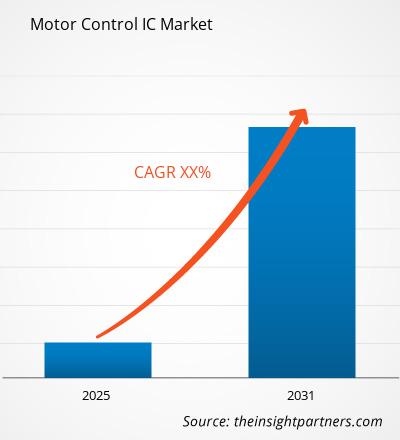
According to The Insight Partners, the Motor Control IC Market was valued at US$ 5.06 Billion in 2025 and is projected to reach US$ 7.76 Billion by 2034, registering a CAGR of 5.49% during 2026–2034. Growing industrial automation, automotive electronics, healthcare equipment, building automation, and consumer electronics adoption are expected to support market expansion.
Key Market Insights
- Market Size in 2025: US$ 5.06 Billion
- Projected Market Size by 2034: US$ 7.76 Billion
- CAGR (2026–2034): 5.49%
- Key Types: 32-bit embedded power motor control ICs, Intelligent motor control ICs, Digital motor control ICs
- Major Applications: Automotive, Healthcare, Building Control, Industrial Automation, Consumer Electronics
- Key Growth Factors: Industrial automation, smart control systems, automotive electrification, energy efficiency, and connected equipment
Get a Sample PDF Report: https://www.theinsightpartners.com/sample/TIPRE00006555
Industrial Automation Strengthens Demand
The expansion of industrial automation is one of the major factors supporting demand for motor control ICs. Manufacturing facilities are increasingly incorporating automated machinery, robotics, conveyor systems, pumps, fans, and precision equipment that require accurate and responsive motor control.
Motor control ICs integrate control functions into compact semiconductor solutions, helping manufacturers improve system efficiency while reducing circuit complexity. The growing deployment of smart factories and connected industrial equipment is further increasing demand for digitally controlled motors.
As manufacturers focus on improving productivity and reducing energy consumption, motor control solutions capable of supporting variable-speed operation and intelligent monitoring are becoming increasingly important.
Automotive Electrification Creates New Opportunities
The automotive industry represents an important application area for motor control ICs. Modern vehicles incorporate numerous electrically driven systems, including cooling fans, pumps, power windows, seat controls, steering systems, HVAC components, and other actuators.
The transition toward electric and hybrid vehicles is further increasing the number of electronically controlled motor functions within vehicles. Manufacturers therefore require compact and efficient motor control solutions capable of operating reliably under demanding automotive conditions.
The development of advanced driver assistance systems and increasingly software-defined vehicle architectures is also creating opportunities for semiconductor suppliers to provide more intelligent motor control capabilities.
Get the Premium Research Report: https://www.theinsightpartners.com/buy/TIPRE00006555
Intelligent Motor Control Supports Smarter Equipment
The evolution from conventional motor controllers toward intelligent and digitally controlled architectures is reshaping product development. Intelligent motor control ICs can support more sophisticated control functions, diagnostics, communication, and system optimization.
Digital control enables equipment manufacturers to improve motor performance while integrating control functions with broader embedded systems. This is particularly relevant in robotics, industrial automation, smart appliances, medical equipment, and building control systems.
The increasing integration of sensors, microcontrollers, connectivity, and embedded software is expected to encourage manufacturers to adopt more advanced motor control architectures.
32-bit Embedded Power Motor Control ICs Expand Embedded Applications
The market is categorized into 32-bit embedded power motor control ICs, Intelligent motor control ICs, and Digital motor control ICs.
32-bit embedded power motor control ICs are suited to applications requiring embedded processing and efficient control of motor functions. Intelligent motor control ICs address applications requiring advanced functionality and system-level optimization, while digital motor control ICs support precise and programmable control architectures.
The choice of motor control IC depends on motor type, power requirements, processing capabilities, control complexity, system architecture, and application-specific performance requirements.
Healthcare and Building Control Offer Additional Growth Areas
Healthcare equipment increasingly incorporates electronically controlled motors for pumps, medical beds, imaging systems, ventilation equipment, and other precision applications. Reliability and accurate control are critical in these systems, creating opportunities for advanced motor control semiconductor solutions.
Building control is another important application area. Automated ventilation, HVAC equipment, pumps, elevators, and other building systems rely on motor-driven equipment. Energy efficiency objectives are encouraging building operators to adopt smarter motor control technologies that can optimize equipment operation.
Consumer electronics also contribute to demand through appliances, cooling systems, smart home devices, and other products that require compact and energy-efficient motor control.
Regional Outlook
North America remains an important region due to its established semiconductor ecosystem, industrial automation adoption, advanced automotive technologies, and investments in smart infrastructure. The United States represents a key market supported by automation, intelligent equipment, and advanced electronics applications.
Europe benefits from its strong automotive and industrial manufacturing base. Demand for efficient motor systems is supported by automation, electrification, energy management, and technological development across manufacturing industries.
Asia Pacific represents a major opportunity due to its large electronics manufacturing base, automotive production, industrial automation investments, and growing adoption of smart appliances and connected equipment. China, Japan, South Korea, and India remain important markets for motor control semiconductor applications.
South and Central America and the Middle East and Africa are also expected to create opportunities as industrial modernization, infrastructure development, automation, and electronics adoption expand.
Competitive Landscape
Key companies profiled in the Motor Control IC Market include:
- Allegro MicroSystems, LLC
- Elmos Semiconductor AG
- Infineon Technologies AG
- Maxim Integrated
- NOVA electronics, INC.
- NXP Semiconductors N.V.
- ON Semiconductor
- Renesas Electronics Corporation
- STMicroelectronics
- Toshiba Corporation
Companies are focusing on improving motor control efficiency, integrating intelligent functionality, expanding product portfolios, and developing solutions for automotive, industrial, healthcare, and consumer applications.
Energy Efficiency Remains a Key Industry Priority
Motor-driven systems account for substantial energy consumption across industrial and commercial environments. Improving motor control can help equipment operate more efficiently by enabling precise speed and torque management according to workload requirements.
The integration of advanced control algorithms, sensors, embedded processing, and power management is therefore becoming increasingly important. Semiconductor manufacturers that can combine control performance with compact form factors and energy-efficient architectures are positioned to address evolving customer requirements.
Future Outlook
The Motor Control IC Market is expected to grow from US$ 5.06 Billion in 2025 to US$ 7.76 Billion by 2034, registering a 5.49% CAGR during 2026–2034.
Industrial automation, automotive electrification, smart building technologies, healthcare equipment, robotics, and consumer electronics are expected to remain key demand areas. At the same time, advancements in intelligent and digital motor control architectures will create opportunities for semiconductor manufacturers to deliver more integrated, efficient, and application-specific solutions.
Related Market Research Reports
Over-ear Headphones Market Size, Share & Forecast by 2034
SF6 Gas Circuit Breaker Market Trends, Demand & Growth by 2034
High-end Inertial Systems Market Share, Growth & Forecast by 2034
Set Top Box Market Size, Share, Growth & Forecast to 2031
About The Partners
The Insight Partners is a Insight global leader in market research, delivering comprehensive analysis and actionable insights across diverse industries. The company empowers decision-makers with data-driven intelligence to navigate evolving markets and accelerate growth.
Contact Us:
